

Blog Post July 22, 2026 | 5 minutes read

Why the Data Standard That Powers Your Reports Will Let Your AI Agents Down

Your data may pass every reporting check, but AI agents need something different to make safe, confident decisions. Here is exactly where the standard changes.

Fully understand MDM's role in agentic AI

Read the white paper

Select an AI tool to explore this article

Why the Data Standard That Powers Your Reports Will Let Your AI Agents Down

Master Data Management Blog by Stibo Systems logo
| 5 minutes read
July 22 2026
Why the Data Standard That Powers Your Reports Will Let Your AI Agents Down
7:30

Reporting tools and AI agents place different demands on your data. And most enterprises are only prepared for one of them.

A reporting environment needs data that is accurate enough to aggregate and display.

An agent, on the other hand, needs data that is:

  • Current and consistent across systems at the moment of decision
  • Connected across domains (product to supplier, supplier to compliance status)
  • Traceable, with every autonomous decision linked back to a trusted source

Think of an agent like an athlete preparing for a major race. Just as an athlete needs more than a decent diet – the training nutrition has to be exact – AI agents competing in high-stakes enterprise decisions need more than reporting-grade data.

The macronutrients got you through the dashboard era. But the micronutrients are what the agent era demands.

Read on and learn:

  • What separates reporting-grade data from agent-grade data
  • What it costs when that distinction is ignored
  • What your infrastructure needs to do it right

Why can't AI agents just use the same data your reports run on?

Reporting tools read your data. Agents act on it. They do so autonomously, without a human reviewing the output before something happens in the real world.

That changes everything about what the data needs to contain.

A record that passes a reporting audit might show the correct product name, category and price. For a dashboard, that is enough.

For an agent deciding whether to place an order or recommend a product, it is not. The agent needs to know whether the supplier is currently approved, whether the product is in active distribution, and whether pricing reflects current contractual terms. Miss any of those, and the agent proceeds with confidence it has not earned.

There is also a semantic dimension that reporting never required. Agents need to understand what data means in context, not just what value sits in a field — and that distinction matters more than most data teams expect.

For example, a product is flagged as "active" in one system and "discontinued" in another.

  • In a BI report, this creates no visible problem
  • When an agent is making fulfillment decisions at scale, it creates a serious problem

Reporting tolerates latency too:

  • Dashboards running on yesterday's data are an accepted norm
  • An agent acting on yesterday's supplier status or contractual pricing is an operational risk

And unlike a stale report, no one catches it before the decision is made.

What goes wrong when your agents run on reporting-grade data?

The consequences are not always immediate. And that is part of what makes them hard to catch. Here are two examples:

Example 1

  1. A procurement agent is working from product and supplier data that is accurate enough for reporting purposes.
  2. The supplier record shows an approved status. Because it was approved – six weeks ago, before a compliance review flagged an issue and updated one system but not the others.
  3. The agent places an order, and the breach is discovered downstream, after the contract is signed.

Example 2

A customer service scenario plays out differently but lands in the same place as the previous example.

  1. A customer exists twice in your data. It’s a duplicate, created when two regional systems were integrated but never resolved.
  2. The agent processes a returns request against one record while a fulfillment system acts on the other.
  3. Two conflicting responses go out before anyone notices.

So, what connects both these scenarios? It’s certainly not bad data in the traditional sense. The underlying records were accurate enough for reporting.

What they lacked was the cross-domain consistency and current status an agent needs to act safely.

If it was just a flawed report, a human may have spotted the issue before anyone acted on it. Agents, on the other hand, do not pause to check their assumptions.

An athlete who preps for a 10K does not fail because they didn’t train enough. They fail because the distance demands fuel their nutrition plan never covered.

What separates agent-grade data from everything that came before it?

Agent-grade data is not a stricter version of clean data. The work involved is completely different: Decisions are made without a human checking the output first.

Five qualities separate agent-grade data from reporting-grade data:

  1. Consistency across connected and/or interoperable systems at the moment of decision, rather than at the last batch update
  2. Relationships that span domains, such as a product record carrying BOM information on raw materials from a supplier, the location/plant/asset that created the product, and how that aligns with downstream compliances or customer requirements, so an agent has the full context of how and where a product is made
  3. Semantic context, so the data carries meaning an agent can interpret rather than just a value sitting in a field
  4. A lineage that can be traced, so every autonomous decision can be linked back to where the data came from and when it last changed
  5. Governance the agent inherits automatically, rather than rules applied after the fact in a separate layer

None of this is domain-specific (or department-specific). It applies whether the agent is working with product data, customer/partner data, supplier data or location data that’s owned by departments like purchasing, receiving, warehouse, product development, marketing, shipping, safety, etc. And the standard has to hold across all four data domains, because an agent rarely stays inside a single domain when it is making a decision.

How does Stibo Systems bring your data up to the agent-grade standard?

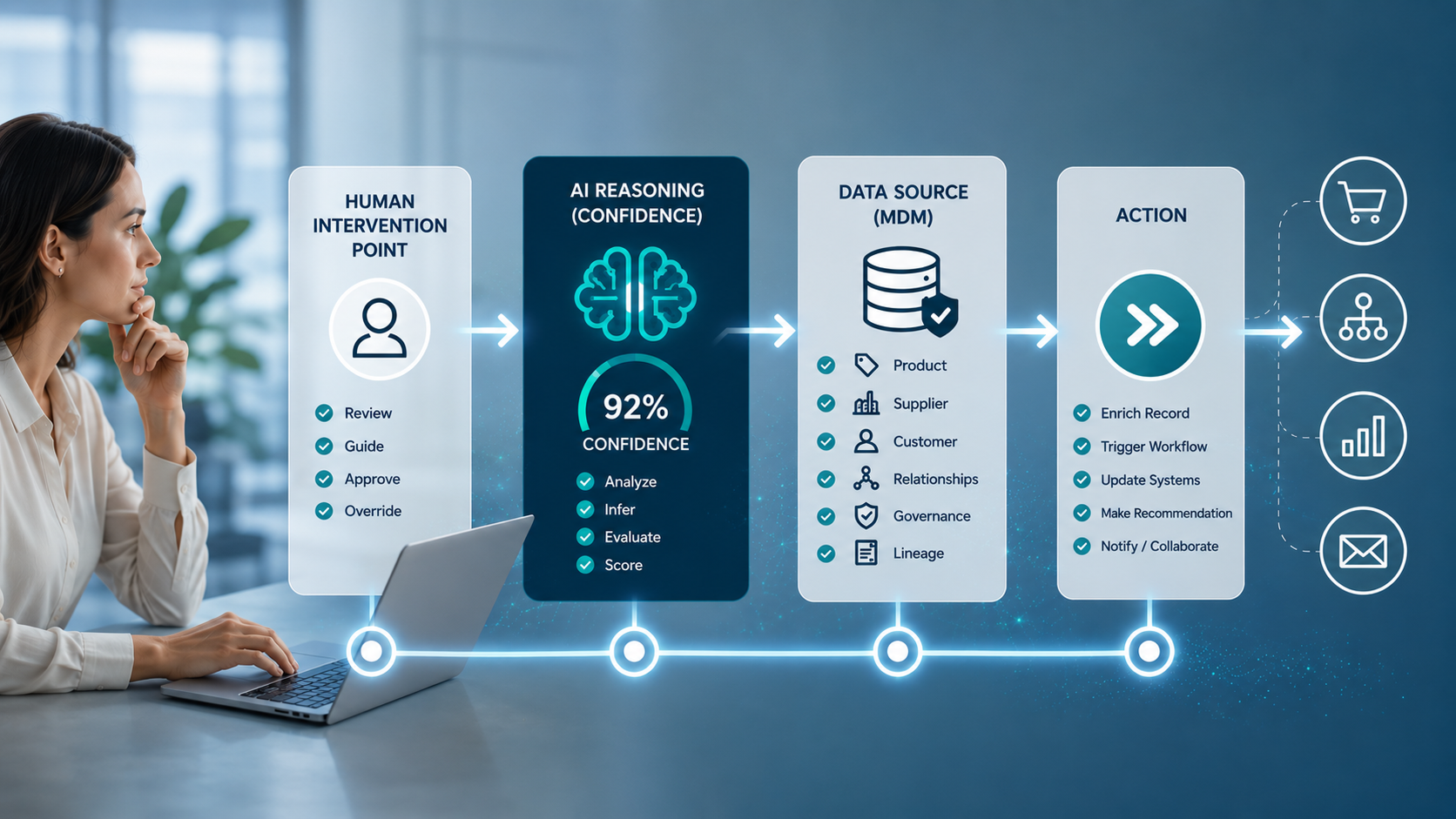
STEP, Stibo Systems’ trusted intelligence platform, is built to bring master data up to the agent-grade standard across every domain an agent touches, not just the one a single department owns.

That means:

  • Product, customer, supplier, business partner and location data managed as one connected system, rather than four separate repositories an agent has to reconcile on its own
  • Governance embedded at the data layer, so agents inherit the rules they need to operate reliably instead of waiting for a separate compliance check
  • Relationships, semantic context and lineage built into the architecture itself, so an agent has what it needs to act without filling gaps with assumptions

The result is data your agents can act on independently, with the traceability and guardrails that autonomous decision-making demands.

It is the master data foundation underneath the agent layer, built before the agent ever makes a call. For the athlete preparing for the big race, this is the very training infrastructure.

Wrapping things up

Reporting-grade data is not bad data. It got your dashboards and your BI team exactly where they needed to be.

But your agents are running a different race, and they need a different level of preparation than your reports ever did. They need access to your organization’s tribal knowledge in order to reason and act effectively.

An athlete who fuels just enough to finish a race does not stand on the podium. The same is true with your data. What gets you a working dashboard will not get your agents to a decision you can trust.

Fixing that means building your data differently from the ground up.

Frequently asked questions

What is the difference between data quality for reporting and data quality for AI agents?

Reporting needs data that is accurate enough to aggregate and display, and it tolerates some latency and isolated inconsistencies because a human is interpreting the output.

AI agents act on data directly, without a human checking the result first, so they need data that stays consistent across systems, carries context they can interpret and can be traced back to its source.

Why do AI agents need real-time data when dashboards don't?

A dashboard built on yesterday's data is a known and accepted limitation. An agent acting on outdated supplier status or pricing makes a decision based on something that may no longer be true, and unlike a stale report, nobody reviews that decision before it takes effect.

Can AI agents work with the same master data used for business intelligence?

They can use the same underlying records, but BI-grade master data is usually missing the cross-domain relationships, current status and traceability an agent needs to act safely.

Most failures happen not because the data was wrong, but because it was never built to support an autonomous decision.

What happens if AI agents are deployed on data that is not agent-grade?

Agents proceed on the data they are given, even when that data is incomplete or out of date, because there is no human in the loop to catch the gap.

This can lead to decisions based on outdated approvals, duplicate records or conflicting information across systems, often with no warning until the consequences show up downstream.


Master Data Management Blog by Stibo Systems logo

James Van Pelt is a Manufacturing Practice Lead at Stibo Systems. His expertise as a data strategist comes from his many years as an operations and sales executive within the manufacturing industry, developing best practices for optimal business-side value and use case workflows. James's skill set encompasses Industry 4.0, digital transformation, business strategy, sales development, software as a service (SaaS), supply chain, and much more.


Connect on:

Discover blogs by topic

  • See more
  • AI
  • Automotive
  • Business Partner Data Cloud
  • Compliance and risk management
  • Consumer packaged goods
  • Customer Experience Data Cloud
  • Customer and party data
  • Customer experience and loyalty
  • Data compliance
  • Data delivery
  • Data governance
  • Data integration
  • Data modeling
  • Data quality
  • Data sharing
  • Data sourcing
  • Digital asset management
  • Digital shelf analytics
  • ERP success
  • Enhanced content
  • Financial services
  • Life sciences
  • Location Data Cloud
  • Location data
  • MDM strategy
  • Manufacturing
  • Multidomain data
  • Operational efficiency
  • Platform
  • Product Experience Data Cloud
  • Product data and PIM
  • Product data syndication
  • Product onboarding
  • Retail
  • Supplier Data Cloud
  • Supplier data
  • Sustainability
  • Translation and localization
  • User experience
July 22, 2026

Why the Data Standard That Powers Your Reports Will Let Your AI Agents Down

July 21, 2026

The 5 Data Standards That Determine Whether Your AI Agents Succeed or Fail

July 20, 2026

Why Most AI Initiatives Fail Before the Model Ever Runs

July 16, 2026

Why Trust Is the Real Bottleneck in Agentic Commerce

July 9, 2026

How to Evaluate MDM Vendors in a Market Full of Acquisitions

July 8, 2026

Why Agentic AI Demands a Digital Twin of the Business

June 19, 2026

AI Systems Want Clean Data – But They NEED Governed Intelligence

June 17, 2026

Bosch and Stibo Systems Partner for Enterprise Data Transformation

June 17, 2026

With Semantic Master Data, Your AI Stops Guessing and Starts Understanding What You Want

June 17, 2026

5 Hidden Costs of Bad Customer Data in Retail (and How to Avoid Them)

June 12, 2026

The Complete PIM Features Guide: The Capabilities You Need for Successful Data Strategies

June 12, 2026

5 Product Data Problems That Make Your Brand Invisible in AI Search

June 11, 2026

4 Common Master Data Management Implementation Styles

June 11, 2026

Designing Trust in Agentic Enterprise Systems

June 8, 2026

AI and Master Data: The Business Powerhouse

June 8, 2026

Master Data Meets Microsoft Fabric: Building a Trusted Foundation for AI and Analytics

June 4, 2026

7 Signs Your Brand Is Losing Ground in Agentic Commerce

June 1, 2026

The Future of Master Data Management: Trends in 2026

June 1, 2026

What is a Data Domain? Meaning & Examples

May 28, 2026

8 Best Practices for Customer Master Data Management

May 27, 2026

Data Migration to SAP S/4HANA ERP: The Fast and Safe Approach with MDM

May 25, 2026

Model Context Protocol (MCP): The Missing Layer for AI Systems That Interact with Enterprise Data

May 21, 2026

Better Together: CRM and Customer Master Data Management

May 21, 2026

4 Supplier Onboarding Taxes That Drain Margin Every Day – and How Agentic AI Fixes Them

May 20, 2026

The 7 Types of Customer Data Your AI Agents Can't Ever Act Without

May 19, 2026

What Is Master Data Governance – And Why Do You Need It?

May 18, 2026

The Difference Between Master Data and Metadata

May 13, 2026

Product Attribution Strategies That Convert Searchers into Buyers

May 12, 2026

How to Choose the Right Master Data Management Solution

May 12, 2026

PIM and MDM: Key Differences, Benefits and How They Work Together

May 12, 2026

5 CPG Industry Trends and Opportunities for 2026

May 11, 2026

A Quick Guide to Golden Customer Records and How to Create Them with Master Data Management

May 11, 2026

What is Master Data Management? A Complete Guide

May 11, 2026

Master Data Management Roles and Responsibilities

May 8, 2026

What is Application Data Management and How Does It Differ From MDM?

April 30, 2026

6 Features of an Effective Master Data Management Solution

April 22, 2026

What is the difference between CPG and FMCG?

April 17, 2026

Most Common ISO Standards in the Manufacturing Industry

March 18, 2026

A Complete Master Data Management Glossary

February 24, 2026

BIC's Blueprint for Conquering Complex Global Product Data Challenges

February 17, 2026

Product 360 After the Salesforce Acquisition: Why You Need to Map Out a Plan B

January 13, 2026

Discover the Value of Your Data: Master Data Management KPIs & Metrics

January 13, 2026

Solving Retail Data Fragmentation: The Key to Consistent Customer Journeys

December 10, 2025

Is Your PIM Strategy Future-Ready? 3 Takeaways from the SPARK Matrix™ Report

December 9, 2025

Product Listing Page Best Practices: How to Create Better Product Listings with PIM

December 8, 2025

The Board of Directors’ Guide to Selecting Product Experience Software (With Checklist)

December 5, 2025

5 PIM Trends That Will Define 2026 and the Near Future (And How to Prepare for Them)

December 4, 2025

Process Insurance Claims Faster with Trusted Data

December 4, 2025

10 Dangerous Myths About Managing Your B2B Partner and Account Data

December 3, 2025

Fixing Fragmented Customer Account Data: Stop Losing Revenue and Trust

December 2, 2025

How Master Data Management Keeps Manufacturers Compliant — From Design to Delivery

November 20, 2025

What is Manufacturing-as-a-Service (MaaS)?

November 18, 2025

AI in Retail: How to Make Your Data Ready to Use in Microsoft Fabric

November 17, 2025

What is Party Data? All You Need to Know About Party Data Management

November 4, 2025

Consumers are Using AI-Powered Tools to Shop Smarter: Why Retail Data Trust Matters More than Ever

October 29, 2025

CDP and MDM: Complementary Forces for Enhancing the Customer Experience

October 27, 2025

How to Estimate ROI of Master Data Management

October 20, 2025

Managing Product Complexity: Leveraging Custom Product Management with BOM-Level Precision

October 2, 2025

How CPG Brands Scale D2C Business Without Breaking What Already Works

September 24, 2025

How Leading Brands Built Trusted Data with Amplifi and Stibo Systems

September 11, 2025

Is Your Data the Cause of Flawed AI Outputs?

September 8, 2025

What’s Next for GenAI in Product Experiences?

August 13, 2025

The 5 Biggest Retail Trends in 2026

August 12, 2025

From Zero to Launch in Under 6 Months: A Quick Guide to Deploying Master Data Management

August 5, 2025

How Operations Leaders are Modernizing Manufacturing Data Without Halting Production

August 4, 2025

Digital Product Passports: The Data Management Mandate

August 1, 2025

How to Improve Back-End Systems Using Master Data Management

July 9, 2025

How to Get More Value from Your Data: The Benefits of Master Data Management

June 26, 2025

PIM explained: How Product Information Management transforms data quality

June 11, 2025

How CPG Сompany Bonduelle Сentralized Product Data Across 37 Countries

June 10, 2025

Master Data Management Tools: A Complete Guide

May 23, 2025

How Signet Jewelers Built Trust in Its Retail Data

May 12, 2025

Manufacturing Trends and Insights in 2026

April 15, 2025

5 Key Trends in Product Experience Management

April 4, 2025

Trust the Machine: Making AI Automation Reliable in Master Data Management

April 2, 2025

How Agentic Workflows Are Changing Master Data Management at the Core

March 17, 2025

What is Smart Manufacturing and Why Does it Matter?

March 11, 2025

How to Implement Master Data Management: Steps and Challenges

March 7, 2025

MDM and AI: Real-World Use Cases and Learnings From OfficeMax and Motion Industries

February 27, 2025

Reyes Holdings' MDM Journey to Better Data

February 3, 2025

4 Trends in the Automotive Industry

January 29, 2025

How to Choose the Right Data Quality Tool?

January 28, 2025

AI Adoption: A High-Stakes Gamble for Business Leaders

January 27, 2025

All You Need to Know About Supplier Information Management

January 27, 2025

How Kramp Optimizes Internal Efficiency with Data Strategy

January 27, 2025

From Patchwork to Precision: Moving Beyond Outdated and Layered ERP Systems

January 24, 2025

Thriving Beyond NRF 2025 with Trustworthy Product Data

January 23, 2025

Building the Future of Construction with AI and MDM

January 17, 2025

Why Addressing Data Complexity in Pharmaceutical Manufacturing Is Critical

January 17, 2025

How URBN Leverages Data Management to Support Its Sustainability Information  

January 14, 2025

An Introductory Guide to Supplier Compliance

January 6, 2025

How to Avoid Bad Retail Customer Data

December 17, 2024

How to Implement Data Governance

December 11, 2024

Gen Z: Seeking Excitement Beyond Amazon

December 10, 2024

A Modern Guide to Data Quality Monitoring: Best Practices

December 9, 2024

What is Supply Chain Analytics and Why It's Important

December 5, 2024

What is Supplier Lifecycle Management?

December 3, 2024

Using Machine Learning and MDM CBAM for Sustainability Compliance

November 25, 2024

AAPEX and SEMA: The Automotive Aftermarket Industry’s Mega-Showcase

October 22, 2024

Live Shopping: How to Leverage Product Information for Maximum Impact

October 16, 2024

Why Data Accuracy Matters for CPG Brands

October 15, 2024

Why Choose a Cloud-Based Data Solution: On-Premise vs. Cloud

September 23, 2024

How Master Data Management Can Enhance Your ERP Solution

September 20, 2024

Navigating Change: Engaging Business Users in Successful Change Management

September 11, 2024

What is Digital Asset Management?

September 3, 2024

How to Improve Your Data Management

August 30, 2024

Digital Transformation in the CPG Industry

August 27, 2024

Responsible AI Relies on Data Governance

August 19, 2024

Making Master Data Accessible: What is Data as a Service (DaaS)?

August 13, 2024

Great Data Minds: The Unsung Heros Behind Effective Data Management

August 6, 2024

A Data Monetization Strategy - Get More Value from Your Master Data

August 4, 2024

Introducing the Master Data Management Maturity Model

July 31, 2024

What is Augmented Data Management? (ADM)

July 17, 2024

GDPR Data Governance and Data Protection, a Match Made in Heaven?

April 11, 2024

Guide: Deliver flawless rich content experiences with master data governance

April 10, 2024

Risks of Using LLMs in Your Business – What Does OWASP Have to Say?

April 9, 2024

Guide: How to comply with industry standards using master data governance

April 2, 2024

Guide: Get enterprise data enrichment right with master data governance

April 2, 2024

Guide: Getting enterprise data modelling right with master data governance

April 2, 2024

Guide: Improving your data quality with master data governance

March 25, 2024

How to Get Rid of Customer Duplicates

March 18, 2024

5 Tips for Driving a Centralized Data Management Strategy

February 20, 2024

5 Key Manufacturing Challenges in 2025

February 20, 2024

How to Enable a Single Source of Truth with Master Data Management

February 12, 2024

What is Data Quality and Why It's Important

February 7, 2024

Data Governance Trends 2026

February 6, 2024

What is Data Compliance? An Introductory Guide

January 18, 2024

How to Build a Master Data Management Strategy

January 16, 2024

The Best Data Governance Tools You Need to Know About

December 19, 2023

Building Supply Chain Resilience: Strategies & Examples

November 29, 2023

Shedding Light on Climate Accountability and Traceability in Retail

November 13, 2023

Location Analytics – All You Need to Know

October 16, 2023

Understanding the Role of a Chief Data Officer

October 5, 2023

5 Common Reasons Why Manufacturers Fail at Digital Transformation

September 29, 2023

How to Digitally Transform a Restaurant Chain

September 14, 2023

Three Benefits of Moving to Headless Commerce and the Role of a Modern PIM

July 6, 2023

12 Steps to a Successful Omnichannel and Unified Commerce

June 28, 2023

Navigating the Current Challenges of Supply Chain Management

April 6, 2023

Product Data Management during Mergers and Acquisitions

March 1, 2023

Asset Data Governance is Central for Asset Management

February 14, 2023

How to Leverage Internet of Things with Master Data Management

February 13, 2023

Sustainability in Retail Needs Governed Data

January 4, 2023

Innovation in Retail

November 21, 2022

Life Cycle Assessment Scoring for Food Products

November 14, 2022

Retail of the Future

November 7, 2022

Omnichannel Strategies for Retail

November 5, 2022

Hyper-Personalized Customer Experiences Need Multidomain MDM

October 25, 2022

What is Omnichannel Retailing and What is the Role of Data Management?

October 17, 2022

How to Get Started with Master Data Management: 5 Steps to Consider

October 1, 2022

An Introductory Guide: What is Data Intelligence?

September 15, 2022

Revolutionizing Manufacturing: 5 Must-Have SaaS Systems for Success

August 25, 2022

Digital Transformation in the Manufacturing Industry

August 17, 2022

Master Data Management Framework: Get Set for Success

June 15, 2022

Supplier Self-Service: Everything You Need to Know

June 14, 2022

Omnichannel vs. Multichannel: What’s the Difference?

June 10, 2022

Create a Culture of Data Transparency - Begin with a Solid Foundation

May 31, 2022

What is Location Intelligence?

May 30, 2022

Omnichannel Customer Experience: The Ultimate Guide

May 24, 2022

Omnichannel Commerce: Creating a Seamless Shopping Experience

May 11, 2022

Top 4 Data Management Trends in the Insurance Industry

May 1, 2022

What is Supply Chain Visibility and Why It's Important

April 21, 2022

The Ultimate Guide to Data Transparency

April 20, 2022

How Manufacturers Can Shift to Product as a Service Offerings

April 16, 2022

How to Check Your Enterprise Data Foundation

April 14, 2022

An Introductory Guide to Manufacturing Compliance

March 31, 2022

Multidomain MDM vs. Multiple Domain MDM

March 23, 2022

How to Build a Successful Data Governance Strategy

March 22, 2022

What is Unified Commerce? Key Advantages & Best Practices

March 17, 2022

6 Best Practices for Data Governance

March 16, 2022

5 Advantages of a Master Data Management System

February 24, 2022

Supply Chain Challenges in the CPG Industry

February 14, 2022

Top 5 Most Common Data Quality Issues

February 10, 2022

What Is Synthetic Data and Why It Needs Master Data Management

February 8, 2022

What is Cloud Master Data Management?

January 28, 2022

Build vs. Buy Master Data Management Software

January 27, 2022

Why is Data Governance Important?

January 24, 2022

Five Reasons Your Data Governance Initiative Could Fail

January 21, 2022

How to Turn Your Data Silos Into Zones of Insight

January 16, 2022

How to Improve Supplier Experience Management

January 16, 2022

​​How to Improve Supplier Onboarding

January 11, 2022

What is a Data Quality Framework?

January 4, 2022

The Ultimate Guide to Building a Data Governance Framework

December 20, 2021

The Dynamic Duo of Data Security and Data Governance

December 20, 2021

How to Choose the Right Supplier Management Solution

December 6, 2021

How Data Transparency Enables Sustainable Retailing

December 1, 2021

What is Supplier Performance Management?

November 7, 2021

The Complete Guide: How to Get a 360° Customer View

October 29, 2021

How Location Data Adds Value to Master Data Projects

October 15, 2021

What is a Data Mesh? A Simple Introduction

September 2, 2021

10 Signs You Need a Master Data Management Platform

August 31, 2021

What Vendor Data Is and Why It Matters to Manufacturers

August 25, 2021

3 Reasons High-Quality Supplier Data Can Benefit Any Organization

August 9, 2021

What is Reference Data and Reference Data Management?

July 25, 2021

GDPR as a Catalyst for Effective Data Governance

May 12, 2021

How to Become a Customer-Obsessed Brand

April 27, 2021

How to Create a Master Data Management Roadmap in Five Steps

April 13, 2021

What is a Data Catalog? Definition and Benefits

April 8, 2021

How to Improve the Retail Customer Experience with Data Management

March 25, 2021

Business Intelligence and Analytics: What's the Difference?

March 21, 2021

What is a Data Lake? Everything You Need to Know

Let’s get started

Ready to see how trustworthy intelligence turns data into confident decisions? Let’s chat.

2