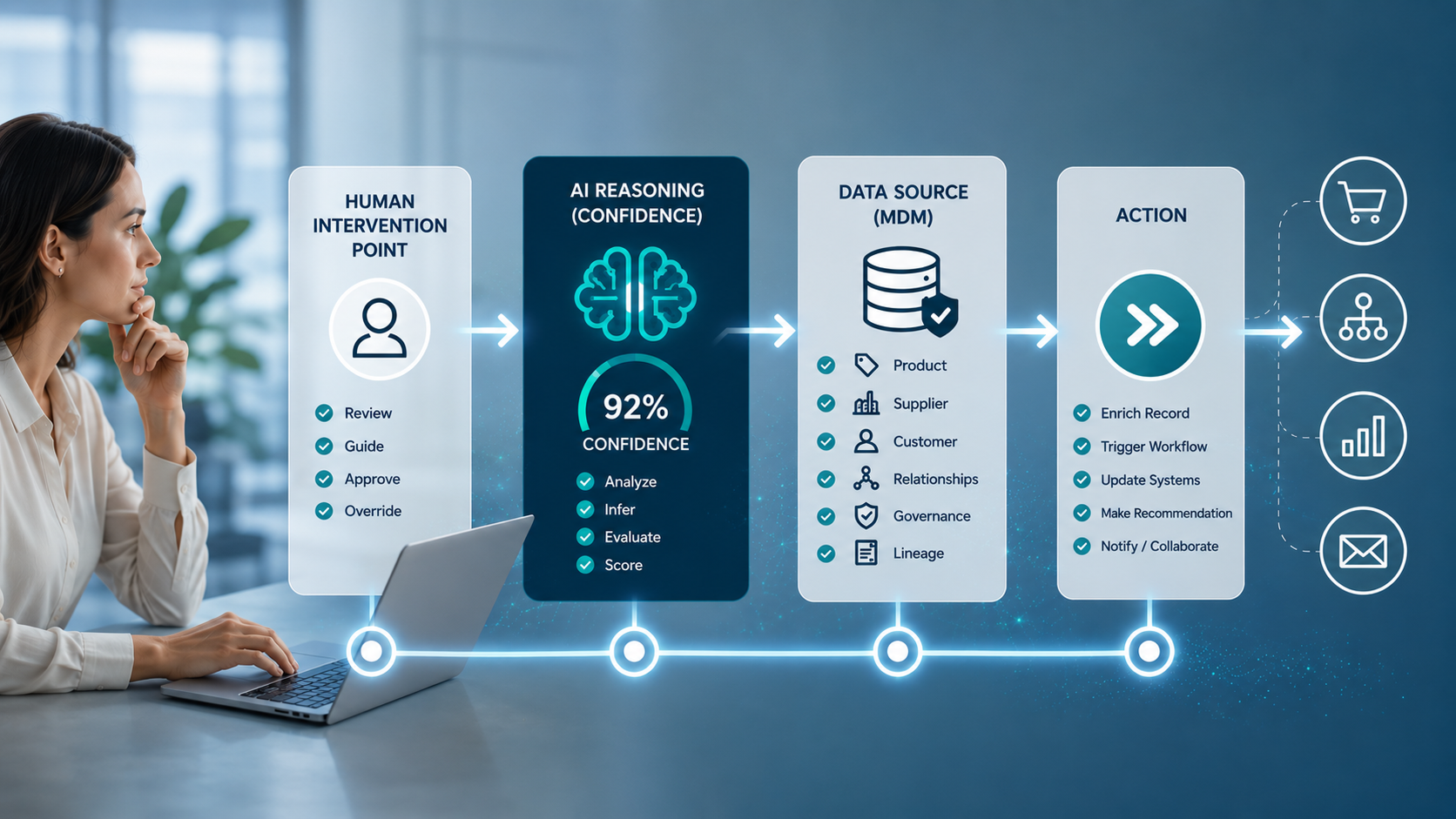


Unless your company was started five minutes ago, your customer data foundations weren't built for autonomous agents.
Most customer data systems were designed for reporting and analysis – maybe some marketing automation. Now you're trying to use them to let agents make decisions and take actions without human intervention.
The data that worked for dashboards doesn't work for that.
Sometimes agents stall and kick decisions back to humans. Sometimes they move forward confidently, and you catch the problem later.
Both happen because you're missing customer data types that agents need to operate independently.
Your agents need seven specific types of customer data to run without supervision. And in this post I walk you through what those are and why each matters.
By the end, you'll know what's missing from your current customer foundation and what you need to build before agents can run at scale. Each of these solves a different kind of ambiguity an agent encounters when deciding or acting. Let’s get to it.
1. Resolved customer identity
An agent that doesn't know who a customer is could act on the wrong customer record. In healthcare, this could mean scheduling a procedure for the wrong patient. In financial services, it could mean transferring funds to the wrong account.
In any industry, it's a compliance breach waiting to happen.
Resolved customer identity means one golden record per customer. No duplicates or confusion about which record is correct.
Without this, agents face chaos. One customer might appear as three separate records across your CRM, ecommerce platform and service system.
An agent sees all three and guesses wrong. The customer gets contacted twice about the same issue, or the agent updates the wrong account.
Even one duplicate in production becomes a decision point for your agent. Resolved identity removes that risk. The agent knows who it's acting on.
2. Real-time customer context
If your agent is acting on yesterday's data, it’s making yesterday's decision for today's customer.
You need fresh data on what the customer did, needs or experienced now. Life events. Recent purchases. Current status. Latest interactions...
The data breaks what you’re trying to build:
- The renewal agent has no idea the customer just bought from a competitor
- The loyalty agent sends a retention offer to someone who bought yesterday
- The support agent doesn't know about the complaint filed this morning
Not only does it slow the agents down, it makes them confident and wrong at the same time.
3. Consent and permission flags
Consent violations don't come from evil agents. They come from agents that don't know the customer said no.
As a customer you have explicit preferences, such as which channels you'll accept contact on, what you've opted in and out of (GDPR, CCPA, internal policies).
All of it lives in consent flags tied to that customer record. And an agent without access to these flags operates blind.
It sends emails to customers who opted out of email. It calls someone who asked for written contact only. It uses data the customer explicitly prohibited.
One violation starts small. One customer complains. Then compliance gets involved.
Then the regulators.
4. Relationship and hierarchy context
If your agents are treating every customer as an individual, they often miss the obvious.
- A household isn't five separate people making five separate decisions
- An organization isn't a list of contact names
- Families have primary decision-makers
- Organizations have hierarchies and dependencies
- B2B accounts have roles that matter
Without relationship context, agents see fragments.
An agent offers a family discount that only applies if the account holder authorizes it, but it contacts the teenager instead.
A B2B agent reaches out to someone who left the company six months ago.
A healthcare agent schedules a procedure without knowing the patient's spouse is their healthcare proxy.
Context changes everything about how an agent should act.
5. Application-specific IDs
Your customer exists in multiple systems, and each one has its own way of identifying them.
The CRM calls your customer "contact_12847." Ecommerce knows them as "user_5029." Your service platform calls them "case_holder_891." Your data warehouse has yet another ID.
A master record ties all these together. It knows that contact_12847 and user_5029 are the same person.
Without that mapping, an agent can fetch data from one system but can't connect it to what's happening in another. Or it finds the customer's purchase history but can't link it to their support tickets.
The agent ends up making decisions with disconnected pieces of information.
When you map all these IDs together, the agent can see the full picture across every system where that customer exists.
6. Data lineage and quality indicators
Not all customer data is created equal, so your agents need to know the difference.
If a customer's email was updated this morning, it carries more weight than one that was entered six months ago. And a phone number confirmed by the customer themselves is more trustworthy than one from a third-party vendor.
You need lineage and quality scores, or those agents will treat everything the same.
Low-quality data gets handled with the same certainty as high-quality data. Agents move forward with false confidence on information they shouldn't trust.
Quality indicators let agents know what to prioritize and what to verify.
7. Business rules and policy context
An agent that doesn't know what it's allowed to do will either:
- Do absolutely nothing
- Do something wrong
Business rules live in your customer records, pricing tiers, eligibility requirements, contract terms, and so on.
When an agent doesn’t have this context, it operates without guardrails.
Maybe it offers a service the customer isn't eligible for or a discount that violates contract terms. Maybe it commits the company to an SLA it can't deliver.
Sometimes the agent stalls because it doesn't know if an action is allowed. Sometimes it acts anyway and creates compliance problems later.
But if you embed business rules into customer records, the agent will know its boundaries before it decides.
Trustworthy intelligence means you have all 7 of these data types – and that you’re ready for customer agents
Autonomy is gated by the weakest of these seven data types. Missing even one forces human intervention.
You don't need all seven to run agents, but you need all seven to run them without supervision. Otherwise, the agent either stalls waiting for information or moves forward with incomplete understanding. You can't trust it enough to let it run.
With all seven in place, the agent becomes infrastructure instead of an experiment. You stop asking "should we let it do this?" and start depending on it to do things you couldn't do at scale before.
How the seven data types come together in one place: Agentic Customer 360
Agentic systems don’t eliminate the need for a Customer 360. They depend on it.
A Customer 360 is not a static object an agent permanently owns. Instead, agents assemble a situational 360 in real time by pulling interactions, events and state from across systems. And it’s all anchored to an authoritative customer master record that defines what is true about the customer over time.
What changes in an agentic world is how that understanding is used.
Agents operationalize customer knowledge into autonomous decisions and actions — but only if they can trust the identity, relationships, consent, and rules behind it.
This makes trusted Customer ID mission‑critical. If identity is uncertain, duplicated or governed differently across systems, agents cannot safely act. They either stall, guess or create risk.
At Stibo Systems, we serve as the authoritative anchor for trusted customer identity and governed customer context. We don’t build agents, and we don’t replace orchestration or LLM frameworks.
Instead, we provide the single customer view (SCV) that agents rely on:
- Resolving identity
- Enforcing consent
- Maintaining relationships
- Preserving lineage and quality
- Embedding business rules
All this so autonomous systems can act with confidence rather than assumption.
In other words:
Agents act.
Customer 360 defines what is true.
Trusted Customer ID makes autonomy possible.