

AI initiatives struggle when the data AI agents reason from is incomplete, inconsistent or ungoverned.
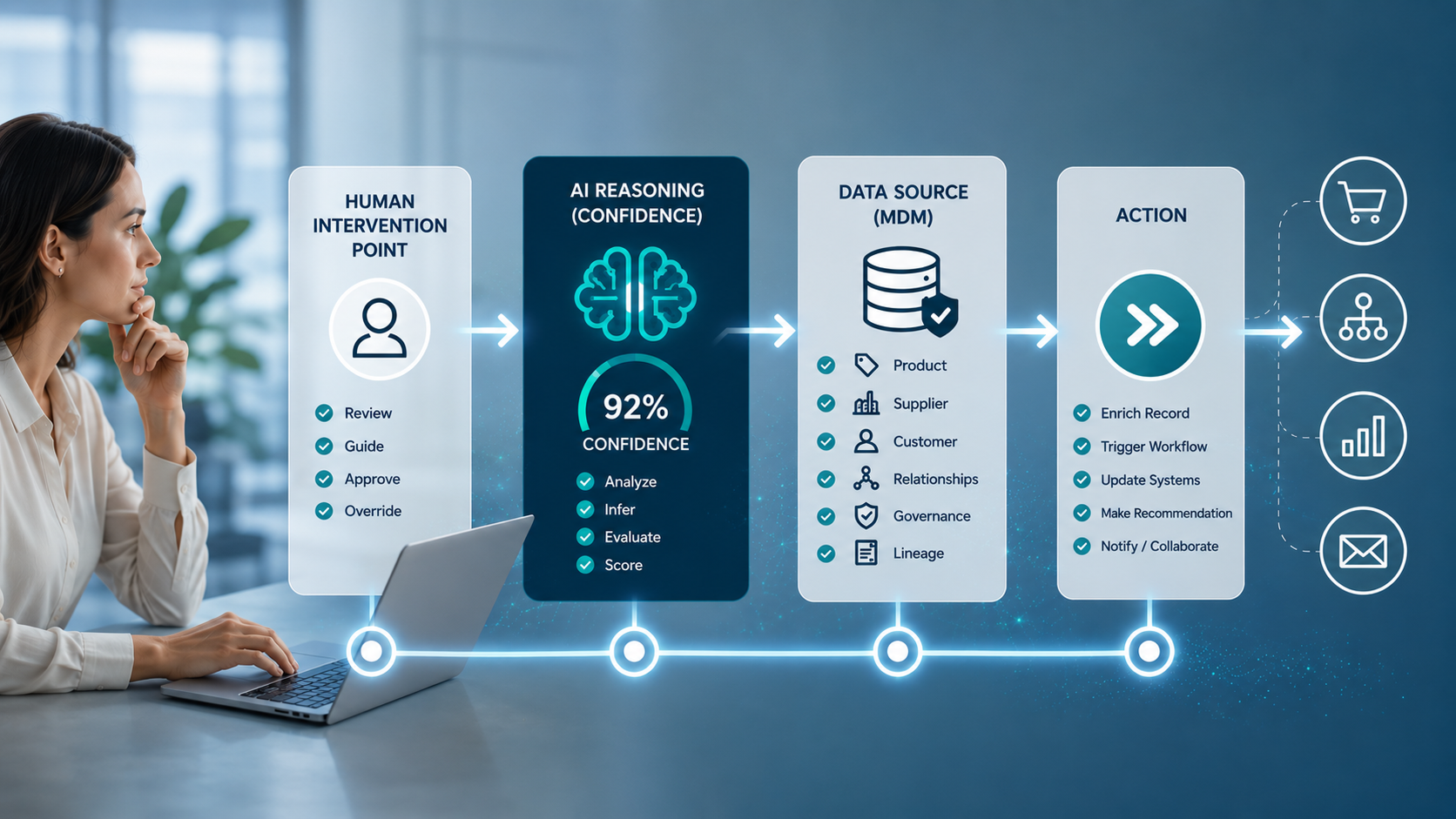
Strong master data is the foundation that prevents AI from going off course. It is the governed, accurate product, customer, supplier and location records every AI agent depends on to make reliable decisions.
Most enterprises heading into AI deployment make the same mistake: They plan extensively for the model – vendor selection, integration, prompt tuning – but not on their master data providing a contextual, single source of truth.
The result is AI agents acting confidently on what they are given, at scale.
By the time a wrong decision surfaces, it has usually already broken something. Like an order or a compliance filing.
Think of preparing for AI like preparing for a race.
You can have the best coach and gear – even the perfect race-day strategy – but they're only as effective as your underlying fitness. In AI, trusted master data is that fitness. It gives your organization the strength and endurance to perform when it matters most.
Most enterprises focus on race day: the AI models, agents, and applications. They skip the "conditioning work” that determines whether they'll actually perform. This article is part of a series on what that conditioning work involves, preparing you for the race of our time.
Why do most AI initiatives fail before the model ever runs?
AI readiness gets treated as a technology decision.
Enterprises evaluate models, compare vendors and benchmark performance against use cases. Conditioning your data rarely enters that conversation. It sits with a different team, on a different timeline, often addressed as a cleanup project after everything is already in motion.
Organizations often don’t see the problems this causes until after launch:
- Product records that conflict across systems
- Customer data duplicated under slightly different names
- Supplier information that hasn't been validated in over a year
- No single source of truth for the entities the AI is meant to reason about
None of this shows up in a demo. Pilots run on curated, hand-picked data, so the model performs well in the room.
The cracks appear once the AI agent works against the full, messy reality of enterprise systems. And by then, business users have started relying on its output, and trust is harder to rebuild than it was to establish.
This is the conditioning work enterprises skip. Not because it doesn't matter, but because no one checks for the base fitness before race day.
What goes wrong when AI agents use bad master data?
Poor master data shows up differently depending on where the AI model breaks. But there is a consistent pattern. An AI agent acts on the data it is given, and when that data is incomplete, inconsistent or outdated, the output reflects it.
There are four failure patterns.
1. Hallucination
The AI agent fills gaps with plausible assumptions. A missing product attribute or an incomplete customer profile gets replaced with a plausible-sounding guess, presented with the same confidence as a verified fact.
2. Inconsistent decisions
The same entity exists differently across systems – a customer with three slightly different addresses, or a product with two different specifications.
The AI agent relies on conflicting versions of the same data, leading to inconsistent responses to the same question depending on which systems it queried.
3. Compliance violations
Without trusted governance and policy context, AI can recommend or execute actions that breach compliance requirements: a transaction approved for a customer who should have been flagged, or a product listed in a market where it is not authorized.
4. Conflicting records triggering the wrong action
Two systems disagree on, for example, stock, pricing or availability, and the AI agent commits to one of them. The order ships against the wrong inventory count. Or the discount applies to the wrong tier.
This is what poor conditioning looks like when AI moves from generating content to making decisions. Not a single dramatic error, but small, compounding inconsistencies that erode trust in every output that follows.
Why is the data that passed your last audit failing your AI agents?
Reporting and AI agents put different demands on the same data. That's why data that passes every reporting check can still fail an AI agent the first time it runs.
There are a few reasons for this:
Reporting tolerates approximation. AI agents do not.
A dashboard rounds a number or shows a slightly outdated total, and a human reader adjusts for it. An AI agent treats the same number as ground truth and acts on it directly.
Reporting works in batches. AI agents work in real time.
Most reporting data refreshes overnight or weekly, which is fine for a quarterly review. An AI agent making a decision right now needs the current state, not last week's snapshot.
Reports tolerate fragmented domain views. AI agents reason across them.
A reporting dashboard can analyze product data, customer data, and supplier data separately. An AI agent resolving a single request, like confirming whether an order can ship, often needs all three to agree.
Reporting absorbs errors at low volume. AI agents do not.
A human analyst catches an obvious outlier before it reaches a board deck. An AI agent making thousands of autonomous decisions a day has no equivalent checkpoint, so the same error rate produces a much larger number of bad outcomes.
These are the differences between training for a casual jog and training for race day. Getting your data clean enough to pass a reporting audit got you fit enough for the jog.
However, AI agents are race day, every day, and most enterprises are showing up with the wrong training plan.
What does your master data need before you deploy AI?
Three foundational capabilities are essential: Lineage, consistency and ownership.
Lineage means every record carries a traceable history – where it came from, when it last changed, who or what changed it.
Without lineage, neither the business nor the AI platform can explain where information came from, how it changed, or whether it should be trusted.
Consistency is the harder one. A "customer" in the CRM has to be the same entity as a "customer" in the order system – same definition, same identifier, no near-matches the AI agent has to guess its way through.
This applies across every data domain an enterprise runs:
- Product
- Customer
- Supplier
- Location
Weakness in one domain quickly propagates into others because AI reasons across connected business entities.
Ownership means every critical business entity has a governed system of record and clear accountability for its quality.
Without clear ownership, conflicting data remains unresolved, increasing the likelihood that AI will act on incomplete or incorrect information.
If reporting-grade data was the casual jog, this is what a real training plan looks like once you write it down. Not glamorous. Just the specific, unglamorous conditioning work that determines whether race day goes well.
None of it is new.
Strong data teams have aimed for this for years. What is different is the consequence of skipping it. A gap that used to surface as a messy spreadsheet now surfaces as a wrong decision, made automatically, at scale.
Wrapping things up
None of this is new territory for strong data teams. The difference is what is at stake when you skip it.
Consistency problems used to lead to messy spreadsheets. Now they lead to wrong decisions, made automatically, at scale.
And there is no human in the loop to catch it first.
In that race you’re preparing for, getting master data right is the conditioning that determines how well you perform. The earlier you invest in it, the stronger every AI initiative that follows becomes.
Frequently asked questions
Who is responsible for master data in an AI-driven enterprise?
This varies by organization, but the role of data owner matters more under AI than it did for reporting. Common owners include:
- A chief data officer overseeing data strategy
- Domain-specific leads (e.g., a product data owner, a customer data owner)
- IT or data engineering teams responsible for the underlying systems
What changes with AI is the cost of ambiguity. When no one owns a data domain, no one is accountable for the information AI uses to make decisions – or the consequences that follow.
What is the role of master data management in enterprise AI reliability?
Master data management (MDM) helps ensure that the core business entities AI depends on – products, customers, suppliers, and locations – are governed, consistent, and trustworthy.
Without an MDM foundation, AI agents operate on incomplete, inconsistent, or poorly governed business data, producing unreliable recommendations and decisions. MDM is not a quality-of-life improvement for AI deployments. It is a foundational layer for deploying trustworthy AI at enterprise scale.
How do you know if your enterprise data is ready for AI?
Ask yourself a few simple questions:
- Can you trace where each core business record came from, who owns it, and when it was last updated?
- Does the same customer, product, supplier, or location have one consistent identity across every system?
- Can AI access trusted, connected business context across domains – not just isolated records?
- Are data quality issues prevented as information enters your systems, rather than corrected later?
- Can you explain why an AI agent made a particular decision by tracing it back to the underlying business data?
If the answer to any of these is no (or even "I'm not sure"), your data foundation is likely not ready to support reliable AI at scale.
What does it mean to have a single source of truth for AI?
A single source of truth means having one governed, authoritative view of each core business entity – such as a product, customer, supplier, or location that every system and AI application can trust.
Without it, different applications or AI agents may act on different versions of the same business entity, leading to inconsistent decisions and unpredictable outcomes. For reporting, those inconsistencies are often manageable. For autonomous AI operating at scale, they become a reliability issue.
What data does an AI agent need to make reliable autonomous decisions?
Four foundational capabilities are required:
- Trusted records with no conflicting versions of the same business entity.
- Current business data that reflects the latest state of the enterprise.
- Connected business context, so products, customers, suppliers, locations, and other core domains work together as a single view.
- Traceable lineage and governance, so every record can be verified, and every AI-driven decision can be explained and audited.