

For years, B2B buyers complained about having too little information.
Today, they have the opposite problem.
With ChatGPT, Claude, Perplexity, and AI-powered search, buyers can compare vendors, analyze requirements, generate shortlists, and evaluate alternatives in minutes rather than weeks. They can ask for a market overview, a feature comparison, a procurement checklist, or a vendor recommendation and get a confident answer almost instantly.
The result seems obvious: more information should lead to better decisions.
But does it?
Or are we confusing access to information with accuracy of information?
That distinction matters more than ever. AI is changing how buyers research, evaluate, and shortlist solutions. It can reduce effort, accelerate discovery, and make complex markets feel easier to understand. Sometimes, information underneath an AI-generated answer can be incomplete, outdated, biased, or simply repeated often enough to sound credible. When that happens, faster research may not lead to better decisions.
It may only lead to more confident ones.
The restaurant that never existed
A few years ago, spotting a fake business online was relatively easy. Maybe the website looked suspicious or the photos felt off. Or maybe the social presence was thin, or the story didn’t hold up.
Today, that’s not always the case.
Take Ethos, the AI-generated restaurant in Austin that attracted widespread attention despite not being a real restaurant. It had the signals people associate with legitimacy: an online presence, professional-looking food photography, social engagement, media attention, and tens of thousands of followers on Instagram. Multiple outlets reported that the restaurant didn’t exist, even though many people interacted with its content as if it were real.
And while it might be easy to jump to the conclusion that people are simply gullible, that’s not the lesson here. The lesson is that in a digital world, visibility is often mistaken for truth.
Ethos looked credible because it had the signals we’ve been trained to trust: polish, activity, attention, and reach. But those signals didn’t prove anything about the restaurant besides that it was a deeply convincing illusion.
That same problem is now moving into higher-stakes decisions.
AI doesn’t really “know”
A buyer might assume that if AI says something, it must have validated the answer.
But that’s not how large language models (LLMs) work.
AI tools are powerful at retrieving information, comparing sources, aggregating perspectives, identifying patterns, and summarizing findings. They can synthesize large amounts of content faster than any individual buyer could reasonably do alone.
What they don’t always do is independently determine whether every source is factually correct, current, objective, or relevant to a specific business context.
If enough sources repeat the same point, an AI system may treat that point as credible. For example, if a vendor is mentioned frequently across comparison pages, listicles, partner content, review pages, and blog posts, it may look like a market leader to an LLM. Or if an outdated claim shows up in several places, it may continue to shape future answers long after the market has moved on.
In short, AI is excellent at identifying consensus. But it’s not always so excellent at identifying truth.
And that difference matters, because B2B buyers are increasingly using AI earlier in their buying journeys.
Gartner has found that technology buyers are already using AI to inform purchasing decisions, with generative AI commonly used in exploration and evaluation stages. But they also make the important distinction that the best buyers use AI to make better decisions, not just faster ones.
From fake restaurants to software recommendations
Now imagine the B2B technology version of the Ethos problem.
A buyer asks AI to compare master data management (MDM) platforms, recommend the best solution for retail, or create a shortlist of vendors for a complex digital transformation project.
B2B technology decisions like these introduce a level of complexity that most daily interactions with AI simply don’t require. Choosing a restaurant, planning a trip, or comparing products often involves a narrow set of variables. But enterprise purchases involve multiple stakeholders, competing priorities, long-term business outcomes, integration requirements, governance considerations, future trade-offs — the list goes on. This complexity changes the role AI plays in the decision-making process.
For example, let’s say you’re researching MDM solutions. You might ask questions like these:
- What are the best MDM platforms?
- Which solution is best for retail?
- Compare Vendor A and Vendor B.
- Create a shortlist for my business.
The answers you get may appear structured and persuasive. They could include vendor names, strengths, weaknesses, and recommendations. They might even sound objective.
But what if the sources behind those answers include outdated product information, missing capabilities, biased rankings, inaccurate positioning, vendor-created claims, or comparison content that was never independently reviewed?
A human analyst might spot those weaknesses. A procurement consultant might question the assumptions. A subject matter expert might know which claims are no longer accurate.
But an AI-generated summary may simply incorporate the information because it appears in sources that look authoritative.
Now, this isn’t a reason to avoid AI in the buying process altogether. Rather, it’s a reason to understand the strengths and limitations of AI, so you can know where AI still needs to earn your trust.
Because while it’s true AI can make software evaluation faster, that speed doesn’t automatically improve judgment. And in some cases — and possibly more often than we know — it can make weak or incorrect information travel further.
The feedback loop problem
There’s another even bigger risk hiding underneath the surface.
AI can now generate persuasive content at scale. That includes product summaries, comparison pages, reviews, market commentary, and vendor analysis. Once that content is published, other sites can reference it, search engines can index it, and AI systems can consume it. Future recommendations can then rely on the same information.
Over time, repetition can begin to resemble expertise.
Research has already shown how difficult this can be in consumer contexts. One study found that humans could not reliably distinguish between genuine and AI-generated fake reviews, with reported accuracy of 53.2%. Another paper found that fake product reviews generated by LLMs were difficult for both humans and machines to distinguish from real reviews, with humans averaging 50.8% accuracy overall.
The B2B equivalent isn’t hard to imagine.
AI generates content, websites publish it, other sites reference it, LLMs consume it, and then future AI-generated recommendations rely on the same information. The loop then continues perpetually, and visibility and repetition gradually become mistaken for expertise.
A recommendation could be well written, coherent, and even useful. But if it was generated by AI, that doesn’t mean it’s grounded in the best available evidence to support real decisions.
Which means that there’s a potentially more dangerous risk here than just misinformation: misplaced confidence.
Why this matters now
Still, risky or not, AI is becoming a regular part of B2B research and evaluation.
One analyst found that buying decisions are now being conducted or augmented by AI and that AI adoption is becoming a strategic imperative across initiatives, including decision-making and business architecture. Forrester supports this, reporting that AI-powered search is a fast-growing driver of B2B organic search traffic and that buyers use generative AI across buying stages, including discovering, evaluating, and committing to solutions.
AI can be a powerful buying tool, but confidence in its answers must still be earned.
As AI becomes one of the first stops in the buying journey, buyers need a better way to evaluate not only what AI recommends, but whether the recommendation is grounded enough to trust.
Five things every enterprise should do before choosing how to scale AI
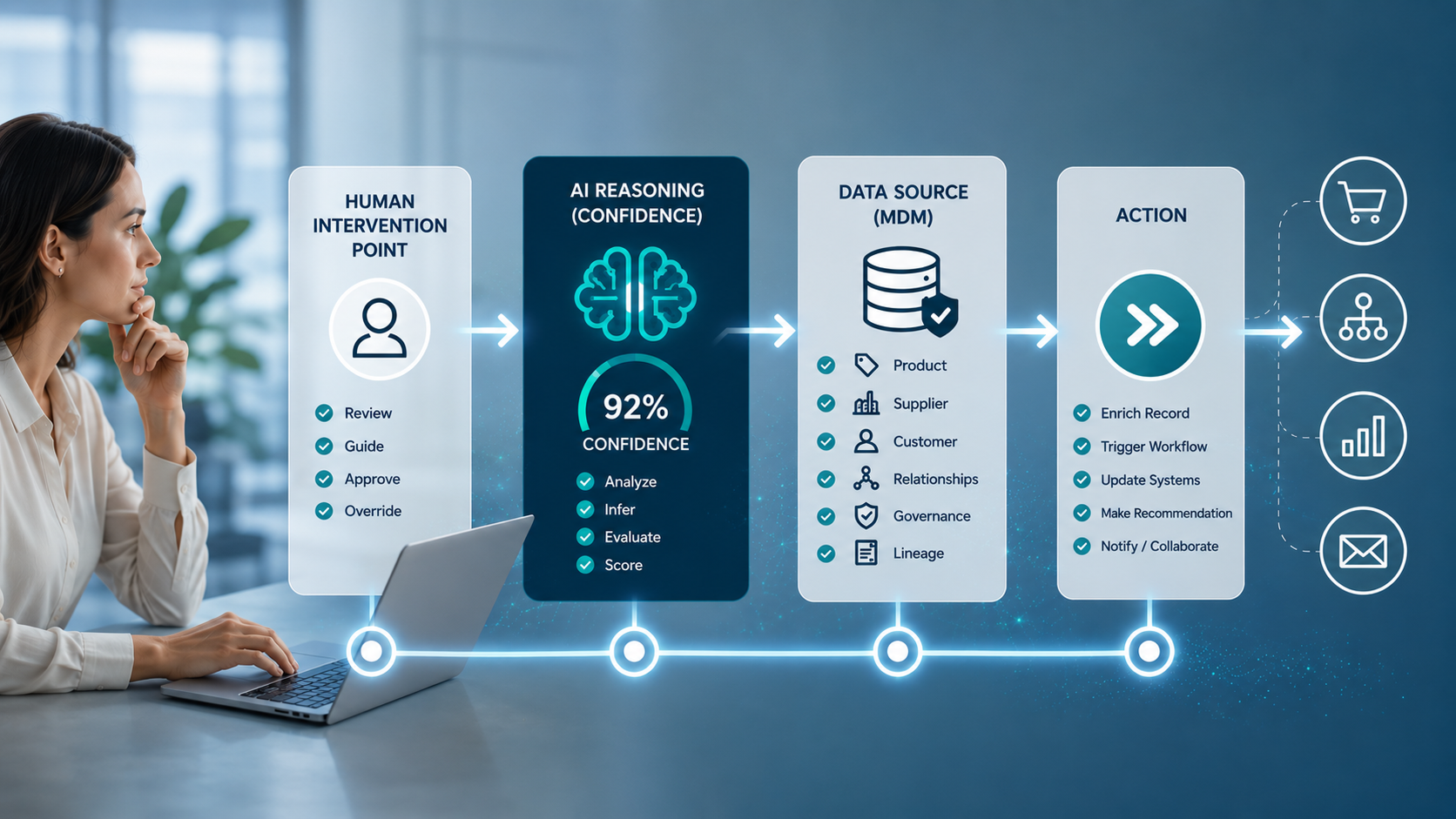
This matters for any AI-assisted purchase. But it matters most when the thing you’re buying is the foundation for a governed, accurate, agentic enterprise.
That’s the trap. Buyers may use AI to research, compare, and shortlist the very solutions meant to make their future AI more trustworthy. But as we’ve seen, AI can mistake visibility for truth and consensus for accuracy. So if a buyer relies too heavily on a system that can be confidently wrong, they may choose the wrong foundation for every AI initiative that follows.
The result is that weakness is built into the layer that everything else depends on. But for these buyers, critical thinking isn’t a nice-to-have. It’s the whole game.
So before you let an AI-generated shortlist shape the decision, do these five things.
1. Interrogate the shortlist before you trust it
An AI-generated shortlist can look authoritative, which is exactly why it deserves scrutiny. It might reflect which vendors are most visible across its sources, but not necessarily those which are most capable of supporting governed, accurate AI at scale.
Ask the same question across ChatGPT, Claude, Perplexity, and other AI tools. Watch how the rankings shift. Then ask each one what it left out, what assumptions it made, and why certain vendors appeared while others did not.
The gaps between answers often reveal more than any single shortlist. They expose where visibility, repetition, and source availability may be shaping the recommendation more than actual fit.
2. Ask what the AI is really measuring
When AI calls a solution “best,” the obvious follow-up is: “Best at what?”
Many AI-generated recommendations quietly optimize for popularity, market presence, feature breadth, or the amount of content available online. Those signals may be useful, but they don’t tell you whether a solution can keep enterprise data accurate, governed, contextual, and usable at scale.
Force the criteria into the open. Is the recommendation based on data governance? Trustworthiness? Ability to provide reliable context to AI systems? Cross-domain consistency? Proven implementation outcomes? Or is it simply ranking vendors based on how often they appear in available sources?
If the AI can’t explain what it’s measuring, its recommendation may not be measuring what matters.
3. Demand proof a look-alike can’t produce
Ethos looked credible because it had many of the signals people associate with legitimacy. Vendor claims can work the same way. Polished language, broad positioning, and repeated phrases like “governed,” “accurate,” or “AI-ready” aren’t enough.
Ask for evidence a look-alike could not easily fake.
That means named enterprise customer references, case studies with measurable outcomes, analyst validation, inspectable product documentation, and clear examples of how governance works in practice. For an AI foundation, proof of governance matters specifically: data lineage, quality controls, ownership models, validation processes, and auditability.
Any vendor can describe trust, but only the right foundation can prove how trust is created, maintained, and scaled in real enterprise environments.
4. Test whether the solution understands meaning, not just data
Accurate AI needs more than clean data. It needs data with context, relationships, and business meaning.
A solution that only moves records, fields, and attributes from one system to another may still leave AI guessing. It may pass along the same ambiguity, duplication, and inconsistency that make automated decisions unreliable in the first place.
Probe for the layer that captures meaning. Can the solution recognize when two records represent the same customer? Can it connect a product to the regulations, suppliers, markets, and channels that affect how it should be used? Can it show how terms, entities, and relationships fit together across the business?
That semantic foundation matters. It’s the difference between AI that can reason from governed context and AI that improvises from disconnected data.
5. Judge the foundation, not the feature list
Features demo well. Foundations scale.
It is easy to be dazzled by a single AI capability in a controlled use case. But the real question is whether governed, accurate, context-rich data can be trusted and reused across the next AI initiative — and the one after that.
Ask whether each new use case would inherit the same trust foundation automatically, or whether your teams would have to rebuild governance, context, and validation from scratch every time. Ask whether the solution can support AI across domains, departments, workflows, and future agentic initiatives, not just the use case in front of you today.
A feature list shows what a solution can do now, but the foundation shows whether your AI will remain trustworthy as it scales.
Better informed does not always mean better prepared
AI can hand buyers a shortlist in seconds. What it can’t always tell them is whether the solutions on that list can deliver the governed, accurate, context-rich foundation needed for trustworthy AI at scale.
That distinction matters. Especially when the purchase decision affects not just one workflow, but the quality of every AI system the enterprise builds next.
Getting this right means using AI to accelerate the buying process without letting it replace the evaluation process. Every recommendation still needs to be pressure-tested: What evidence supports it, what assumptions shaped it, what context is missing, and whether the foundation can make future AI decisions more trustworthy.
As AI makes recommendations faster and more confidently, the real advantage comes from knowing which answers are grounded enough to guide the next move.
Because in an age of instant, confident recommendations, the real advantage belongs to those who know which answers deserve to shape what comes next.