

Blog Post March 9, 2026 | 7 minute read

Master Data Meets Microsoft Fabric: Building a Trusted Foundation for AI and Analytics

AI is only as good as the data behind it. Learn why Master Data Management is critical for creating a single source of truth and reliable AI outcomes.

Master Data Meets Microsoft Fabric: Building a Trusted Foundation for AI and Analytics

Master Data Management Blog by Stibo Systems logo
| 7 minutes read
March 09 2026
Master Data Meets Microsoft Fabric
15:04

The trusted data foundation of intelligent enterprise

Every AI model is only as intelligent as the data it learns from. Every analytical dashboard is only as trustworthy as the data it displays. Yet across industries, from retail and healthcare to financial services and manufacturing, organizations struggle with a fundamental challenge: Their master data exists in silos, riddled with inconsistencies that undermine even the most sophisticated AI and analytics initiatives.

Consider a global retailer attempting to deploy a personalized recommendation engine. Customer records exist in its ecommerce platform, loyalty system, point-of-sale database, and customer service tools each with slightly different addresses, contact preferences, and purchase histories. Without a single source of truth, the AI model trains on conflicting signals, producing recommendations that miss the mark and erode customer trust.

This is where master data management (MDM) becomes mission-critical, and why the integration layer connecting it to your analytics ecosystem matters so much. Rather than forcing teams into a single, unfamiliar workflow, the right platform should meet people where they already work. Business analysts building dashboards, data engineers managing pipelines, and data scientists training models each have their own preferred tools and environments. And they shouldn't have to compromise on them to access trusted, governed data.

By connecting your MDM solution to the data warehouses, data lakehouses, and analytics workspaces your teams already rely on, you eliminate the friction that has historically delayed or derailed data initiatives  without disrupting the ways of working that make those teams effective in the first place.

AI-driven conversational commerce: From concept to reality

The combination of large language models (LLMs) together with clean master data is creating transformative business capabilities. At the recent National Retail Federation (NRF) 2026 Retail’s Big Show, conversational commerce emerged as a defining trend. This is where AI agents can understand natural language queries, access unified customer and product data, and answer complex queries and execute complex transactions seamlessly.

Imagine a customer asking an AI shopping assistant, "Find me the same running shoes I bought last year in blue, and ship them to my home." This seemingly simple request requires the system to access accurate customer purchase history, product master data with size availability, multiple shipping addresses, and payment preferences. Without MDM ensuring data consistency across all these domains, the conversation breaks down. With master data properly managed and exposed through Microsoft Fabric's OneLake, the LLM-powered agent retrieves the exact product variant, confirms inventory availability through real-time operational data, and completes the transaction, all within seconds.

Beyond commerce, organizations are deploying AI agents to answer complex analytical questions. A supply chain analyst might ask, "Which suppliers had the highest defect rates for automotive components last quarter, and what was the financial impact?" The agent needs to correlate supplier master data, product hierarchies, quality metrics, and financial data  all of which flow through different systems.

Microsoft Fabric's ability to blend MDM data with transactional databases and data warehouses means the LLM can access a complete, consistent view to generate accurate insights rather than hallucinated responses based on fragmented data. When building LLM applications or AI agents, treat MDM integration as a foundational requirement, not an afterthought.

Gaining insights by combining trusted data and business metrics

Organizations that connect clean master data to operational and transactional metrics gain visibility that competitors simply cannot replicate. This isn't about having more data, rather it's about having connected, trustworthy data that reveals the relationships driving business performance.

Consider customer lifetime value (CLV) modeling. A company with siloed data might calculate CLV using only purchase transaction history. But an organization with MDM integrated through Microsoft Fabric can enrich that same model with customer demographic attributes, service interaction patterns, product affinity clusters, digital engagement metrics, and even sentiment analysis from support tickets, all unified through consistent customer identifiers. The resulting model doesn't just predict future revenue; it identifies the specific experiences, products, and touchpoints that maximize value for different customer segments.

This depth of insight creates sustainable competitive advantages. When a financial services firm can instantly see how product holdings, life stage transitions, and channel preferences interact across their entire customer base, it can personalize offerings at scale while competitors are still reconciling spreadsheets. When a manufacturer connects supplier master data with quality metrics, delivery performance, and component specifications, it can optimize its entire value chain while others struggle with manual supplier scorecards.

By leveraging Microsoft Fabric's Power BI integration to create composite metrics that blend master data attributes with transactional patterns, the combined views reveal opportunities that single-source reports cannot surface.

Eliminating analytics bottlenecks to accelerate decision-making

Without a streamlined approach, analytics workflows can become a bottleneck. Data must be manually extracted from multiple source systems, conflicting records reconciled, formats standardized and outputs validated – all before a single insight reaches a decision-maker. Each handoff introduces delay, and by the time analysis is complete, the business context may have already shifted.

Modern platforms like Microsoft Fabric are designed to address exactly this, replacing fragmented, manual pipelines with an optimized, integrated process that reduces friction at every stage and gets trusted data into the hands of the right people, faster.

Microsoft Fabric with integrated MDM collapses this timeline dramatically. Because master data is continuously synchronized and governed within Microsoft Fabric's OneLake, analysts and machine learning engineers work with pre-validated, analysis-ready datasets. With this approach, there's no waiting for overnight batch processes to reconcile customer records or product hierarchies.

Overcoming traditional data management barriers

Integrating MDM with Microsoft Fabric addresses some of the most common and costly challenges in enterprise data management, both upstream in how data is governed and mastered, and downstream in how it is consumed and acted upon.

  • Data silos: Storing information across disparate sources – like customer data in Salesforce, product data in SAP, financial data in Oracle – often creates blind spots, duplication and conflicting records. Not every data source needs to pass through MDM; some data is reconciled and integrated directly within Microsoft Fabric, while MDM focuses on where it adds the most value – establishing golden records through deduplication, data quality rules, and entity unification. The result is that analysts spend less time chasing down "which customer table is correct" and more time delivering insights.

  • Governance complexity: Compliance requirements like GDPR, CCPA, and industry-specific regulations demand strict controls over data access, clear audit trails, and the ability to fulfill data subject requests. MDM provides the governance framework of defining data ownership, quality rules, and lineage, while Microsoft Fabric enforces access controls, enables auditing and provides the infrastructure for compliant data operations. When a customer requests deletion, the change propagates from MDM through all downstream analytics automatically.
  • Quality at scale: Maintaining data quality manually doesn't scale. MDM automates validation, deduplication and enrichment at the source, while Microsoft Fabric extends this with continuous monitoring across your broader data estate. This ensures quality isn't just established once but maintained over time. Business rules, such as "every product must have a valid category" or "customer email addresses must be unique," are enforced at ingestion, not discovered months later during a critical analysis.
  • Cross-functional collaboration: Marketing wants customer segments, finance needs revenue attribution, and operations requires inventory visibility, all from the same underlying data. Without integration, functions build their own disconnected and inconsistent pipelines and definitions. With a unified MDM and Microsoft Fabric approach, every team gets access to consistent, governed data, without sacrificing the tools and workflows they rely on.

Measuring the impact of MDM + Microsoft Fabric

Organizations implementing MDM with Microsoft Fabric report transformative improvements across multiple dimensions:

  1. Time savings: The most immediate gain is often the simplest: Data professionals get to work in the tools they already know. Rather than context-switching between unfamiliar systems or waiting on IT to compile reports from disparate sources, analysts, engineers and scientists can access trusted, governed data directly within their preferred workflows. Beyond that, the manual effort of reconciling records, chasing down quality issues and cross-checking data across systems is dramatically reduced. What once took days now takes hours or minutes, freeing teams to focus on analysis rather than administration.

  2. Model accuracy: Machine learning and analytics models perform markedly better when trained on clean, consistent master data. Organizations observe fewer false positives in fraud detection systems, more accurate customer churn predictions, and improved demand forecasting. The elimination of duplicate records and conflicting data points means models learn from reality rather than noise, leading to recommendations and predictions that business users actually trust and act upon.
  3. Revenue impact: Sales teams close deals faster when they have a single, accurate view of customer relationships and history. Marketing campaigns deliver higher conversion rates when targeting is based on unified customer profiles rather than fragmented data silos. Cross-sell and upsell opportunities become visible when all touchpoints and preferences are consolidated, turning data quality from a back-office concern into a front-line revenue driver.
  4. Compliance efficiency: Regulatory compliance is no longer a static target. As requirements evolve, whether through updates to GDPR, emerging regional mandates, or industry-specific rule changes, organizations need the agility to adapt quickly without rebuilding their data foundations from scratch. A unified MDM and Microsoft Fabric approach provides exactly that: A governed, traceable data estate with clear audit trails, documented lineage and flexible compliance processes that can be adjusted as regulations change. Responding to a data subject request or regulatory inquiry becomes much easier, replacing a weeks-long scramble with a straightforward, repeatable process that reduces both legal risk and the ongoing burden on compliance teams.

How MDM + Microsoft Fabric connects

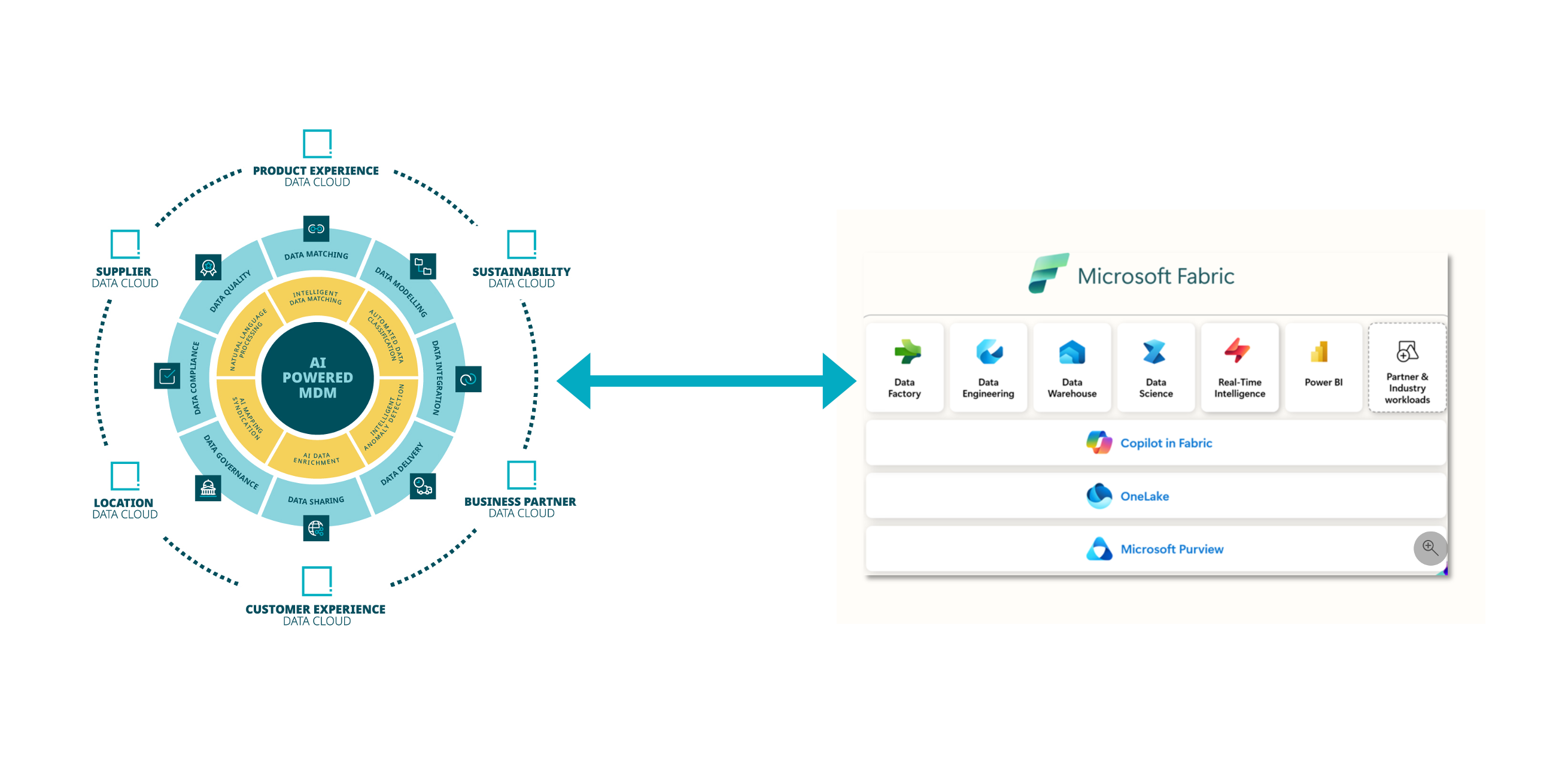
Stibo Systems MasterFabric creates a layered data platform that connects MDM with Microsoft Fabric, serving multiple analytical and AI workloads simultaneously:

  • Master data layer: The MDM solution sits at the heart of the architecture, receiving data from ingestion pipelines, applying business rules and executing matching and merging algorithms to maintaining golden records for critical entities such as customers, products, suppliers and locations. Changes to master data trigger downstream updates through to Microsoft Fabric.

  • Data ingestion layer: Source systems like ERP, CRM, ecommerce platforms, IoT sensors and third-party data providers connect to Microsoft Fabric through native connectors or APIs. This allows data to flow into OneLake in its raw form, maintaining lineage and audit trails.
  • Integration and transformation layer: All data transformation is handled directly within MasterFabric, where MDM-provided dimensions are referenced to ensure consistency across datasets. For example, transaction data is enriched with complete customer attributes from MDM before being loaded into the data warehouse. Crucially, this requires no custom programming or deep knowledge of MDM – MasterFabric automates the entire process. Although the integration itself does not rely on Microsoft Fabric pipelines, it can be incorporated into them when it needs to operate as part of a larger, end-to-end process.
  • Analytics and AI layer: This is where value is realized. Power BI dashboards connect with semantic models built on MDM-conformed dimensions, ensuring consistent and trusted data underpins every report. Machine learning models in Microsoft Fabric's data science workspaces draw on curated datasets that blend master data with transactional history to generate accurate, context-rich predictions. Real-time analytics applications subscribe to change streams from MDM to keep operational dashboards current and reflective of the latest data.
  • Governance and security layer: Microsoft Purview provides data cataloging, sensitivity labeling, and policy enforcement across the entire platform. MDM's data stewardship workflows integrate with Purview's governance capabilities, ensuring that quality issues flagged in MDM trigger alerts in downstream analytical processes.
The integrated future of MDM + Microsoft Fabric

AI and analytics are transforming every industry, but transformation requires a foundation. MDM integrated with Microsoft Fabric provides that foundation by unifying fragmented data, ensuring quality, enabling governance, and accelerating insights. Organizations that invest in this integration don't just improve existing processes; they unlock entirely new capabilities that create sustainable competitive advantages.

The question isn't whether to integrate MDM with your analytics platform. The question is how quickly you can eliminate the data friction that's limiting your AI and analytical potential. With Microsoft Fabric and MDM working together, that friction disappears, and your data becomes the strategic asset it was always meant to be.

Ready to learn more?

Interested in joining the public preview of Stibo Systems MasterFabric at FabCon 2026 and gaining early access? Connect with your account manager or email us today.


value_supply-chain_partners-optimized
Master Data Management Blog by Stibo Systems logo

Simon Tuson is a product manager within the product innovation team. With over 20 years of experience in master data management, he has had the opportunity to work in a variety of areas addressing the needs of many different customers. In his current role he has a focus on sustainability and analytics believing we have a duty to extract as much value out of data wherever possible.


Discover blogs by topic

  • See more
  • MDM strategy
  • Data governance
  • Retail
  • Customer and party data
  • Data quality
  • Product data and PIM
  • AI and machine learning
  • Manufacturing
  • Product Experience Data Cloud
  • Supplier data
  • Consumer packaged goods
  • Customer experience and loyalty
  • Data compliance
  • Sustainability
  • Data integration
  • Financial services
  • Compliance and risk management
  • Operational efficiency
  • Customer Experience Data Cloud
  • Location data
  • Product data syndication
  • Multidomain data
  • Product onboarding
  • Supplier Data Cloud
  • Business Partner Data Cloud
  • ERP success
  • Life sciences
  • Location Data Cloud
  • Automotive
  • Data modeling
  • Data sourcing
  • Digital asset management
  • Platform
  • Translation and localization
  • Data delivery
  • Data sharing
  • Digital shelf analytics
  • Enhanced content
March 9, 2026

Master Data Meets Microsoft Fabric: Building a Trusted Foundation for AI and Analytics

February 24, 2026

BIC's Blueprint for Conquering Complex Global Product Data Challenges

February 17, 2026

Product 360 After the Salesforce Acquisition: Why You Need to Map Out a Plan B

January 27, 2026

5 Hidden Costs of Bad Customer Data in Retail (and How to Avoid Them)

January 20, 2026

What is the difference between CPG and FMCG?

January 13, 2026

Discover the Value of Your Data: Master Data Management KPIs & Metrics

January 13, 2026

Solving Retail Data Fragmentation: The Key to Consistent Customer Journeys

January 5, 2026

What is a Data Domain? Meaning & Examples

December 15, 2025

The Difference Between Master Data and Metadata

December 10, 2025

Is Your PIM Strategy Future-Ready? 3 Takeaways from the SPARK Matrix™ Report

December 9, 2025

Master Data Management Roles and Responsibilities

December 9, 2025

Product Listing Page Best Practices: How to Create Better Product Listings with PIM

December 8, 2025

The Board of Directors’ Guide to Selecting Product Experience Software (With Checklist)

December 5, 2025

5 PIM Trends That Will Define 2026 and the Near Future (And How to Prepare for Them)

December 4, 2025

Process Insurance Claims Faster with Trusted Data

December 4, 2025

10 Dangerous Myths About Managing Your B2B Partner and Account Data

December 3, 2025

Fixing Fragmented Customer Account Data: Stop Losing Revenue and Trust

December 2, 2025

A Quick Guide to Golden Customer Records and How to Create Them with Master Data Management

December 2, 2025

How Master Data Management Keeps Manufacturers Compliant — From Design to Delivery

November 20, 2025

What is Manufacturing-as-a-Service (MaaS)?

November 18, 2025

AI in Retail: How to Make Your Data Ready to Use in Microsoft Fabric

November 17, 2025

What is Party Data? All You Need to Know About Party Data Management

November 4, 2025

Consumers are Using AI-Powered Tools to Shop Smarter: Why Retail Data Trust Matters More than Ever

October 29, 2025

CDP and MDM: Complementary Forces for Enhancing the Customer Experience

October 27, 2025

How to Estimate ROI of Master Data Management

October 24, 2025

Model Context Protocol (MCP): The Missing Layer for AI Systems That Interact with Enterprise Data

October 20, 2025

Managing Product Complexity: Leveraging Custom Product Management with BOM-Level Precision

October 2, 2025

How CPG Brands Scale D2C Business Without Breaking What Already Works

September 24, 2025

How Leading Brands Built Trusted Data with Amplifi and Stibo Systems

September 11, 2025

Is Your Data the Cause of Flawed AI Outputs?

September 8, 2025

What’s Next for GenAI in Product Experiences?

August 27, 2025

PIM and MDM: Key Differences, Benefits and How They Work Together

August 13, 2025

The 5 Biggest Retail Trends in 2026

August 12, 2025

From Zero to Launch in Under 6 Months: A Quick Guide to Deploying Master Data Management

August 12, 2025

5 CPG Industry Trends and Opportunities for 2026

August 5, 2025

How Operations Leaders are Modernizing Manufacturing Data Without Halting Production

August 4, 2025

Digital Product Passports: The Data Management Mandate

August 1, 2025

How to Improve Back-End Systems Using Master Data Management

July 14, 2025

Product Attribution Strategies That Convert Searchers into Buyers

July 9, 2025

How to Get More Value from Your Data: The Benefits of Master Data Management

July 4, 2025

The Complete PIM Features Guide: The Capabilities You Need for Successful Data Strategies

June 26, 2025

PIM explained: How Product Information Management transforms data quality

June 25, 2025

What is master data management? A complete and concise answer

June 12, 2025

Better Together: CRM and Customer Master Data Management

June 11, 2025

How CPG Сompany Bonduelle Сentralized Product Data Across 37 Countries

June 10, 2025

Master Data Management Tools: A Complete Guide

May 23, 2025

How Signet Jewelers Built Trust in Its Retail Data

May 12, 2025

Manufacturing Trends and Insights in 2026

April 30, 2025

Data Migration to SAP S/4HANA ERP: The Fast and Safe Approach with MDM

April 15, 2025

5 Key Trends in Product Experience Management

April 4, 2025

Trust the Machine: Making AI Automation Reliable in Master Data Management

April 2, 2025

How Agentic Workflows Are Changing Master Data Management at the Core

March 17, 2025

What is Smart Manufacturing and Why Does it Matter?

March 11, 2025

How to Implement Master Data Management: Steps and Challenges

March 7, 2025

MDM and AI: Real-World Use Cases and Learnings From OfficeMax and Motion Industries

February 27, 2025

Reyes Holdings' MDM Journey to Better Data

February 17, 2025

The Future of Master Data Management: Trends in 2026

February 3, 2025

8 Best Practices for Customer Master Data Management

February 3, 2025

4 Trends in the Automotive Industry

January 29, 2025

How to Choose the Right Data Quality Tool?

January 28, 2025

AI Adoption: A High-Stakes Gamble for Business Leaders

January 27, 2025

All You Need to Know About Supplier Information Management

January 27, 2025

How Kramp Optimizes Internal Efficiency with Data Strategy

January 27, 2025

From Patchwork to Precision: Moving Beyond Outdated and Layered ERP Systems

January 24, 2025

Thriving Beyond NRF 2025 with Trustworthy Product Data

January 23, 2025

Building the Future of Construction with AI and MDM

January 17, 2025

Why Addressing Data Complexity in Pharmaceutical Manufacturing Is Critical

January 17, 2025

How URBN Leverages Data Management to Support Its Sustainability Information  

January 14, 2025

An Introductory Guide to Supplier Compliance

January 6, 2025

How to Avoid Bad Retail Customer Data

December 17, 2024

How to Implement Data Governance

December 11, 2024

Gen Z: Seeking Excitement Beyond Amazon

December 10, 2024

A Modern Guide to Data Quality Monitoring: Best Practices

December 9, 2024

What is Supply Chain Analytics and Why It's Important

December 5, 2024

What is Supplier Lifecycle Management?

December 3, 2024

Using Machine Learning and MDM CBAM for Sustainability Compliance

November 25, 2024

AAPEX and SEMA: The Automotive Aftermarket Industry’s Mega-Showcase

October 22, 2024

Live Shopping: How to Leverage Product Information for Maximum Impact

October 16, 2024

Why Data Accuracy Matters for CPG Brands

October 15, 2024

Why Choose a Cloud-Based Data Solution: On-Premise vs. Cloud

September 23, 2024

How Master Data Management Can Enhance Your ERP Solution

September 20, 2024

Navigating Change: Engaging Business Users in Successful Change Management

September 11, 2024

What is Digital Asset Management?

September 3, 2024

How to Improve Your Data Management

August 30, 2024

Digital Transformation in the CPG Industry

August 27, 2024

Responsible AI Relies on Data Governance

August 19, 2024

Making Master Data Accessible: What is Data as a Service (DaaS)?

August 15, 2024

6 Features of an Effective Master Data Management Solution

August 13, 2024

Great Data Minds: The Unsung Heros Behind Effective Data Management

August 6, 2024

A Data Monetization Strategy - Get More Value from Your Master Data

August 4, 2024

Introducing the Master Data Management Maturity Model

July 31, 2024

What is Augmented Data Management? (ADM)

July 17, 2024

GDPR Data Governance and Data Protection, a Match Made in Heaven?

May 12, 2024

What Is Master Data Governance – And Why Do You Need It?

April 11, 2024

Guide: Deliver flawless rich content experiences with master data governance

April 10, 2024

Risks of Using LLMs in Your Business – What Does OWASP Have to Say?

April 9, 2024

Guide: How to comply with industry standards using master data governance

April 2, 2024

Guide: Get enterprise data enrichment right with master data governance

April 2, 2024

Guide: Getting enterprise data modelling right with master data governance

April 2, 2024

Guide: Improving your data quality with master data governance

March 25, 2024

How to Get Rid of Customer Duplicates

March 18, 2024

5 Tips for Driving a Centralized Data Management Strategy

March 18, 2024

What is Application Data Management and How Does It Differ From MDM?

February 20, 2024

5 Key Manufacturing Challenges in 2025

February 20, 2024

How to Enable a Single Source of Truth with Master Data Management

February 12, 2024

What is Data Quality and Why It's Important

February 7, 2024

Data Governance Trends 2026

February 6, 2024

What is Data Compliance? An Introductory Guide

January 18, 2024

How to Build a Master Data Management Strategy

January 16, 2024

The Best Data Governance Tools You Need to Know About

January 15, 2024

How to Choose the Right Master Data Management Solution

December 19, 2023

Building Supply Chain Resilience: Strategies & Examples

November 29, 2023

Shedding Light on Climate Accountability and Traceability in Retail

November 13, 2023

Location Analytics – All You Need to Know

October 16, 2023

Understanding the Role of a Chief Data Officer

October 5, 2023

5 Common Reasons Why Manufacturers Fail at Digital Transformation

September 29, 2023

How to Digitally Transform a Restaurant Chain

September 14, 2023

Three Benefits of Moving to Headless Commerce and the Role of a Modern PIM

July 6, 2023

12 Steps to a Successful Omnichannel and Unified Commerce

June 28, 2023

Navigating the Current Challenges of Supply Chain Management

April 6, 2023

Product Data Management during Mergers and Acquisitions

March 14, 2023

A Complete Master Data Management Glossary

March 1, 2023

Asset Data Governance is Central for Asset Management

February 21, 2023

4 Common Master Data Management Implementation Styles

February 14, 2023

How to Leverage Internet of Things with Master Data Management

February 13, 2023

Sustainability in Retail Needs Governed Data

January 4, 2023

Innovation in Retail

November 21, 2022

Life Cycle Assessment Scoring for Food Products

November 14, 2022

Retail of the Future

November 7, 2022

Omnichannel Strategies for Retail

November 5, 2022

Hyper-Personalized Customer Experiences Need Multidomain MDM

October 25, 2022

What is Omnichannel Retailing and What is the Role of Data Management?

October 18, 2022

Most Common ISO Standards in the Manufacturing Industry

October 17, 2022

How to Get Started with Master Data Management: 5 Steps to Consider

October 1, 2022

An Introductory Guide: What is Data Intelligence?

September 15, 2022

Revolutionizing Manufacturing: 5 Must-Have SaaS Systems for Success

August 25, 2022

Digital Transformation in the Manufacturing Industry

August 17, 2022

Master Data Management Framework: Get Set for Success

June 15, 2022

Supplier Self-Service: Everything You Need to Know

June 14, 2022

Omnichannel vs. Multichannel: What’s the Difference?

June 10, 2022

Create a Culture of Data Transparency - Begin with a Solid Foundation

May 31, 2022

What is Location Intelligence?

May 30, 2022

Omnichannel Customer Experience: The Ultimate Guide

May 24, 2022

Omnichannel Commerce: Creating a Seamless Shopping Experience

May 11, 2022

Top 4 Data Management Trends in the Insurance Industry

May 1, 2022

What is Supply Chain Visibility and Why It's Important

April 21, 2022

The Ultimate Guide to Data Transparency

April 20, 2022

How Manufacturers Can Shift to Product as a Service Offerings

April 16, 2022

How to Check Your Enterprise Data Foundation

April 14, 2022

An Introductory Guide to Manufacturing Compliance

March 31, 2022

Multidomain MDM vs. Multiple Domain MDM

March 23, 2022

How to Build a Successful Data Governance Strategy

March 22, 2022

What is Unified Commerce? Key Advantages & Best Practices

March 17, 2022

6 Best Practices for Data Governance

March 16, 2022

5 Advantages of a Master Data Management System

February 24, 2022

Supply Chain Challenges in the CPG Industry

February 14, 2022

Top 5 Most Common Data Quality Issues

February 10, 2022

What Is Synthetic Data and Why It Needs Master Data Management

February 8, 2022

What is Cloud Master Data Management?

January 28, 2022

Build vs. Buy Master Data Management Software

January 27, 2022

Why is Data Governance Important?

January 24, 2022

Five Reasons Your Data Governance Initiative Could Fail

January 21, 2022

How to Turn Your Data Silos Into Zones of Insight

January 16, 2022

How to Improve Supplier Experience Management

January 16, 2022

​​How to Improve Supplier Onboarding

January 11, 2022

What is a Data Quality Framework?

January 4, 2022

The Ultimate Guide to Building a Data Governance Framework

December 20, 2021

The Dynamic Duo of Data Security and Data Governance

December 20, 2021

How to Choose the Right Supplier Management Solution

December 6, 2021

How Data Transparency Enables Sustainable Retailing

December 1, 2021

What is Supplier Performance Management?

November 7, 2021

The Complete Guide: How to Get a 360° Customer View

October 29, 2021

How Location Data Adds Value to Master Data Projects

October 15, 2021

What is a Data Mesh? A Simple Introduction

September 2, 2021

10 Signs You Need a Master Data Management Platform

August 31, 2021

What Vendor Data Is and Why It Matters to Manufacturers

August 25, 2021

3 Reasons High-Quality Supplier Data Can Benefit Any Organization

August 9, 2021

What is Reference Data and Reference Data Management?

July 25, 2021

GDPR as a Catalyst for Effective Data Governance

May 12, 2021

How to Become a Customer-Obsessed Brand

April 27, 2021

How to Create a Master Data Management Roadmap in Five Steps

April 13, 2021

What is a Data Catalog? Definition and Benefits

April 8, 2021

How to Improve the Retail Customer Experience with Data Management

March 25, 2021

Business Intelligence and Analytics: What's the Difference?

March 21, 2021

What is a Data Lake? Everything You Need to Know

February 24, 2021

Are you making decisions based on bad HCO/HCP information?

December 15, 2020

5 Trends in Telecom that Rely on Transparency of Master Data

November 19, 2020

10 Data Management Trends in Financial Services

October 29, 2020

What Is a Data Fabric and Why Do You Need It?

October 14, 2020

Transparent Product Information in Pharmaceutical Manufacturing

August 23, 2020

How Retailers Can Increase Online Sales in 2025

August 14, 2020

Master Data Management (MDM) & Big Data

August 9, 2020

Key Benefits of Knowing Your Customers

July 21, 2020

Customer Data in Corporate Banking Reveal New Opportunities

July 18, 2020

4 Ways Product Information Management (PIM) Improves the Customer Experience

July 1, 2020

How to Estimate the ROI of Your Customer Data

June 17, 2020

How to Personalise Insurance Solutions with MDM

May 25, 2020

How to Get Buy-In for a Master Data Management Solution

July 18, 2019

How to Improve Your Product's Time to Market With PDX Syndication

June 1, 2019

8 Tips For Pricing Automation In The Aftermarket