

More and more organizations find out that even their highest-quality data is not ready for AI agents to make decisions based on it.
To know for sure if your data is “agent-grade” – not just “report-grade” – you need ways to test this.
Here are five tests you can run against your own environment to make sure your data is agent-grade.
1. Is your data consistent across every system an agent touches?
This is a question of whether your systems have a structural reason to agree, or whether each one is left to hold its own version of the truth.
To assess it, look at:
- How often key fields disagree for the same entity across systems, such as a product's description, a customer's contact details or a supplier's status
- Whether those disagreements are caught automatically, or only surface once something downstream breaks
- Whether each system pulls from a single governed source, or maintains its own copy that can drift over time
If the answer to that last point is its own copy, an agent has no way to know which version is correct.
It will act on whichever one it reaches first, and the decision carries that uncertainty with it.
2. Is your data complete enough for an agent to act without guessing?
A report can work around a missing field. A dashboard shows a blank, and the person reading it knows to ask someone. But an agent has no one to ask.
Completeness for an agent is not about how full a record looks overall, but about specific attributes a workflow needs. Are those attributes populated, consistently, across every record that workflow touches?
To test this, map one agent workflow end to end and list every field it reads from.
Then run a population check against that list, not against the record as a whole. Look at the failure rate per field rather than per record.
A customer file can pass every reporting completeness check and still be missing entitlement status on a meaningful share of accounts. That is not a big issue on a dashboard. But when an agent has to decide what a customer is owed, it will stall or guess.
3. Does your data come with context an agent can interpret on its own?
A raw value does not tell an agent what it means. A reporting tool pulls a number and presents it, and a person decides what it implies. An agent has to decide that itself.
To test this, pick a record type and check whether the relationships it depends on are stored as structured data, not just known by the people who work with it:
- Is a product's category mapped consistently across every market it sells in? Or does it vary by region with no link between the versions?
- Does a customer's account name resolve to a single legal entity? Or could two records describe the same company without anything connecting them?
If those relationships exist only as something a person would recognize, an agent has nothing to query.
It will act on the raw value, and there is no way to predict whether that reading is correct.
4. Is your data accurate at the very moment an agent uses it?
A report can run on yesterday's numbers and still be useful. An agent making a live decision cannot.
To test this, pick a field that changes frequently, such as:
- Inventory levels
- Supplier lead times
- Product classification
- Capacity status
- Compliance or certification status
Compare its value in the system an agent reads from against the value in the system of record at the same moment.
Then check the lag. How long does it take for an update in one to reach the other?
A few hours of lag costs nothing on a weekly report. But for an agent routing inventory or confirming availability in real time, that same lag means it is acting on a number that was already wrong by the time it reached the decision.
If your systems sync on a schedule rather than continuously, that schedule is your real answer to how current your data is.
5. Can your data prove what an agent decided, and why?
Agents make decisions without anyone watching in real time, which means the proof has to already exist by the time someone asks for it.
In this test, pick one agent decision from the past month and try to answer four questions without asking anyone:
- Which version of each input record did the agent read, and at what time?
- Which rule or policy applied to that decision, and was it the current version at that moment?
- Where did the decision get logged, and for how long is that log retained?
- If the agent passed its output to another agent or system, can you trace what happened next?
If you can answer all four from the system itself, you can reconstruct the decision on demand.
If any answer depends on someone's memory, a screenshot, or a log that gets overwritten after a set number of days, you won’t discover it’s unprovable until someone asks.
What does passing all five agent-grade data tests depend on?
Passing all five tests depends on how well your product, customer, supplier, location and business partner data are structured and connected. It is not about any single domain in isolation.
An agent rarely stays inside one domain.
- A sourcing decision touches supplier and product data together
- A service decision touches customer and product data together
If one domain meets the bar and another does not, the agent inherits the weaker one the moment its workflow crosses between them.
This is why fixing domains one at a time rarely gets an organization where it needs to be. The work that moves the needle connects all domains without losing:
- Consistency
- Completeness
- Context
- Accuracy
- Traceability
Like the nutrition behind that athlete’s training plan, this needs to be maintained. It is not a one-time fix.
How does Stibo Systems pull this all together on one platform?
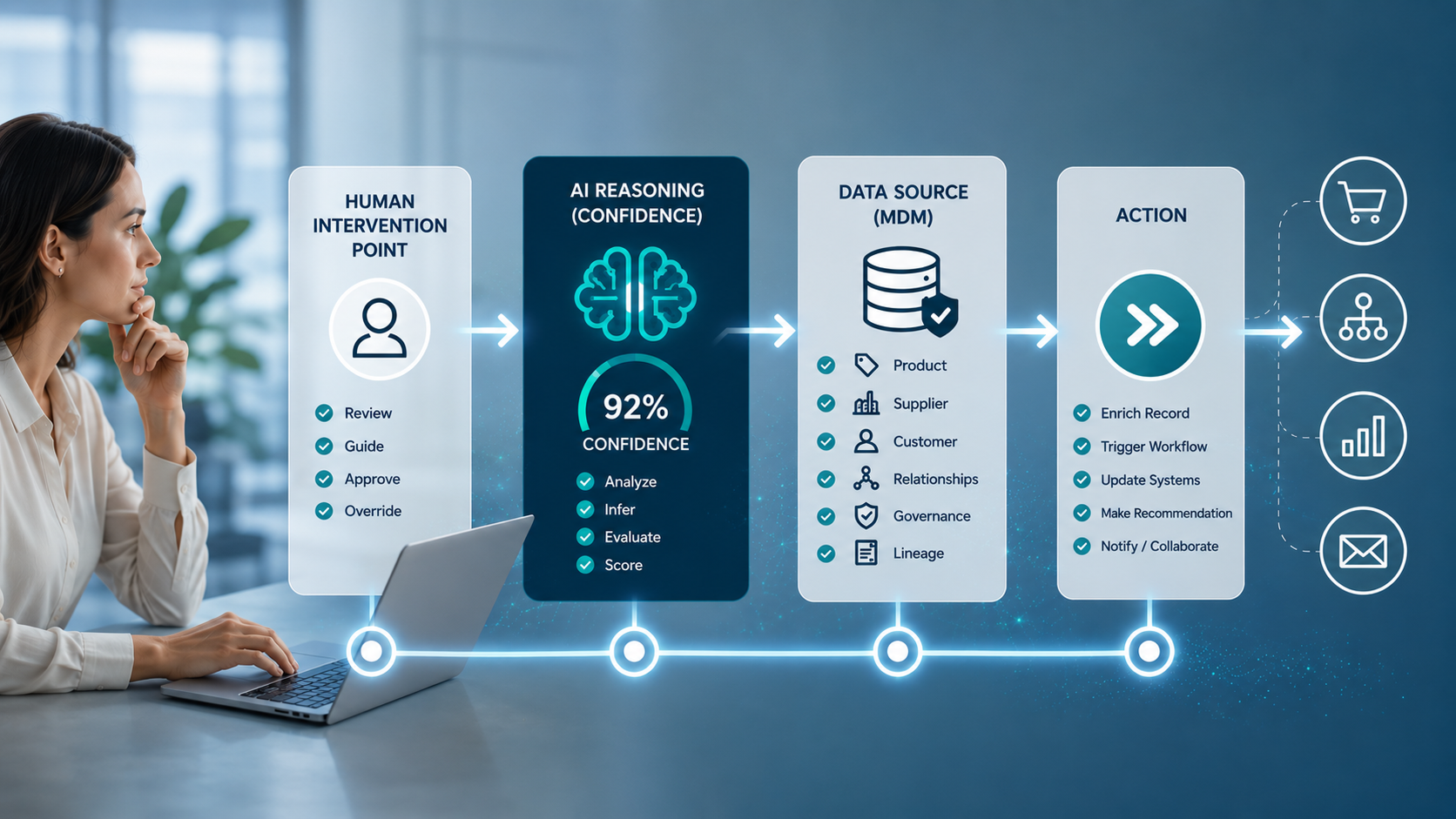
Through STEP, our trusted intelligence platform, Stibo Systems structures your product, customer, supplier and business partner data within a single platform, so the five tests hold across all four domains at once.
- A shared data model across domains, so a product, its supplier and the customer buying it stay connected and consistent with each other
- Governance and access rules built into the data itself, so agents inherit the right rules automatically as they act
- Full lineage on every record, so every input an agent used and every output it produced can be reconstructed on demand
- Continuous synchronization across connected systems, so agents are working from current data rather than a periodic snapshot
The result is a foundation that keeps holding as more agents get added, instead of a setup that needs to be re-checked each time.
Frequently asked questions
What is agent-grade data?
Agent-grade data is enterprise data structured to support autonomous decision-making: consistent across systems, complete at the domain level, semantically rich, accurate in real time, and fully traceable. Most enterprise data was built for reporting, which sets a lower bar.
How is agent-grade data different from clean data?
Clean data can be accurate within a single system and still fail an agent if it conflicts with another system, lacks context, or cannot be traced after the fact. Cleanliness is necessary but not sufficient for agent-grade.
Can AI agents work with existing enterprise data?
Often only partially. Most enterprise data was not conditioned for autonomous action, so agents may stall, guess or act on outdated or inconsistent inputs unless the data is upgraded.
What happens if an AI agent uses bad data?
Unlike a human reviewing a report, an agent acts immediately on what it finds. An inconsistency or gap does not get caught before a decision is made, it becomes the decision.
How do you prepare data for AI agents?
Preparation means addressing five areas: consistency across systems, completeness at the domain level, semantic context, real-time accuracy, and governance with full traceability, across all connected data domains rather than one at a time.
What is master data management's role in AI readiness?
MDM provides the structured, governed foundation that connects product, customer, supplier and business partner data, which is what allows agents to act reliably across domains instead of failing at the handoff between them.