


Blog Post August 10, 2026 | 5 minutes read

Why enterprise AI stalls at scale — and why data is the barrier leaders must solve

Enterprise AI pilots often stall at scale due to data quality, governance, and trust challenges. Learn why explainable, governed data is the foundation for AI success.

Scale AI with confidence

Get the white paper

Select an AI tool to explore this article

Why enterprise AI stalls at scale — and why data is the barrier leaders must solve

Master Data Management Blog by Stibo Systems logo
| 5 minutes read
August 10 2026
Why enterprise AI stalls at scale — and why data is the barrier leaders must solve
9:09

Enterprise leaders have moved beyond asking whether AI can create value. The harder question is whether their organizations can reproduce that value consistently, responsibly, and at scale.

Across industries, organizations report gains in productivity, efficiency, decision-making, and customer experience. These are encouraging (and often substantial) results.

Yet many of those same organizations are finding out that what works in a pilot doesn’t always translate to a functional solution at enterprise scale. AI outputs become inconsistent, different regions receive different recommendations, business users question results, and governance concerns float to the surface.

But more importantly, trust starts to erode. And when that happens, AI initiatives lose momentum fast.

The issue is not that the AI model suddenly stops working. The deeper challenge is whether the enterprise has the data foundation, governance model, and operating discipline to put AI into production with confidence.

Where pilots fall short

One of the biggest misconceptions in enterprise AI is the belief that a successful pilot is proof that it’s ready for enterprise use cases.

The difference is that conditions in most pilots are carefully controlled: Data is manually curated, scope is limited, and ownership is clear. Plus, governance decisions are straightforward because only a small number of stakeholders are involved.

That makes pilots valuable, but also potentially misleading if leaders treat them as proof that the same solution is ready for enterprise deployment.

In real-world scenarios, AI must operate across functions, geographies, systems, and data domains simultaneously. Product information connects to supplier data, which connects to financial structures. Customer, market, and regulatory information all influence decisions.

So although an AI model might be set up perfectly, the enterprise will inevitably introduce complexity that quickly pressure tests the system and exposes weaknesses that never popped up during the pilot phase.

What performed well in a bounded environment is suddenly forced to operate within a fragmented data ecosystem that has accumulated years of inconsistent definitions, duplicate records, competing standards, and disconnected governance models.

It is the difference between proving an AI use case in a controlled project environment and embedding it into the enterprise processes, accountability structures, and data flows that run the business every day.

How scaling unmasks data you can’t trust

That complexity is rooted in the way enterprise systems have evolved.

Most enterprises have spent decades building systems optimized for their specific business functions. For example, they've set up an ERP system to manage transactions, a PLM platform to manage product development, PIM solutions to manage product content, supplier portals to support procurement, and regional systems to support local operations.

And while they each serve an important purpose, the challenge is getting AI to reason accurately across all of them.

AI depends on context more than traditional analytics. It requires a reliable understanding of relationships between data entities, business rules, classifications, hierarchies, and lineage.

When those relationships are inconsistent across systems, AI encounters conflicting versions of truth. The result isn’t always a failed deployment or a broken system. More often, it’s something even more dangerous: AI outputs that appear to be credible but can’t be consistently trusted.

This is where many scaling efforts stall.

Each additional pilot built on fragmented data can increase what might be called AI governance debt: More models, workflows, and automated decisions that depend on inconsistencies that haven’t yet been resolved.

It’s at this point where teams discover that the data foundation supporting the pilot can’t support decision-making across the enterprise. And if you can’t trust your data, you certainly can’t trust your AI.

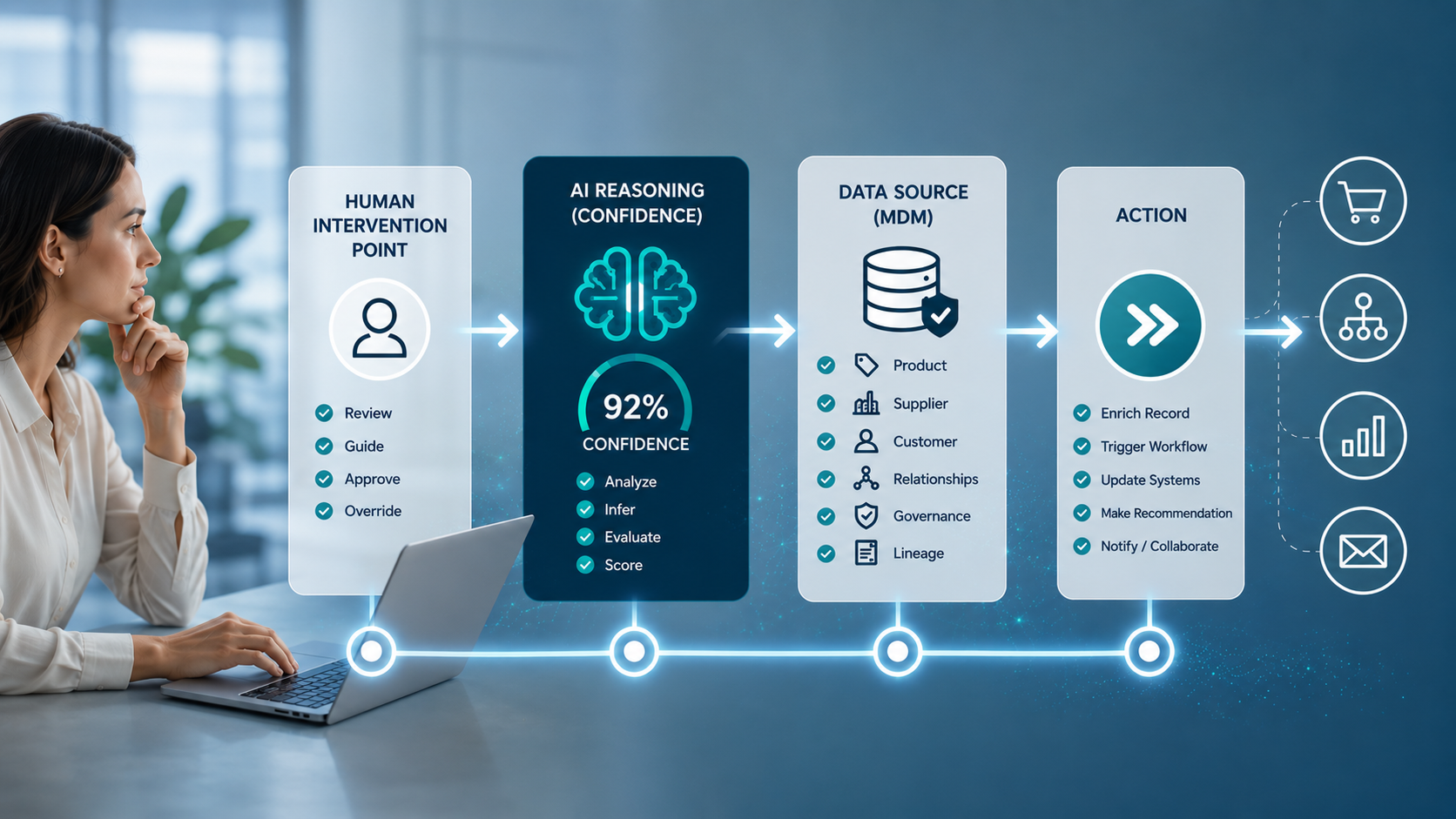
So now teams start to ask the tough questions: Why did the system make this recommendation? Why did we receive a different answer than another team? Which data sources informed this decision? Can we validate the output?

Suddenly, it’s no longer enough to get the “right” answer. Instead, organizations demand to understand how that answer came to be.

Why explainability is so important

In other words, explainability is now a strategic requirement for enterprise organizations, especially as they move from experimentation to operational AI. Business leaders increasingly need to understand not just what an AI system recommended, but why.

And the pressure is only increasing: Regulatory expectations are growing. Internal governance standards are tightening. AI agents are beginning to act rather than simply make recommendations.

When an agent can update records, initiate purchases, or trigger downstream workflows, inconsistent data no longer creates only a questionable recommendation. It can propagate errors across the enterprise before a human can intervene.

Explainability is only as strong as the data foundation beneath it. Without governed, traceable data, it quickly breaks down.

When multiple versions of the same product, supplier, customer, or financial hierarchy exist across the enterprise, it becomes difficult to reconstruct how AI arrived at a specific conclusion.

This is why trust deteriorates — not because the model is inherently flawed, but because the organization lacks confidence in the data that informed it.

Ultimately, trust in AI is built on data integrity.

Which means realizing AI’s full potential isn’t possible through only focusing on model performance. The path to true growth and innovation is to address the underlying data and governance challenges that determine whether AI can be trusted, explained, and scaled.

The new foundation for AI at scale

Real progress in AI does not come from deploying more advanced models alone. It comes from treating data, governance, process design, and accountability as core enterprise capabilities for AI at scale.

That means moving beyond isolated data domains and building governed, connected, enterprise-wide data foundations that can:

  • Align business-critical data across domains
  • Establish consistent definitions and relationships
  • Govern policies through repeatable processes
  • Provide lineage and traceability for explainability
  • Create trustworthy inputs for AI, analytics, and automation

But technology is only one part of the equation. It’s still crucial to pair modern data architectures with operating models that clearly define ownership, governance processes, accountability structures, and AI oversight.

Technology provides part of the foundation. Governance determines whether that foundation remains trusted as AI use cases expand, data changes, and automated decisions become part of everyday operations.

At enterprise scale, governance must also move beyond policy documents. Organizations need explicit ownership across data domains, repeatable rules that can be enforced through workflow, and clear controls over when AI may recommend, decide, or act. Without these structures, governance remains aspirational while AI operates at machine speed.

Three steps to start removing the data barrier

  1. Identify the curated data, manual fixes, and human interventions that made the pilot succeed.
  2. Map the authoritative sources, relationships, and ownership across every domain the AI must traverse.
  3. Establish traceability, governance rules, and exception handling before expanding AI into operational decision-making.

Data is the next AI battleground

More and more organizations have access to similar AI capabilities. Which means the next wave of competitive advantage isn’t going to come from having access to bigger, better models.

No, the differentiator will be the ability to operationalize those capabilities across the enterprise with confidence.

Those that succeed will be those that establish governed, explainable, multidomain data foundations capable of supporting AI at scale. They will be able to trust their outputs, meet governance requirements, and extend AI into increasingly critical business processes.

We already know AI works.

The real question is whether your data foundation is ready to make AI work reliably, responsibly, and repeatedly at enterprise scale.


To explore that question in greater depth, get our complete white paper. It examines why AI initiatives often stall as they move beyond controlled pilots, how data governance shapes trust and explainability, and what it takes to build an enterprise foundation capable of supporting AI at scale. Download the paper to evaluate whether your organization is ready to move beyond AI pilots and scale AI with confidence across the enterprise.

Frequently asked questions

Why do AI pilots often succeed while enterprise AI initiatives struggle to scale?

AI pilots typically operate within controlled environments with curated data, clearly defined ownership, and limited complexity. Scaling AI across the enterprise introduces fragmented systems, inconsistent data definitions, governance challenges, and cross-functional dependencies. As complexity increases, organizations often discover that the data foundation supporting the pilot is not equipped to support enterprise-wide decision-making.

Why is data governance important for enterprise AI?

Data governance helps ensure that AI systems are built on accurate, consistent, and traceable information. Without strong governance practices, organizations may struggle with duplicate records, conflicting data sources, and limited visibility into how AI-generated outputs are produced. Effective governance improves trust, supports explainability, and helps organizations scale AI more confidently.

What does an organization need to scale AI successfully?

Successfully scaling AI requires more than access to advanced models. Organizations need a governed, connected data foundation that establishes consistent business definitions, maintains data quality, provides lineage and traceability, and supports explainable decision-making. With the right foundation in place, enterprises can extend AI into critical business processes while maintaining trust, compliance, and operational confidence.


Master Data Management Blog by Stibo Systems logo

Michael Fieg is Managing Director in Accenture’s European AI & Data practice, helping organizations turn data and AI investments into scalable business value. He works closely with global enterprises on data-driven transformation initiatives and the adoption of enterprise AI solutions across industries. Michael is a recognized leader in Master Data Management, Product Information Management, and enterprise data platforms. He has helped some of the world's leading organizations design and implement modern data foundations, data governance capabilities, and master data ecosystems that improve operational efficiency, accelerate digital commerce, and enable AI at scale.



Connect on:
Master Data Management Blog by Stibo Systems logo

Sal Seno is a Principal Director in Accenture’s North America AI & Data practice, helping organizations implement trusted, governed data management solutions that efficiently unlock higher-value AI and analytics outcomes. Sal specializes in multidomain master data management, product information management (PIM), and metadata management. He serves as the Stibo Systems Capability Lead in North America and manages Accenture’s global relationship with Stibo Systems.

Connect on: LinkedIn Profile

Discover blogs by topic

  • See more
  • AI
  • Automotive
  • Business Partner Data Cloud
  • Compliance and risk management
  • Consumer packaged goods
  • Customer Experience Data Cloud
  • Customer and party data
  • Customer experience and loyalty
  • Data compliance
  • Data delivery
  • Data governance
  • Data integration
  • Data modeling
  • Data quality
  • Data sharing
  • Data sourcing
  • Digital asset management
  • Digital shelf analytics
  • ERP success
  • Enhanced content
  • Financial services
  • Life sciences
  • Location Data Cloud
  • Location data
  • MDM strategy
  • Manufacturing
  • Multidomain data
  • Operational efficiency
  • Platform
  • Product Experience Data Cloud
  • Product data and PIM
  • Product data syndication
  • Product onboarding
  • Retail
  • Supplier Data Cloud
  • Supplier data
  • Sustainability
  • Translation and localization
  • User experience
August 10, 2026

Why enterprise AI stalls at scale — and why data is the barrier leaders must solve

July 31, 2026

How to Build Data Governance That Holds Up Across Agent-to-Agent AI Workflows

July 30, 2026

Why Master Data Management Is Critical to Reliable AI Agents

July 27, 2026

Is Your Data Ready for AI Agents? 5 Tests to Find Out

July 24, 2026

From Zero to Launch in Under 6 Months: A Quick Guide to Deploying Master Data Management

July 23, 2026

5 Key Trends in Product Experience Management

July 23, 2026

The New Rules of Competition in Agentic Commerce

July 22, 2026

Why the Data Standard That Powers Your Reports Will Let Your AI Agents Down

July 21, 2026

The 5 Data Standards That Determine Whether Your AI Agents Succeed or Fail

July 20, 2026

Why Most AI Initiatives Fail Before the Model Ever Runs

July 20, 2026

Solving Retail Data Fragmentation: The Key to Consistent Customer Journeys

July 20, 2026

What’s Next for GenAI in Product Experiences?

July 20, 2026

Is Your PIM Strategy Future-Ready? 3 Takeaways from the SPARK Matrix™ Report

July 19, 2026

CDP and MDM: Complementary Forces for Enhancing the Customer Experience

July 17, 2026

Reyes Holdings' MDM Journey to Better Data

July 17, 2026

PIM explained: How Product Information Management transforms data quality

July 16, 2026

Why Trust Is the Real Bottleneck in Agentic Commerce

July 16, 2026

How to Avoid Bad Retail Customer Data

July 16, 2026

10 Dangerous Myths About Managing Your B2B Partner and Account Data

July 16, 2026

Master Data Management Tools: A Complete Guide

July 15, 2026

How Agentic Workflows Are Changing Master Data Management at the Core

July 14, 2026

How to Implement Master Data Management: Steps and Challenges

July 13, 2026

How Signet Jewelers Built Trust in Its Retail Data

July 13, 2026

A Modern Guide to Data Quality Monitoring: Best Practices

July 13, 2026

Guide: Get enterprise data enrichment right with master data governance

July 10, 2026

Guide: How to comply with industry standards using master data governance

July 9, 2026

How to Evaluate MDM Vendors in a Market Full of Acquisitions

July 9, 2026

Guide: Improving your data quality with master data governance

July 9, 2026

How Operations Leaders are Modernizing Manufacturing Data Without Halting Production

July 9, 2026

Guide: Getting enterprise data modelling right with master data governance

July 9, 2026

How URBN Leverages Data Management to Support Its Sustainability Information  

July 8, 2026

Why Agentic AI Demands a Digital Twin of the Business

July 8, 2026

AAPEX and SEMA: The Automotive Aftermarket Industry’s Mega-Showcase

July 7, 2026

Trust the Machine: Making AI Automation Reliable in Master Data Management

July 7, 2026

Is Your Data the Cause of Flawed AI Outputs?

July 7, 2026

Risks of Using LLMs in Your Business – What Does OWASP Have to Say?

July 6, 2026

Navigating Change: Engaging Business Users in Successful Change Management

July 6, 2026

Consumers are Using AI-Powered Tools to Shop Smarter: Why Retail Data Trust Matters More than Ever

July 6, 2026

Building Supply Chain Resilience: Strategies & Examples

July 4, 2026

Gen Z: Seeking Excitement Beyond Amazon

July 3, 2026

How CPG Сompany Bonduelle Сentralized Product Data Across 37 Countries

July 2, 2026

AI Adoption: A High-Stakes Gamble for Business Leaders

July 2, 2026

Why Data Accuracy Matters for CPG Brands

July 1, 2026

Building the Future of Construction with AI and MDM

July 1, 2026

Why Choose a Cloud-Based Data Solution: On-Premise vs. Cloud

June 19, 2026

AI Systems Want Clean Data – But They NEED Governed Intelligence

June 17, 2026

Bosch and Stibo Systems Partner for Enterprise Data Transformation

June 17, 2026

With Semantic Master Data, Your AI Stops Guessing and Starts Understanding What You Want

June 17, 2026

5 Hidden Costs of Bad Customer Data in Retail (and How to Avoid Them)

June 12, 2026

The Complete PIM Features Guide: The Capabilities You Need for Successful Data Strategies

June 12, 2026

5 Product Data Problems That Make Your Brand Invisible in AI Search

June 11, 2026

4 Common Master Data Management Implementation Styles

June 11, 2026

Designing Trust in Agentic Enterprise Systems

June 8, 2026

AI and Master Data: The Business Powerhouse

June 8, 2026

Master Data Meets Microsoft Fabric: Building a Trusted Foundation for AI and Analytics

June 4, 2026

7 Signs Your Brand Is Losing Ground in Agentic Commerce

June 1, 2026

The Future of Master Data Management: Trends in 2026

June 1, 2026

What is a Data Domain? Meaning & Examples

May 28, 2026

8 Best Practices for Customer Master Data Management

May 27, 2026

Data Migration to SAP S/4HANA ERP: The Fast and Safe Approach with MDM

May 25, 2026

Model Context Protocol (MCP): The Missing Layer for AI Systems That Interact with Enterprise Data

May 21, 2026

Better Together: CRM and Customer Master Data Management

May 21, 2026

4 Supplier Onboarding Taxes That Drain Margin Every Day – and How Agentic AI Fixes Them

May 20, 2026

The 7 Types of Customer Data Your AI Agents Can't Ever Act Without

May 19, 2026

What Is Master Data Governance – And Why Do You Need It?

May 18, 2026

The Difference Between Master Data and Metadata

May 13, 2026

Product Attribution Strategies That Convert Searchers into Buyers

May 12, 2026

How to Choose the Right Master Data Management Solution

May 12, 2026

PIM and MDM: Key Differences, Benefits and How They Work Together

May 12, 2026

5 CPG Industry Trends and Opportunities for 2026

May 11, 2026

A Quick Guide to Golden Customer Records and How to Create Them with Master Data Management

May 11, 2026

What is Master Data Management? A Complete Guide

May 11, 2026

Master Data Management Roles and Responsibilities

May 8, 2026

What is Application Data Management and How Does It Differ From MDM?

April 30, 2026

6 Features of an Effective Master Data Management Solution

April 22, 2026

What is the difference between CPG and FMCG?

April 17, 2026

Most Common ISO Standards in the Manufacturing Industry

March 18, 2026

A Complete Master Data Management Glossary

February 24, 2026

BIC's Blueprint for Conquering Complex Global Product Data Challenges

February 17, 2026

Product 360 After the Salesforce Acquisition: Why You Need to Map Out a Plan B

January 13, 2026

Discover the Value of Your Data: Master Data Management KPIs & Metrics

December 9, 2025

Product Listing Page Best Practices: How to Create Better Product Listings with PIM

December 8, 2025

The Board of Directors’ Guide to Selecting Product Experience Software (With Checklist)

December 5, 2025

5 PIM Trends That Will Define 2026 and the Near Future (And How to Prepare for Them)

December 4, 2025

Process Insurance Claims Faster with Trusted Data

December 3, 2025

Fixing Fragmented Customer Account Data: Stop Losing Revenue and Trust

December 2, 2025

How Master Data Management Keeps Manufacturers Compliant — From Design to Delivery

November 20, 2025

What is Manufacturing-as-a-Service (MaaS)?

November 18, 2025

AI in Retail: How to Make Your Data Ready to Use in Microsoft Fabric

November 17, 2025

What is Party Data? All You Need to Know About Party Data Management

October 27, 2025

How to Estimate ROI of Master Data Management

October 20, 2025

Managing Product Complexity: Leveraging Custom Product Management with BOM-Level Precision

October 2, 2025

How CPG Brands Scale D2C Business Without Breaking What Already Works

September 24, 2025

How Leading Brands Built Trusted Data with Amplifi and Stibo Systems

August 13, 2025

The 5 Biggest Retail Trends in 2026

August 4, 2025

Digital Product Passports: The Data Management Mandate

August 1, 2025

How to Improve Back-End Systems Using Master Data Management

July 9, 2025

How to Get More Value from Your Data: The Benefits of Master Data Management

May 12, 2025

Manufacturing Trends and Insights in 2026

March 17, 2025

What is Smart Manufacturing and Why Does it Matter?

March 7, 2025

MDM and AI: Real-World Use Cases and Learnings From OfficeMax and Motion Industries

February 3, 2025

4 Trends in the Automotive Industry

January 29, 2025

How to Choose the Right Data Quality Tool?

January 27, 2025

All You Need to Know About Supplier Information Management

January 27, 2025

How Kramp Optimizes Internal Efficiency with Data Strategy

January 27, 2025

From Patchwork to Precision: Moving Beyond Outdated and Layered ERP Systems

January 24, 2025

Thriving Beyond NRF 2025 with Trustworthy Product Data

January 17, 2025

Why Addressing Data Complexity in Pharmaceutical Manufacturing Is Critical

January 14, 2025

An Introductory Guide to Supplier Compliance

December 17, 2024

How to Implement Data Governance

December 9, 2024

What is Supply Chain Analytics and Why It's Important

December 5, 2024

What is Supplier Lifecycle Management?

December 3, 2024

Using Machine Learning and MDM CBAM for Sustainability Compliance

October 22, 2024

Live Shopping: How to Leverage Product Information for Maximum Impact

September 23, 2024

How Master Data Management Can Enhance Your ERP Solution

September 11, 2024

What is Digital Asset Management?

September 3, 2024

How to Improve Your Data Management

August 30, 2024

Digital Transformation in the CPG Industry

August 27, 2024

Responsible AI Relies on Data Governance

August 19, 2024

Making Master Data Accessible: What is Data as a Service (DaaS)?

August 13, 2024

Great Data Minds: The Unsung Heros Behind Effective Data Management

August 6, 2024

A Data Monetization Strategy - Get More Value from Your Master Data

August 4, 2024

Introducing the Master Data Management Maturity Model

July 31, 2024

What is Augmented Data Management? (ADM)

July 17, 2024

GDPR Data Governance and Data Protection, a Match Made in Heaven?

April 11, 2024

Guide: Deliver flawless rich content experiences with master data governance

March 25, 2024

How to Get Rid of Customer Duplicates

March 18, 2024

5 Tips for Driving a Centralized Data Management Strategy

February 20, 2024

5 Key Manufacturing Challenges in 2025

February 20, 2024

How to Enable a Single Source of Truth with Master Data Management

February 12, 2024

What is Data Quality and Why It's Important

February 7, 2024

Data Governance Trends 2026

February 6, 2024

What is Data Compliance? An Introductory Guide

January 18, 2024

How to Build a Master Data Management Strategy

January 16, 2024

The Best Data Governance Tools You Need to Know About

November 29, 2023

Shedding Light on Climate Accountability and Traceability in Retail

November 13, 2023

Location Analytics – All You Need to Know

October 16, 2023

Understanding the Role of a Chief Data Officer

October 5, 2023

5 Common Reasons Why Manufacturers Fail at Digital Transformation

September 29, 2023

How to Digitally Transform a Restaurant Chain

September 14, 2023

Three Benefits of Moving to Headless Commerce and the Role of a Modern PIM

July 6, 2023

12 Steps to a Successful Omnichannel and Unified Commerce

June 28, 2023

Navigating the Current Challenges of Supply Chain Management

April 6, 2023

Product Data Management during Mergers and Acquisitions

March 1, 2023

Asset Data Governance is Central for Asset Management

February 14, 2023

How to Leverage Internet of Things with Master Data Management

February 13, 2023

Sustainability in Retail Needs Governed Data

January 4, 2023

Innovation in Retail

November 21, 2022

Life Cycle Assessment Scoring for Food Products

November 14, 2022

Retail of the Future

November 7, 2022

Omnichannel Strategies for Retail

November 5, 2022

Hyper-Personalized Customer Experiences Need Multidomain MDM

October 25, 2022

What is Omnichannel Retailing and What is the Role of Data Management?

October 17, 2022

How to Get Started with Master Data Management: 5 Steps to Consider

October 1, 2022

An Introductory Guide: What is Data Intelligence?

September 15, 2022

Revolutionizing Manufacturing: 5 Must-Have SaaS Systems for Success

August 25, 2022

Digital Transformation in the Manufacturing Industry

August 17, 2022

Master Data Management Framework: Get Set for Success

June 15, 2022

Supplier Self-Service: Everything You Need to Know

June 14, 2022

Omnichannel vs. Multichannel: What’s the Difference?

June 10, 2022

Create a Culture of Data Transparency - Begin with a Solid Foundation

May 31, 2022

What is Location Intelligence?

May 30, 2022

Omnichannel Customer Experience: The Ultimate Guide

May 24, 2022

Omnichannel Commerce: Creating a Seamless Shopping Experience

May 11, 2022

Top 4 Data Management Trends in the Insurance Industry

May 1, 2022

What is Supply Chain Visibility and Why It's Important

April 21, 2022

The Ultimate Guide to Data Transparency

April 20, 2022

How Manufacturers Can Shift to Product as a Service Offerings

April 16, 2022

How to Check Your Enterprise Data Foundation

April 14, 2022

An Introductory Guide to Manufacturing Compliance

March 31, 2022

Multidomain MDM vs. Multiple Domain MDM

March 23, 2022

How to Build a Successful Data Governance Strategy

March 22, 2022

What is Unified Commerce? Key Advantages & Best Practices

March 17, 2022

6 Best Practices for Data Governance

March 16, 2022

5 Advantages of a Master Data Management System

February 24, 2022

Supply Chain Challenges in the CPG Industry

February 14, 2022

Top 5 Most Common Data Quality Issues

February 10, 2022

What Is Synthetic Data and Why It Needs Master Data Management

February 8, 2022

What is Cloud Master Data Management?

January 28, 2022

Build vs. Buy Master Data Management Software

January 27, 2022

Why is Data Governance Important?

January 24, 2022

Five Reasons Your Data Governance Initiative Could Fail

January 21, 2022

How to Turn Your Data Silos Into Zones of Insight

January 16, 2022

How to Improve Supplier Experience Management

January 16, 2022

​​How to Improve Supplier Onboarding

January 11, 2022

What is a Data Quality Framework?

January 4, 2022

The Ultimate Guide to Building a Data Governance Framework

December 20, 2021

The Dynamic Duo of Data Security and Data Governance

December 20, 2021

How to Choose the Right Supplier Management Solution

December 6, 2021

How Data Transparency Enables Sustainable Retailing

December 1, 2021

What is Supplier Performance Management?

November 7, 2021

The Complete Guide: How to Get a 360° Customer View

October 29, 2021

How Location Data Adds Value to Master Data Projects

October 15, 2021

What is a Data Mesh? A Simple Introduction

September 2, 2021

10 Signs You Need a Master Data Management Platform

August 31, 2021

What Vendor Data Is and Why It Matters to Manufacturers

August 25, 2021

3 Reasons High-Quality Supplier Data Can Benefit Any Organization

August 9, 2021

What is Reference Data and Reference Data Management?

July 25, 2021

GDPR as a Catalyst for Effective Data Governance

May 12, 2021

How to Become a Customer-Obsessed Brand

Let’s get started

Ready to see how trustworthy intelligence turns data into confident decisions? Let’s chat.

2