

Enterprise UX, which is the use of software, tools, products, and services in a work environment, was traditionally built around a simple assumption: A human makes the final decision.
- A user reviews the data.
- A manager approves the workflow.
- An employee validates the recommendation.
Agentic AI, software that pursues goals and takes action autonomously, is changing that assumption.
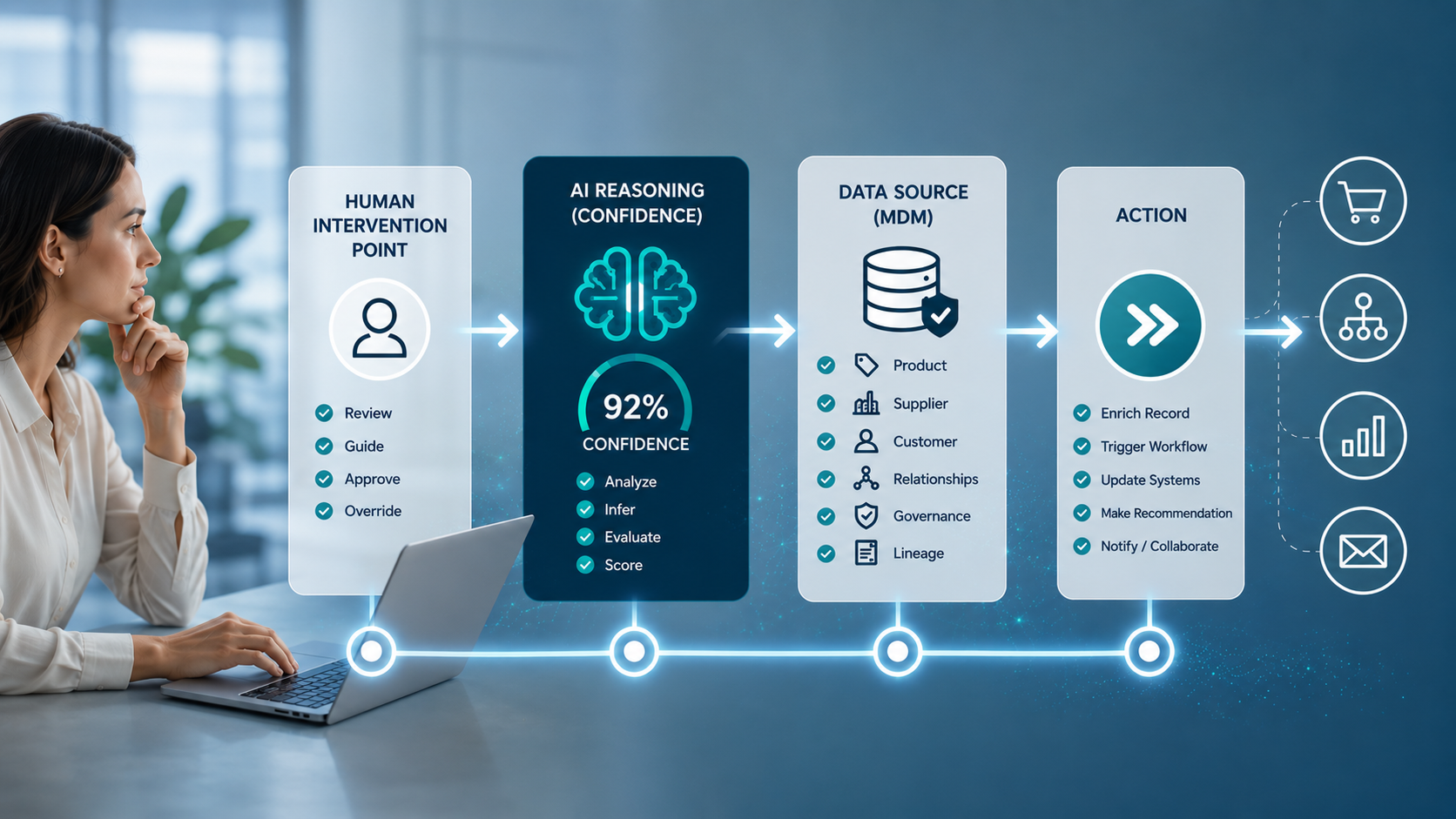
Today, AI systems classify products, enrich master data, recommend actions, validate records, trigger workflows, and collaborate with other systems autonomously. In many enterprise environments, humans are no longer the primary operators inside the workflow, but the supervisors of systems acting on their behalf.
This changes the role of UX dramatically. The challenge expands beyond designing screens, forms, or dashboards to designing trust between humans, AI agents, and enterprise data ecosystems.
In enterprise AI, trust is everything.
AI sounds intelligent because of pattern recognition
Large language models, or LLMs, do not truly “understand” information the way humans do. They predict statistically probable outputs based on patterns in training data and contextual input (Source: Jamie Bartlett, How to Talk to AI, Penguin, 2026). That distinction matters because AI often sounds confident to human users even when it lacks sufficient context, business rules, semantic meaning, or trustworthy source data. Humans naturally associate fluency with intelligence, which creates a dangerous illusion of certainty. This is why the term “hallucination” can sometimes oversimplify the problem.
In enterprise environments, AI is often not “imagining” incorrect answers, but attempting to infer meaning from incomplete, fragmented, or poorly governed data. The result is still wrong, but the root cause frequently lies deeper within the data ecosystem itself. This becomes critical when autonomous systems start making operational decisions.
An AI agent enriching customer records with inconsistent master data can multiply governance issues faster than any human team ever could. A recommendation engine trained on poorly structured product relationships can confidently deliver misleading information at enterprise scale that is difficult to catch.
When humans disengage too deeply from decision-making, organizations risk losing contextual judgment, domain expertise, and critical thinking capabilities. Productivity gains can unintentionally create new operational blind spots, and potentially more work having to backtrack and fix data errors the AI agent created.
AI does not remove data quality problems – it amplifies them when the full flow has not been intentionally designed and humans are left too much out of the loop.
The goal should not be replacing human thinking, but augmenting human capability responsibly through a well-designed agentic experience.
Why MDM matters even more in the AI era
As organizations accelerate AI adoption, many are discovering that trustworthy AI requires trustworthy data foundations. As stated above, this is where master data management (MDM) and data quality become even more strategically important.
AI agents rely on context. They depend on consistent definitions, governed relationships, semantic clarity, and reliable enterprise knowledge. Without these foundations, even the most advanced models struggle to produce outcomes that business users can trust.
An AI system cannot reliably reason about customers, suppliers, products, or assets if those entities are duplicated, fragmented, or inconsistently defined across enterprise systems.
In many ways, semantic master data acts as the connective tissue between AI capability and enterprise trust.
When data ecosystems provide clear meaning, lineage, governance, and relationships, AI systems stop “guessing” and begin operating with far greater contextual understanding. Confidence becomes grounded in enterprise knowledge rather than probability alone.
This shift has significant UX implications as users are no longer evaluating only the interface, but whether the system itself behaves predictably, transparently, and responsibly.
Designing for confidence becomes an even greater focus when defining good usability of enterprise systems.
UX is no longer only human-to-machine interaction
Human-to-machine interaction is not new. UX has always been about reducing friction between people and systems. Agentic systems introduce a new layer: machine-to-machine collaboration.
AI agents now:
- Consume enterprise data
- Trigger workflows
- Coordinate with APIs
- Enrich records
- Validate information
- Recommend actions to other systems
In many cases, the interface itself becomes increasingly invisible due to agentic automation and ad-hoc tasks performed via chatbots. Ironically, this makes UX even more important because users aren’t directly observing every operational step, so they rely heavily on trust signals:
- Why did the AI make this decision?
- What data informed this recommendation?
- How confident is the system?
- Can I intervene or override the outcome?
- What happens if the system is wrong?
All these questions should be answered through the system's UX. Establishing trust in agent output comes from transparent communication, including clear methods for overriding or canceling an operation.
This means usability heuristics remain consistently relevant in the age of AI. Principles like visibility of system status, user control and freedom, visual consistency, and error prevention become essential design requirements for agentic systems. (Source: Nielsen Norman Group, "10 Usability Heuristics for User Interface Design"). Even autonomous workflows need explainability.
Users need:
- Confidence indicators
- Escalation paths
- Predictable system behavior
- Error recovery without losing trust
The interface may shrink while the experience layer becomes more critical than ever. But organizations focusing too heavily on AI capabilities may overlook the foundations of trust and adoption.
Agentic systems require service design thinking
Traditional enterprise UX primarily focused on frontstage interactions and patterns for:
- Screens
- Forms
- Dashboards
- Workflows
But agentic enterprise systems rely heavily on backstage functionality.
AI agents depend on orchestration layers, semantic relationships, governance pipelines, confidence scoring, approval routing, escalation mechanisms, and audit systems that users may never directly see. Yet user trust depends heavily on how reliably these invisible systems operate.
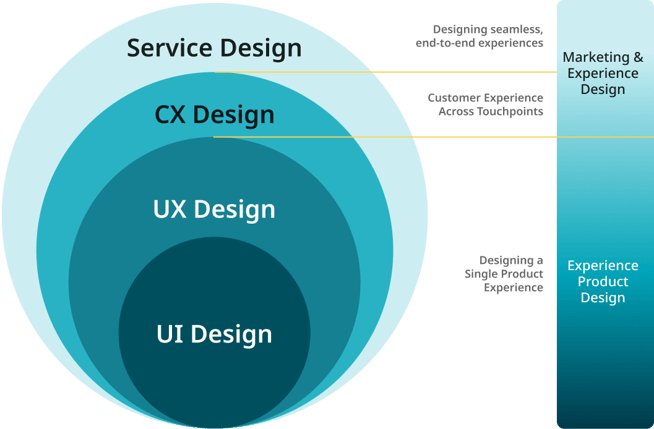
Designing enterprise AI resembles service design (the planning and arranging of people, infrastructure, communication, and material components of a service in order to improve its quality and the interaction between the service provider and its users – Source: Wikipedia, "Service design") and service blueprinting rather than traditional interface optimization alone. The challenge is no longer only understanding what users click or see, but understanding how decisions move across interconnected systems, AI agents, enterprise data, APIs, governance layers, and human oversight structures.
Every autonomous action creates a chain of service dependencies.
When an AI agent autonomously classifies a product, enriches a customer record, or triggers a workflow, that decision may affect downstream systems, operational teams, compliance processes, and customer experiences simultaneously. The user may never observe the full chain directly, but they still experience the consequences when systems behave unpredictably.
Because of this, the invisible operational architecture becomes part of the user experience itself. As AI systems become more autonomous, enterprise UX can no longer focus exclusively on usability at the interface layer. It must design the reliability, transparency, and accountability of entire service ecosystems.
Designing for trust is designing for adoption
Research increasingly shows that enterprise AI adoption struggles are rarely caused by the underlying models or technical capability alone. Much of the resistance is emotional and cognitive. People do not fear automation because it changes workflows, but they fear systems they cannot predict, validate, or challenge (Source: BCG, "The AI Adoption Puzzle: Why Usage Is Up but Impact Is Not").
If users cannot understand why a recommendation appears, confidence erodes quickly. If AI outputs feel inconsistent, trust collapses. If governance visibility disappears behind automation, enterprise adoption slows dramatically.
Designing for trust means designing systems that help users feel informed rather than replaced.
That includes:
- Transparent recommendations
- Explainable workflows
- Clear confidence levels
- Meaningful human oversight
- Governance visibility
- Recoverability when failures occur
Trust is not created through marketing claims about “smart AI,” but through experiencing consistent and predictable behavior over time. The more trusted the system is, the higher its adoption rate will be.
Designing confidence ecosystems
Today, UX operates at the intersection of humans, AI agents, enterprise data, governance systems, and automation frameworks. It’s designing confidence in complex ecosystems. Enterprise AI is no longer experienced through isolated interfaces alone, but through interconnected services, workflows, governance structures, escalation paths, and operational ecosystems.
Delivering that experience depends on the backstage machinery users never see:
- Confidence scoring
- Decision logs and audit trails
- Approval and escalation routing
- Rollback and override controls
- Data lineage and provenance
- Trust recovery when something fails
In the age of agentic AI, the most successful enterprise systems will not be the ones generating the most answers at the highest speeds, but the systems people trust enough to embrace their agentic opportunities.
Enterprise-scale AI emphasizes that building user trust is never a happy accident, but thoughtfully and purposefully designed.