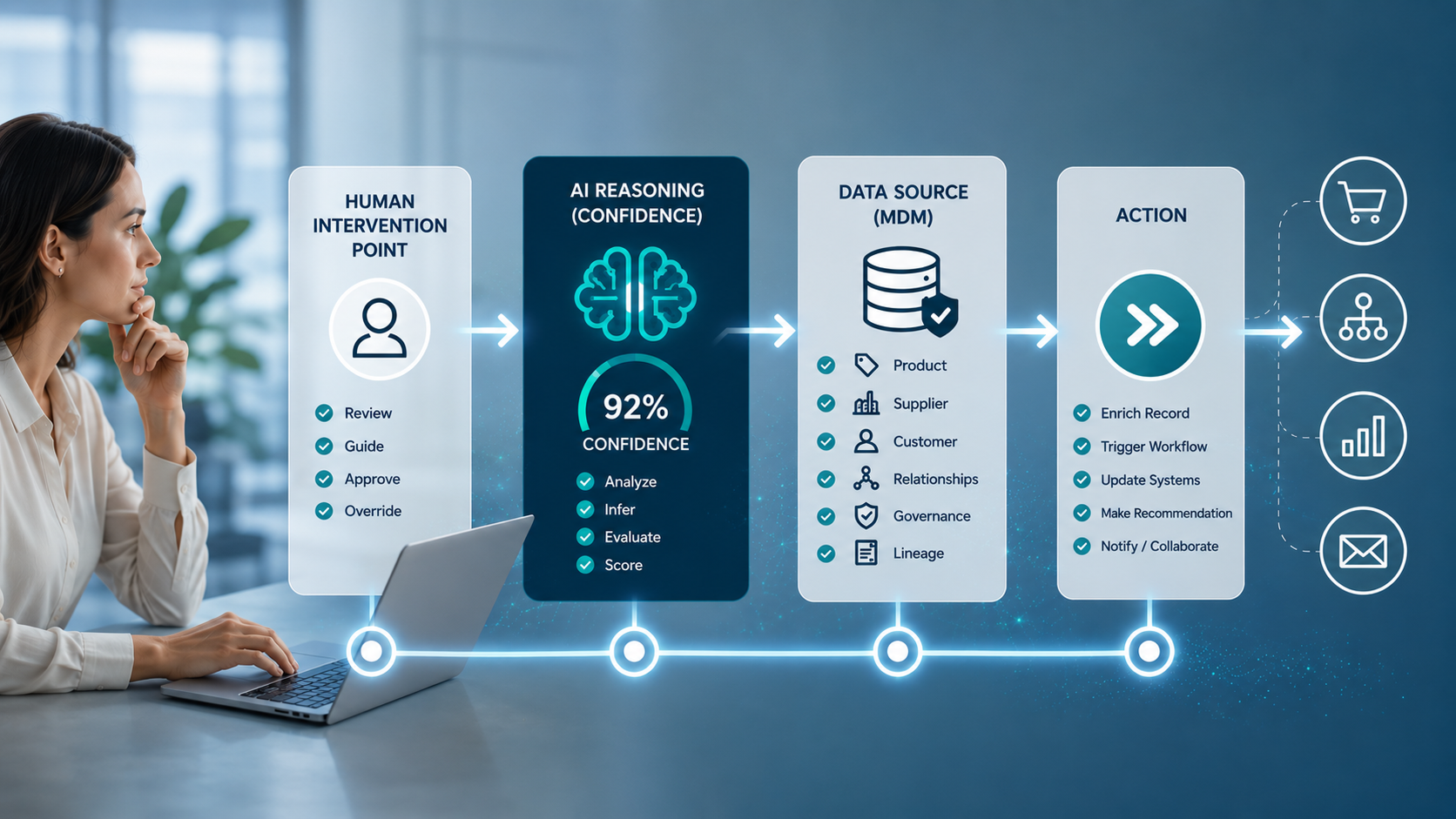

When an AI agent passes data to another agent, how much a human actually reviews depends on how the workflow was built. Most companies today still keep a person somewhere in the loop – but at the specific point where one agent’s output becomes another agent’s input, that handoff usually happens with no one watching in real time.
So, without warning, if there is any inconsistency in that data, there is a flawed decision.
It is like a relay race. You can have the best sprinters in the world, and a coach watching every exchange. But if the handoff itself is not governed by design, no one can intervene fast enough to stop the baton from hitting the ground.
Agent-to-agent AI workflows fail the same way – at the point where data moves between systems, across domains, without consistent governance holding it together.
That governance has to come from somewhere: either a human checks the handoff, or the system is built to check itself. Governance that depends on human review at every handoff is a bottleneck that slows the workflow to the speed of the people inside it.
In this blog, you will learn why agent-to-agent workflows break down at the data layer, and what governed data infrastructure needs to look like to prevent it.
Why do agent-to-agent workflows create data problems that single-agent systems don't?
A single AI agent operating within one system has a contained data problem. If the data it reads is inconsistent, the error stays local. A human or downstream process can catch it.
Multi-agent workflows reduce that containment, and in fully autonomous configurations, remove it entirely.
Each agent acts on the output of the previous one, across systems and domains that were never designed to share a single version of the truth. Therefore, an error at step one does not stay at step one.
Consider what a typical agentic commerce workflow crosses:
- Product data (descriptions, attributes, classifications)
- Inventory positions across warehouses and regions
Governance may work within each domain. The problem appears at the handoff when an agent built for one domain passes data into a context it was not originally structured for.
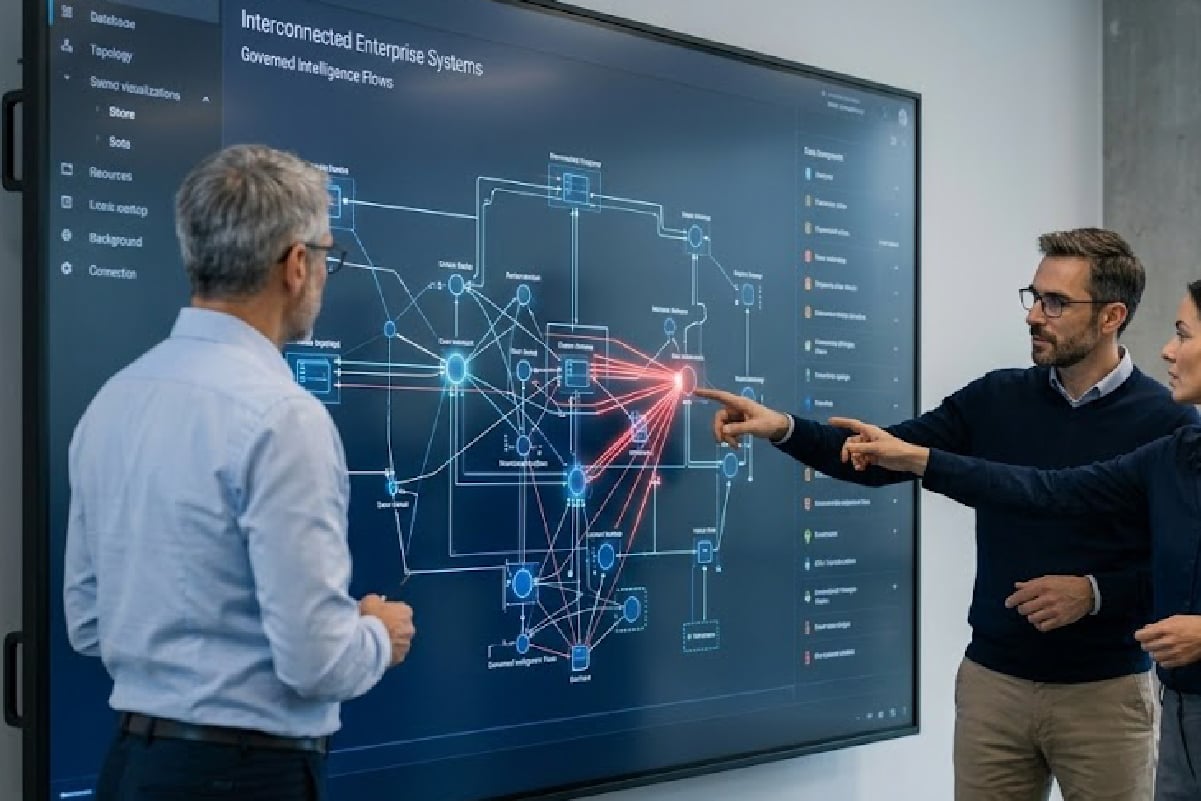
Without governance that spans those domains, inconsistencies travel unnoticed through the chain, getting worse with every exchange.
In a relay race, a dropped baton does not slow one runner: It ends the race for every runner behind them.
What does a data failure across an agent chain look like?
Take an agentic commerce workflow where a product recommendation agent feeds an inventory agent, which feeds a supplier agent.
Each is doing exactly what it was configured to do.
Now introduce one inconsistency:
The product data at step one contains a classification error: a SKU mapped to the wrong product category.
This is what happens:
- The recommendation agent acts on it
- The inventory agent receives that output and allocates stock accordingly
- The supplier agent places an order based on that allocation
By the time the error becomes visible, several autonomous decisions have already executed. No single agent made a mistake in its own logic. Each one simply trusted the data it received.
Multi-agent failure is very different from failures in single-agent systems:
- The error is delayed and does not surface at the point of origin
- The blast radius grows with every handoff, as each downstream agent compounds the problem rather than catching it
- The workflow appears to have been executed successfully because no agent flags anything as wrong
- Retraining the agents does not fix it, because the problem lives in the data layer underneath them
Without a governed data layer connecting those agents, there is no mechanism to trace which data state each agent acted on, or where the chain went wrong.
Why does data governance break down specifically at agent handoffs?
Most enterprise data governance was built around systems that wait for instructions.
- A user queries a database
- A report pulls from a warehouse
- An application reads a record
The data sits still long enough to be checked.
Agents are increasingly designed to act, pass outputs onward and trigger the next step. And it often happens within the same workflow execution, with no checkpoint in between.
Governance that was designed for static consumption breaks down when data starts moving autonomously between systems.
Agents draw from ungoverned source systems
Most enterprises have multiple source systems, each with its own data standards, definitions and update cycles. A product record governed in one system does not carry that governance with it when another agent consumes it elsewhere.
Domain-crossing removes shared context
Data that is accurate within one domain loses integrity when an agent in a different domain interprets it without shared definitions. What "active" means for a product record is not the same as what it means for a supplier relationship.
There is no audit trail at the handoff point
When something goes wrong, there is often no record of what data state each agent acted on at the moment it made a decision.
Without that visibility, tracing a failure back through a multi-agent chain is almost impossible. You can see the outcome, but not which handoff caused it – or what the data looked like when it crossed that boundary.
What does your data layer need to support agent-to-agent AI?
The answer is not more data. Most enterprises already have enough of it. The problem is that the data is ungoverned at the points where agents hand off to each other. What it needs is the following four elements.
1. A single governed record across domains
Every agent in the chain needs to consume the same governed record. Product, supplier, customer, partner and location data need to be connected and consistent. They cannot be managed as separate silos that happen to share an infrastructure.
2. Governance that travels with the data
Governance applied at ingestion and abandoned at the first handoff is not governance for agents. The rules, definitions and standards attached to a data record need to follow it as it moves between agents and across domains.
3. Auditability at every step
When an agent chain produces an unexpected outcome, you need to identify exactly which data state each agent acted on, and when. Without that, the audit trail ends at the workflow log, not at the data layer where the failure originated.
Auditability also changes how you design governance upfront. If every data state needs to be traceable after the fact, the structure that supports that needs to be built in from the start.
4. A structure built for chains
Traditional data governance was designed around individual applications that consumed data on request.
In multi-agent workflows, you need a layer designed to support sequential, autonomous consumption across domain boundaries where, unless the governance layer catches it first:
- Human review at every handoff is not guaranteed (and in autonomous configurations, not present at all)
- No system flags an inconsistency unless the governance layer catches it first
How does Stibo Systems make agent-to-agent workflows trustworthy?
STEP, Stibo Systems' trusted intelligence platform, is a leading master data management (MDM) platform. With it, you govern product, customer, partner, supplier and location data as a connected whole instead of as separate domains with separate standards.
For multi-agent AI, that means:
- Single governed record at every handoff
- Governance rules travel with the data
- Cross-domain relationships maintained across the chain
- Continuous data validation across all domains
- Every data state is traceable after the fact
- Domain-crossing is supported natively, without losing consistency
As agent-to-agent AI moves from pilot to production, the data layer underneath it becomes the determining factor.
In a relay race, the fastest team loses if the exchange zone is ungoverned. The same is true here: The agents can be well-configured and purpose-built, but without a governed data layer connecting them, the handoff is where performance breaks down.
Stibo Systems structures your business for trustworthy agent-to-agent intelligence.
Frequently asked questions
What is the difference between data governance for traditional software and data governance for AI agents?
Traditional data governance was designed for systems that consume data on request: a user runs a query and an application reads a record. AI agents consume data autonomously and pass it onward without pause.
Governance built for the first model breaks down in the second because there is no human review between steps and no natural checkpoint where inconsistencies get caught.
How do you audit an AI agent workflow when something goes wrong?
Auditing a multi-agent workflow requires visibility at the data layer (not just the workflow log). You need to know what data state each agent acted on at the moment it made a decision.
Without that, you can identify that something went wrong, but not where in the chain it originated or what data triggered it.
What does governed master data mean for AI agent deployments?
Governed master data means every agent in a workflow reads from a single, authoritative record – one that carries consistent definitions, classifications and relationships across every domain it touches.
For AI agents, ungoverned master data is not just a quality problem. It is a reliability problem at the point of every autonomous decision.
What is multidomain master data management?
Multidomain master data management governs multiple data domains – product, customer, partner, supplier and location – as a connected whole rather than as separate systems with separate standards.
For enterprises deploying AI agents across business functions, it provides the consistent data foundation that agent chains require to operate reliably.
How does data quality affect AI agent performance?
Data quality determines whether an agent can be trusted to act autonomously. An agent operating on inconsistent or incomplete data will produce outputs that reflect those inconsistencies. In a multi-agent workflow, those outputs become the inputs for the next agent in the chain.