

Clean data isn't the same as data your AI can reason with. Most enterprises have the first. Very few have the second.
Your AI systems process data literally. A recommendation engine doesn't notice that a supplier went inactive six months ago – it just sees a valid record and acts on it. A procurement agent doesn't question whether a price is a list price or a cost – it picks an interpretation and runs with it.
The data passed every quality check, but the failures happen anyway. What's missing is governed intelligence.
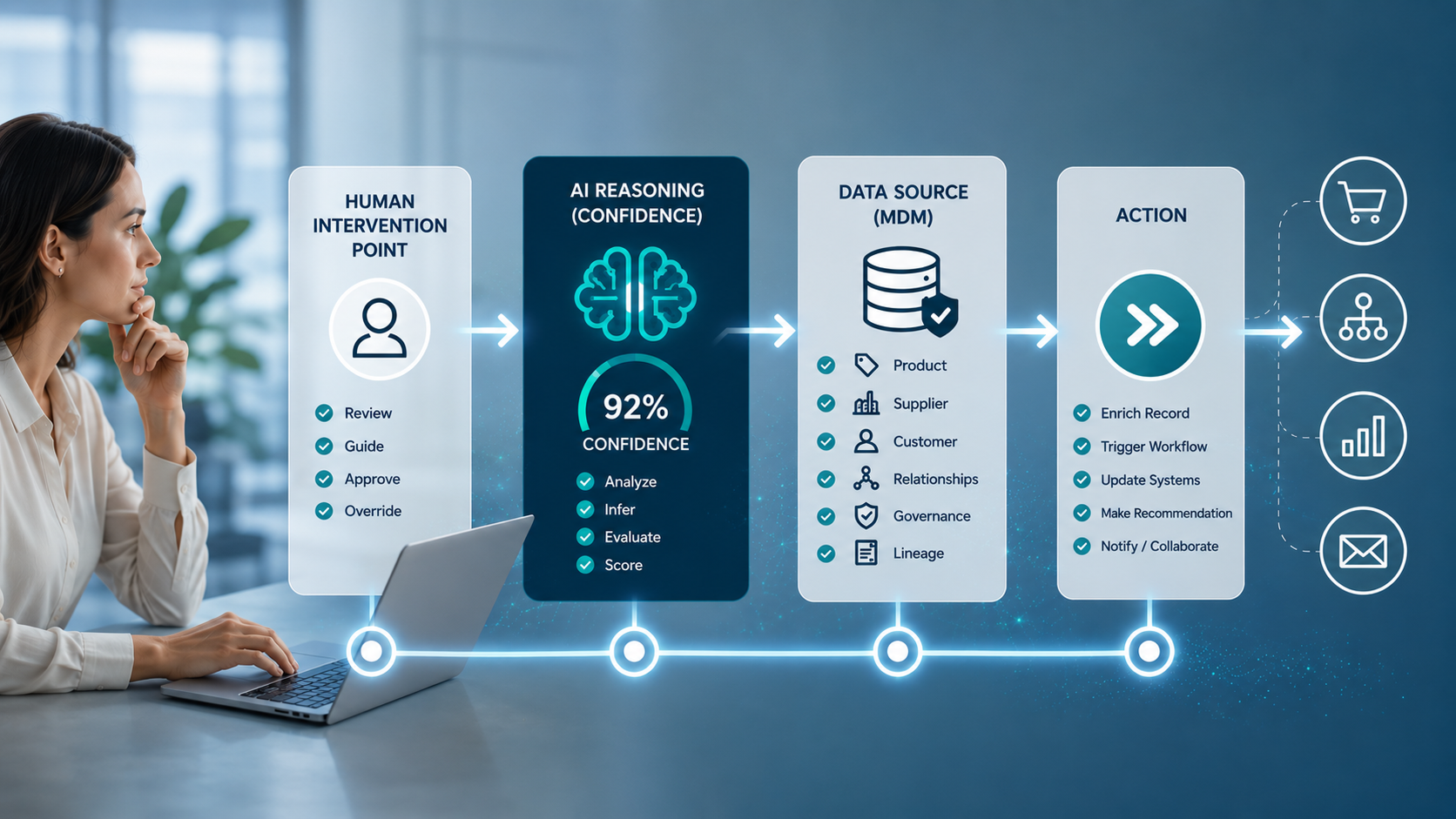
Governed intelligence is a layer of meaning on top of clean data that tells AI systems not just what the values are, but also:
- What they mean
- How they relate to everything else
- What rules apply
Without it, AI systems make confident decisions based on incomplete context.
This is essential knowledge in the AI age, so read on and learn the difference between clean data and governed data, and why it matters more than most organizations realize.
Why clean data and governed data are different problems
Data quality work solves a specific problem:
Are all systems using the same information consistently?
It means no duplicate records, null values or formatting errors. Customer ID 12345 refers to the same person across billing, shipping and customer service.
That's valuable. But it doesn't answer a different question: What does this data mean?
Your customer database can be perfectly clean and still contain no shared definition of what makes someone a customer. Is it an email address? A purchase history? An active subscription?
Without clarity, different systems interpret the same record differently – and AI systems inherit that ambiguity directly.
The distinction comes down to this:
- Data quality asks: "Is this value correct and consistent?"
- Governed data asks: "Does the AI know what this value means?"
They're related problems, but they need different solutions. You can't deduplicate your way to semantic clarity. Most organizations have spent years optimizing the first while leaving the second largely unaddressed.
That's where the AI failures happen.
The 4 capabilities governed intelligence adds that clean data can't
1. Semantic clarity
Clean data tells your systems what values exist. Semantic clarity tells them what those values mean in your business context.
A product record with a lifecycle stage of "declining" means something specific, like “don't prioritize it in recommendations” or “don't commit new supplier contracts against it.” Or a customer status of "dormant" means something different to your billing system than to your marketing system.
Semantic clarity makes those definitions explicit and machine-readable, so every system works from the same understanding.
2. Relationship governance
Entities don't exist in isolation. A product belongs to a category, comes from a supplier, carries compliance tags and sits at a particular point in its lifecycle. A customer has orders, preferences, a payment history and a regional profile.
Relationship governance makes those connections explicit.
Without it, AI systems see isolated records. With it, they see context.
3. Executable business rules
This is where AI systems can follow your business logic. Not just read your data, but act within your constraints.
In real life that could be, for example:
- Don't recommend products from suppliers with an inactive status
- Don't offer products outside a customer's permitted territory
- Flag any procurement order where supplier risk rating exceeds threshold
When a rule is violated, the system knows exactly why. And when a decision is made correctly, you can trace exactly which rules governed it.
4. Provenance and lineage
Every value has a history. Where did it come from? When was it last updated? How confident are we in it?
That’s important, because AI decisions are only as trustworthy as their inputs. When something goes wrong – and eventually something will – provenance tells you which data fed the decision, which system owned it, and where the gap was.
That's what turns a one-off fix into a permanent improvement.
What governed intelligence looks like when it's properly in place
Let’s look at an example:
- A customer browses office chairs. A recommendation engine finds a matching product – same category, similar price. Clean logic and clean data.
- Without governance, the recommendation goes out. The product comes from a supplier the company stopped working with six months ago. The record is valid, nothing's wrong with it, but there's no flag that says "inactive."
- The customer orders. Waits weeks, but it never ships.
With governance in place, the same query runs differently. Before the recommendation surfaces, the engine checks:
- Is the supplier active?
- Is the product available in the customer's region?
- Does available inventory mean ready-to-ship, or are units on hold or damaged?
The answer to the first question is no. The recommendation doesn't go out.
The immediate win
The immediate win is that a failure doesn't happen.
The massive, big-picture win
The bigger change is what happens when something does go wrong. Without governance, the team digs in, finds the data gap, fixes it manually and waits for the next failure from a different angle. The same firefighting loop, indefinitely.
With governance, a failed decision points to a specific gap. Supplier status wasn't current.
- Fix it systematically
- Add a rule that checks before every recommendation
- Monitor for drift
The AI gets more reliable over time – not because the algorithm changed, but because the governance improved.
How Stibo Systems helps you get there
Governed intelligence is a capability that needs to be built deliberately across your whole data infrastructure. STEP, our trusted intelligence platform, is designed to do exactly that.
- Governed product and supplier data keeps inactive relationships from surfacing in AI recommendations before any damage is done
- Semantic product master data keeps territorial restrictions, inventory state and pricing context attached to every record agents touch
- A governed customer 360 keeps conflicting definitions of active, dormant and at-risk from confusing your customer-facing agents
- Supplier master data with enforced rules keeps high-risk or non-compliant suppliers out of autonomous procurement decisions
- Full data lineage and rule traceability keeps your team able to explain exactly which data and rules drove any AI decision
- A governed data foundation keeps each new AI initiative from starting at zero – so production timelines shrink with every deployment
- Consistent intelligence across applications, workflows and agents keeps your enterprise from making different decisions with the same data
If your AI projects are stalling in production, the gap is rarely the algorithm. Start with the data it's reasoning from.