

Most enterprise data quality programs were not built with AI agents in mind. They were built to produce accurate reports and reliable inputs for human decision-makers.
AI agents make their own decisions.
And the data standard they require is categorically higher than the one your reporting infrastructure was designed to meet.
This is similar to athletes having training zones. The training effort for a local competition will not take you to the Olympics. With higher stakes come higher standards. Data works the same way.
So, what do you need to compete? These are the five standards your data needs to meet.
1. Consistent data across every system an agent relies on
When a human analyst spots an inconsistency between systems, it becomes a conversation. Someone investigates and a judgment call gets made. There is a human in the loop who can absorb that friction.
An AI agent has no such buffer.
It acts on what it finds. If what it finds in one system contradicts what sits in another, it could just continue. The decision it makes downstream reflects the inconsistency, and there's no guarantee anyone catches it before the error propagates further.
Your data may be completely accurate within each individual system. But it also has to stay consistent across them at the moment an agent needs it and across:
- Your product records
- Your customer data
- Your supplier information
- Your location data
All of them, at the same time.
2. Domain relationships structured for agents to follow
Reporting tools are built to work within boundaries.
- A sales dashboard draws on customer data
- A supply chain report pulls from supplier records
Each is designed for its domain. And it works because a human is making the connections between them.
Agents do not work that way. A single agent workflow might move from a customer record to a related product, then to the supplier behind it, then to a compliance rule that governs the transaction.
That chain only holds if the relationships between domains are explicit, governed and traversable without the agent hitting a dead end. Or even worse: filling the gap with an assumption.
Most enterprise data environments were not built for that kind of traversal. The domains exist, but often, not the relationships. At least not in a form an agent can follow without human intervention.
3. Semantic context that agents can interpret without human input
Retrieving data and understanding it are not the same thing. A reporting tool pulls a value and presents it – the human on the other end decides what it means.
An agent has to make that call itself, in the moment.
Enterprise data is rarely as unambiguous as it looks. For example, a product categorized differently across two markets, or a customer record where the account name does not match the legal entity. A human analyst would pause on either of those.
An agent has no reason to. It will proceed on whatever interpretation the data allows, unless something in its design has told it to stop.
Semantic context is what changes that.
- Metadata
- Relationships
- Definitions
These are embedded in the data itself, giving an agent something to work with beyond the raw value in a field.
4. End-to-end lineage that makes every agent decision traceable
When a human makes a decision, there is usually a trail. An email, a meeting or a document that explains the reasoning.
It is the same principle as when elite athletes log their training. Every session, every variable – every outcome tracked and stored. Only then can they improve with certainty and full control.
Agent decision-making works the same way. When an agent acts, that trail only exists if the data infrastructure was built to create it.
Agents operate at a speed and scale that makes manual oversight impossible. A single automated workflow can trigger hundreds of downstream actions before anyone has reviewed the first one.
That is not a problem if every decision is traceable. But it becomes a serious one when something goes wrong and your team needs to understand why – and the data path behind the decision simply does not exist.
Lineage needs to be structural, built into how your data is managed from the ground up. Every input an agent acted on, and every output it produced. All of it is reconstructible, without you having to go looking for evidence after the fact.
5. Built-in governance that agents carry with them everywhere
Governance applied after an agent has acted isn’t really governance. Then it’s damage control.
Most enterprise governance frameworks were designed around human workflows. There, a person can be trained, reminded or stopped before a decision gets made.
Agents move fast across systems and domains. They still need checkpoints, but governance built for how people work won't hold for how agents work. It has to be built around the agent, not the other way around.
For governance to hold in an agentic environment, it has to be embedded in the data itself. Enforced through the structure of how data is managed, rather than through a separate process running alongside agent workflows.
When your governance is structural, your agents carry it with them as they work. The rules travel with the data, instead of with the person overseeing it.
Where does your enterprise data sit on the readiness scale?
Not all enterprise data is trained for the same workload. Like an athlete who has built enough fitness to complete a race but not enough to compete in one, most enterprise data has been conditioned for a specific level of demand.
And that level is rarely the one AI agents need to succeed.
There are three distinct zones:
Zone 1: Record-keeping
Transaction data. Accurate enough to log what happened, not structured for anything beyond that.
Zone 2: Reporting
The standard most enterprises have reached. Fit for dashboards and BI, reliable enough for human analysts to draw conclusions from. Most AI initiatives launch assuming Zone 2 is sufficient.
Zone 3: Autonomous decision-making
The standard agents require. Consistent across systems, semantically rich, fully traceable and governed by default.
The gap between Zone 2 and Zone 3 is where most agent deployments run into trouble. That’s where the five standards above become the diagnostic.
How to get to agent-grade data with Stibo Systems
Reaching Zone 3 is a progression, and the sequence in which you build matters as much as what you build.
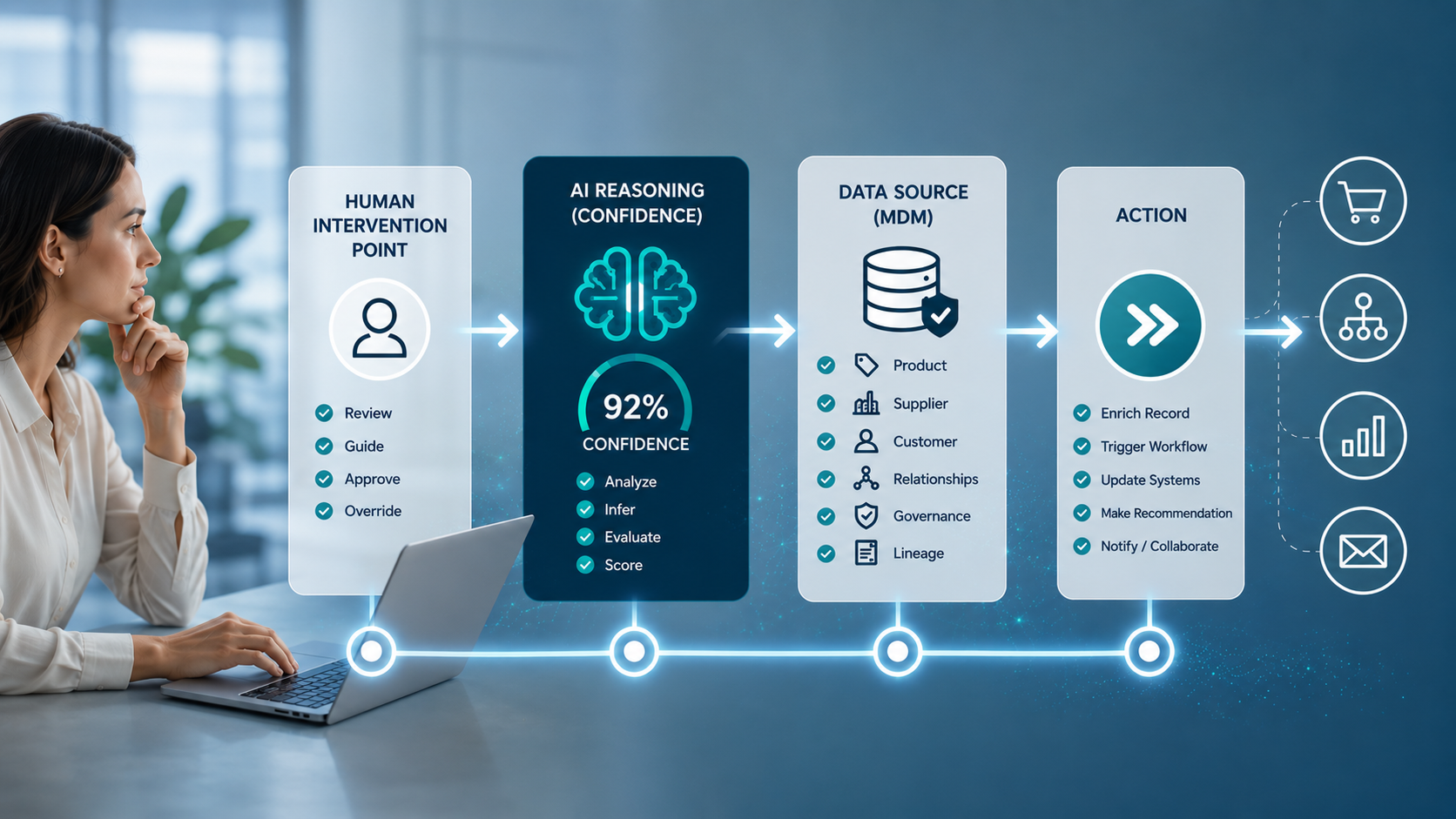
At Stibo Systems, we structure that progression through STEP, our trusted intelligence platform. As a multidomain MDM platform, it’s designed to bring all four data domains up to the standard agents require:
- Product
- Customer / Business partner
- Supplier
- Location
When data is mastered across domains, agents have the governance foundation they need built in. One version of the truth, not a rulebook layered on afterward.
Semantic context, cross-domain relationships and full lineage are built into the very architecture.
You get data that agents can act on independently, with the traceability and guardrails that autonomous decision-making demands.
Frequently asked questions
What is the difference between clean data and agent-grade data?
Data can be clean and still fall short of agent-grade.
Why do AI agents need different data standards than reporting tools?
How do you know if your data is ready for AI agents?
Gaps in any of these indicate the data is reporting-grade rather than agent-grade.