

Artificial intelligence is entering a new operational phase, and many enterprises may be moving faster than their foundations can support.
Over the past two years, organizations have focused heavily on generative AI models, copilots, and productivity gains. But the next wave of enterprise AI is fundamentally different. Agentic AI systems are beginning to automate workflows, orchestrate decisions, trigger downstream actions, and interact across enterprise systems with increasing autonomy.
That changes what enterprise leaders need from their data foundations.
The question is no longer simply whether AI can generate insights. The more important question is whether AI truly understands the business context behind the data it consumes.
Without that context, organizations risk scaling inconsistency and operational complexity across enterprise systems and customer experiences.
A question increasingly raised by enterprise leaders is:
“Why doesn’t ChatGPT recommend our products when customers search within our category?”
The answer often comes down to the quality, consistency, and trustworthiness of the enterprise data behind AI systems.
As AI agents begin making recommendations and decisions on behalf of users and organizations, trusted business context becomes increasingly important.
I recently had the opportunity to sit down with Roy Hasson, Sr. Director of Product for Microsoft Fabric, to explore why trusted business context is becoming foundational for enterprise AI readiness and long-term scalability as part of a podcast on agentic AI.
In this conversation, you’ll learn:
-
New challenges for CIOs when shifting their focus from generative AI to agentic AI
-
What “business context” actually means for AI systems
-
Why master data management is becoming critical for AI readiness
-
How AI agents rely on trusted relationships between data entities
-
What enterprise leaders should consider before scaling AI agents
The enterprise AI challenge is no longer about data volume
Most large enterprises already have more data than they can effectively manage. So, they turn to AI.
The real challenge is that business meaning is fragmented across systems, teams, and workflows.
Customer records differ between applications. Product definitions vary by region or business unit. Supplier relationships, operational rules, and compliance requirements often live across disconnected systems with inconsistent governance models.
Humans can usually compensate for these inconsistencies through experience and institutional knowledge.
AI agents cannot. Not without context!
They need to understand how products relate to suppliers, how customers relate to regions, how policies relate to compliance requirements, and how operational rules apply across the enterprise.
Without a trusted business foundation, and a semantic data model, AI does not eliminate complexity. It amplifies it.
This is why leading organizations are shifting from asking:
-
“How advanced are our AI models?” to asking:
-
“Does our AI understand the business well enough to act safely and intelligently?”
That distinction is becoming increasingly important as enterprises move from experimentation into operational AI deployment.
Why trusted business context matters for AI agents
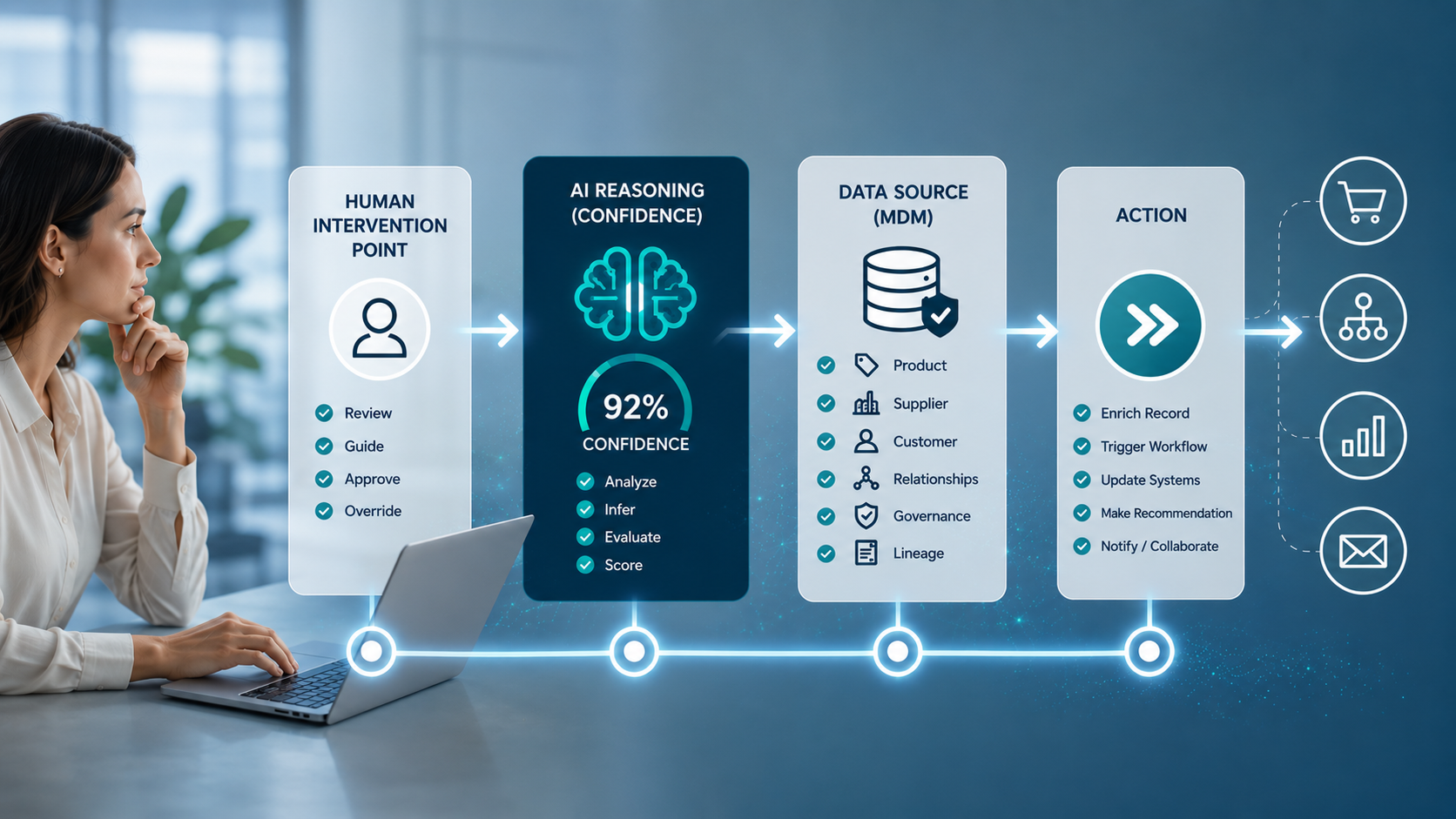
Traditional generative AI systems primarily supported human productivity. Agentic AI introduces a different level of responsibility because AI systems are beginning to take action on behalf of the organization.
AI agents may soon:
-
Automate workflow approvals
-
Recommend operational decisions
-
Coordinate across systems
-
Trigger downstream business processes
-
Orchestrate tasks between applications and teams
But autonomous systems are only effective when they operate from a trusted and governed business context.
If customer data is inconsistent, AI recommendations become inconsistent.
If product definitions differ between systems, AI-driven automation becomes unreliable.
If governance is fragmented, organizations may struggle to explain or trust AI-generated actions and decisions.
This is where master data management with a semantic data model becomes significantly more strategic.
Historically, many organizations viewed master data management as back-office IT hygiene. Today, it is evolving into a foundational capability for enterprise AI.
A trusted master data foundation creates a consistent representation of customers, products, suppliers, locations, and relationships across the organization. That foundation helps establish what many leaders now describe as a digital twin of the business.
For AI systems, that digital twin provides the business context required to reason consistently across enterprise environments.
AI agents depend on shared business context
As enterprises adopt AI agents across workflows and applications, trusted business context becomes increasingly important.
In the podcast, Hasson emphasized that the challenge is no longer simply about models or tooling. Technologies like Copilot, Copilot Studio, and Fabric Data Agents are making enterprise AI more accessible. The next challenge is ensuring AI systems have the right business context to make intelligent decisions.
AI agents rarely operate in isolation. One system may retrieve customer information, another may recommend actions, and another may support downstream operational processes. If those systems rely on inconsistent product definitions, fragmented customer records, or disconnected enterprise data, AI outcomes become less reliable.
This is why enterprise AI success depends on more than model selection alone.
Organizations preparing for agentic AI should prioritize:
-
Trusted business definitions
-
Connected enterprise data
-
Consistent customer and product information
-
Shared context across systems and workflows
-
Visibility into core business entities and relationships
As the discussion highlighted, the future of enterprise AI depends less on raw data volume and more on whether AI systems can understand how the business actually operates.
Three executive takeaways
-
Agentic AI changes the role of enterprise data: Unlike generative AI, AI agents take actions and make decisions. That makes trusted enterprise data increasingly important.
-
Trusted business context helps AI make smarter decisions: As discussed by Microsoft and Stibo Systems, AI systems need more than models alone. They need accurate, contextual business data to operate effectively.
-
Master data management helps create the foundation for scalable AI: Consistent customer, product, supplier, and operational data helps AI systems reason more reliably across enterprise workflows and experiences.
The next phase of enterprise AI transformation will not be defined solely by bigger models or faster automation.
It will be defined by whether enterprises create the trusted business foundation required for AI to operate responsibly, consistently, and intelligently at scale.
That is why the conversation around AI is shifting from data quantity to business understanding.
Because ultimately, AI can only act as intelligently as the foundation beneath it.
Learn more
Hear perspectives from Microsoft and Stibo Systems on why trusted, contextual enterprise data is becoming increasingly important for agentic AI and business-ready AI experiences.