

Blog Post April 20, 2026 | 6 minutes read

5 Product Data Problems That Make Your Brand Invisible in AI Search

Discover 5 product data problems that make your brand invisible in AI search – and how to fix them to stay competitive.

Be the brand AI recommends

Learn more about AI visibility

Explore this article with AI

5 Product Data Problems That Make Your Brand Invisible in AI Search

Master Data Management Blog by Stibo Systems logo
| 6 minutes read
April 20 2026
5 Product Data Problems That Make Your Brand Invisible in AI Search
9:54

Your customers are asking AI to find products like yours. But when AI can't find trustworthy product data, it recommends your competitors instead – or skips you entirely.

AI systems evaluate whether your product information is complete, consistent and accurate before they decide to recommend you.

Most brands haven't updated their data infrastructure for this reality. So now is a great time to take the lead in your industry.

The difference between being recommended and being invisible comes down to five specific data problems you probably have right now.

In this blog post I will walk you through all five, why fixing them matters for your revenue – and of course how to fix them.

But first, we need to set the scene.

Your customers are outsourcing a lot of the decisions

When customers used search engines, they did the filtering.

  • Compared options

  • Read reviews

  • Visited websites...

They made the decision themselves. You just needed to show up in the results.

With AI, your customers hand off the decision to a machine. More and more, they ask:

"What's the best wireless speaker under $200" and accept what AI recommends. They don't dig deeper. And they don't visit your site unless AI suggests it first.

The AI assumes the responsibility. So, now your data has to convince the machine, not the person.

And machines evaluate data differently than people do. They don't care about persuasive copy. They care about completeness, consistency, accuracy – the qualities that scream of trustworthiness.

When you compete for human attention, your best product wins. When you compete for AI recommendation, your best data wins.

Data governance used to be back-office. Now it impacts revenue.

Data governance lived in IT. Compliance checklists. Data quality rules. Nobody in sales cared because it didn't affect visibility or traffic.

Search engines didn't demand perfect data – they just indexed whatever existed.

AI systems demand a different approach. They deprioritize sources with incomplete or inconsistent data. Poor quality looks bad. But now it also costs you recommendations. Discovery. Real revenue.

The 5 data problems keeping AI from recommending you

1. Incomplete data means AI can't confidently recommend you

Your product specs have gaps. Critical attributes are missing – dimensions you didn't capture, compatibility details you never documented, performance metrics you assumed were obvious...

When AI evaluates your product against competitors, it really pays attention.

Incomplete data signals uncertainty. AI systems exclude products with missing information from comparisons because they can't confidently evaluate them against alternatives. If you're not in the comparison, you're not getting recommended.

Content won't fix this. Better marketing copy doesn't fill data gaps. Only complete product information does.

2. Inconsistent data across channels makes AI doubt your brand

The same product is described differently across your website, your marketplace listings and your regional sites.

  • One channel lists width × depth × height in inches, another in centimeters – and the conversions don't align.

  • Your website says "100% polyester," but your retail partner's listing says "polyester blend" without specifying percentages.

  • Your ecommerce platform shows "in stock," while your marketplace listing shows "limited availability" or "pre-order."

Inconsistency signals unreliability. And systems actively deprioritize sources they can't trust, which means your products get pushed down in recommendations. Or excluded all together.

The customer and AI would agree on this one: How can you trust a brand when its own data contradicts itself?

3. Without semantic context, AI can't explain why your product is the best choice

You have the specs. Weight, dimensions, certifications, materials...

But what you don't have is the relationships and context that explain:

  • When to use your product

  • Which problems it solves

  • Which industries benefit most

  • Why a customer should choose you over alternatives. AI can recite specifications. But it can't explain why without context.

Without use-case clarity, your products become interchangeable. Just another option with similar specs.

AI has no reason to recommend you specifically.

Semantic richness – the connections between data that create meaning – separates differentiated products from commodities. Without it, even your superior product looks generic to AI systems.

4. AI actively avoids low-quality data sources

Data quality problems compound. Typos in product names, outdated specifications, duplicate entries, and validation gaps that let basic errors slip through to customers and AI systems.

And AI systems actively deprioritize sources with inconsistent, error-prone information.

Because low quality correlates with untrustworthiness. The way AI reasons, if your data has mistakes, other aspects of your brand reliability come into question.

Your competitors with cleaner data get higher placement in recommendations. You get filtered out.

5. When you take too long to enrich new products, AI moves on

New products sit in your system incomplete.

  • Specs missing

  • Descriptions not finalized

  • Categorization pending

By the time you've enriched the data to acceptable standards, AI has already indexed the incomplete version. And it has marked your brand as low quality based on that snapshot.

AI systems form impressions at lightning speed.

And once they've indexed incomplete or inaccurate information about your products, recovering from that assessment is hard. The damage compounds over time as AI continues to deprioritize you.

Together, all these problems signal to AI: "don't recommend this brand"

These failures don't exist in isolation. Incomplete data, combined with a lack of contextual richness, combined with poor quality across channels, creates a cumulative message to AI systems: “Unreliable, untrustworthy, not worth recommending.”

AI doesn't evaluate problems one at a time. It aggregates signals.

Missing specs + contradictory information + typos = a brand that doesn't deserve visibility. Each problem reinforces the others, making your overall data profile look worse.

One data gap is fixable. Five systemic problems are a verdict.

How to make your product data ready for AI

For AI-ready data, you need consistent governance across all your channels and systems. One source of truth for product information. Not fragmented across websites, marketplaces, regional platforms and internal databases.

Trustworthiness is the foundation.

  • Complete product attributes

  • Consistent descriptions everywhere

  • Accurate specifications

  • Semantic context that explains use cases and differentiation

  • Data quality rules that catch errors before they reach customers or AI systems

Not exactly something you layer on top of your existing infrastructure.

You need a data foundation built specifically for this. One that enforces consistency at scale and keeps product information current across every channel where AI systems find it.

Solving all this with Product Experience Data Cloud

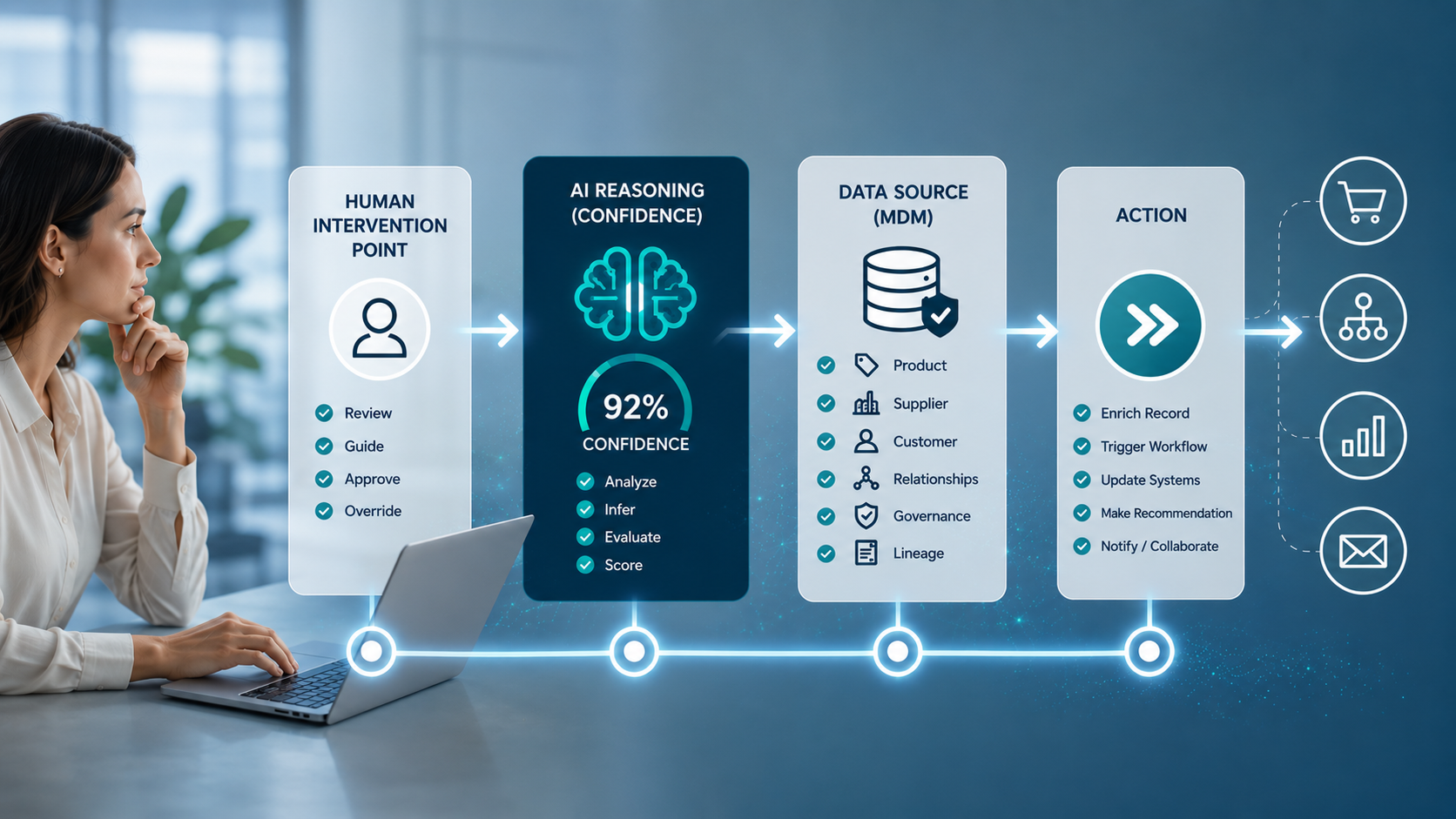
At Stibo Systems, our Product Experience Data Cloud centralizes all your product information into one governed source of truth.

  • Every attribute is accurate, complete and consistent – and automatically enforced across all channels

  • Automated quality rules validate data before it reaches customers or AI systems

  • Missing attributes get flagged. Inconsistencies surface immediately. Typos and outdated information are caught before they damage your trustworthiness signal

Speed matters. New products move through enrichment faster, so they’re getting indexed by AI systems while your data is still authoritative. And before competitors fill the gap.

One foundation powers everything. Answer engine optimization, personalization, conversational commerce... You don’t need to build separate data infrastructure for each downstream AI use case. You're building the trusted data foundation once, then using it everywhere.

Semantic richness adds the context AI needs to differentiate you – use cases, relationships between products and application scenarios. You know, that information that transforms specs into recommendations.

What happens next is up to you

AI systems now decide which products get discovered. You can't change this, but you can decide whether your data infrastructure is ready for it.

Every day without AI-ready data costs you discovery.

Your competitors who've fixed their data foundation are getting recommended. You're getting filtered out. The longer you wait, the harder it becomes to recover from AI's assessment of your brand.

In this blog post I outlined five data problems:

  • Incomplete specs

  • Inconsistency

  • Missing context

  • Poor quality

  • Slow enrichment

These are all widespread. Most brands have all five. But they're also all fixable with the right infrastructure and governance approach.

Answer engine optimization isn't a new channel to manage, rather, it's a consequence of how you manage your data. The five problems in this post are the default state for most brands, and AI systems are already penalizing them for it. The good news is that fixing them doesn't require a separate AEO strategy. It requires the same thing every AI use case requires: a single, governed source of truth for your product information.

Brands that show up consistently in AI-generated recommendations share one thing: product data that AI systems can evaluate with confidence. Product Experience Data Cloud builds that capability at the scale your brand requires.

FAQs

How do I know if my product data has the five problems you mentioned?

Start with your most important product categories. Open an AI tool like ChatGPT, Perplexity, or Gemini and search for product recommendations in your category. If your brand isn’t showing up, it’s very likely that your data is already being filtered out. Then, check if the same product is described identically across your website, marketplace listings, and regional sites. Look for missing specs that competitors have. Time how long it takes to create a new product from initial onboarding to full market readiness. These audits reveal which problems are most severe.

Does centralizing data really improve AI recommendations, or is it just best practice?

It directly improves recommendations. AI systems are more likely to cite and recommend brands with governed, centralized data because consistency and completeness signal trustworthiness. Brands that move first with clean data infrastructure see measurable improvements in AI mentions within months.

What's the difference between fixing data quality and building an AI-ready foundation?

Data quality fixes individual errors – catching typos, validating specs. An AI-ready foundation prevents problems systematically. It enforces consistency across channels before data goes live, automates quality validation and adds semantic context that AI needs to differentiate you. One is reactive; the other is preventive at scale.

How much product data do I need for AI to recommend me?

Completeness varies by industry and product type, but AI systems need enough attributes to confidently evaluate your products against alternatives. The exact threshold depends on your category, but the pattern is consistent: more complete data = higher recommendation likelihood.

If I fix my data, how long before AI systems notice?

AI systems continuously re-index and re-evaluate sources. Improvements in data quality can shift AI behavior within weeks, though it depends on how frequently systems crawl your data sources. Early improvements in trustworthiness signals compound over time.

Can I do this without replacing my entire data infrastructure?

Not entirely. You need a centralized governance layer that can enforce consistency across your existing systems and channels. A full replacement isn't necessary, but you do need infrastructure designed specifically for multi-channel data governance – not patches on fragmented systems.


Master Data Management Blog by Stibo Systems logo

Fueled by curiosity and cafecitos, Calianne helps organizations go to market with product strategies that deliver impact and drive competitive advantage. With global experience in enterprise data management organizations, she specializes in translating complex technologies into clear, compelling business value.

Discover blogs by topic

  • See more
  • MDM strategy
  • Data governance
  • Retail
  • Customer and party data
  • Data quality
  • Product data and PIM
  • AI and machine learning
  • Manufacturing
  • Product Experience Data Cloud
  • Supplier data
  • Consumer packaged goods
  • Customer experience and loyalty
  • Data compliance
  • Sustainability
  • Data integration
  • Financial services
  • Compliance and risk management
  • Operational efficiency
  • Customer Experience Data Cloud
  • Location data
  • Product data syndication
  • Multidomain data
  • Product onboarding
  • Supplier Data Cloud
  • Business Partner Data Cloud
  • ERP success
  • Life sciences
  • Location Data Cloud
  • Automotive
  • Data modeling
  • Data sourcing
  • Digital asset management
  • Platform
  • Translation and localization
  • Data delivery
  • Data sharing
  • Digital shelf analytics
  • Enhanced content
April 20, 2026

5 Product Data Problems That Make Your Brand Invisible in AI Search

March 9, 2026

Master Data Meets Microsoft Fabric: Building a Trusted Foundation for AI and Analytics

February 24, 2026

BIC's Blueprint for Conquering Complex Global Product Data Challenges

February 17, 2026

Product 360 After the Salesforce Acquisition: Why You Need to Map Out a Plan B

January 27, 2026

5 Hidden Costs of Bad Customer Data in Retail (and How to Avoid Them)

January 20, 2026

What is the difference between CPG and FMCG?

January 13, 2026

Discover the Value of Your Data: Master Data Management KPIs & Metrics

January 13, 2026

Solving Retail Data Fragmentation: The Key to Consistent Customer Journeys

January 12, 2026

What is master data management? A complete and concise answer

January 5, 2026

What is a Data Domain? Meaning & Examples

January 2, 2026

Data Migration to SAP S/4HANA ERP: The Fast and Safe Approach with MDM

December 15, 2025

The Difference Between Master Data and Metadata

December 10, 2025

Is Your PIM Strategy Future-Ready? 3 Takeaways from the SPARK Matrix™ Report

December 9, 2025

Master Data Management Roles and Responsibilities

December 9, 2025

The Future of Master Data Management: Trends in 2026

December 9, 2025

Product Listing Page Best Practices: How to Create Better Product Listings with PIM

December 8, 2025

The Board of Directors’ Guide to Selecting Product Experience Software (With Checklist)

December 5, 2025

5 PIM Trends That Will Define 2026 and the Near Future (And How to Prepare for Them)

December 4, 2025

Process Insurance Claims Faster with Trusted Data

December 4, 2025

10 Dangerous Myths About Managing Your B2B Partner and Account Data

December 3, 2025

Fixing Fragmented Customer Account Data: Stop Losing Revenue and Trust

December 2, 2025

A Quick Guide to Golden Customer Records and How to Create Them with Master Data Management

December 2, 2025

How Master Data Management Keeps Manufacturers Compliant — From Design to Delivery

November 20, 2025

What is Manufacturing-as-a-Service (MaaS)?

November 18, 2025

AI in Retail: How to Make Your Data Ready to Use in Microsoft Fabric

November 17, 2025

What is Party Data? All You Need to Know About Party Data Management

November 10, 2025

A Complete Master Data Management Glossary

November 4, 2025

Consumers are Using AI-Powered Tools to Shop Smarter: Why Retail Data Trust Matters More than Ever

October 29, 2025

CDP and MDM: Complementary Forces for Enhancing the Customer Experience

October 27, 2025

How to Estimate ROI of Master Data Management

October 24, 2025

Model Context Protocol (MCP): The Missing Layer for AI Systems That Interact with Enterprise Data

October 20, 2025

Managing Product Complexity: Leveraging Custom Product Management with BOM-Level Precision

October 2, 2025

How CPG Brands Scale D2C Business Without Breaking What Already Works

September 24, 2025

How Leading Brands Built Trusted Data with Amplifi and Stibo Systems

September 11, 2025

Is Your Data the Cause of Flawed AI Outputs?

September 8, 2025

What’s Next for GenAI in Product Experiences?

August 27, 2025

PIM and MDM: Key Differences, Benefits and How They Work Together

August 13, 2025

The 5 Biggest Retail Trends in 2026

August 12, 2025

From Zero to Launch in Under 6 Months: A Quick Guide to Deploying Master Data Management

August 12, 2025

5 CPG Industry Trends and Opportunities for 2026

August 5, 2025

How Operations Leaders are Modernizing Manufacturing Data Without Halting Production

August 4, 2025

Digital Product Passports: The Data Management Mandate

August 1, 2025

How to Improve Back-End Systems Using Master Data Management

July 14, 2025

Product Attribution Strategies That Convert Searchers into Buyers

July 9, 2025

How to Get More Value from Your Data: The Benefits of Master Data Management

July 4, 2025

The Complete PIM Features Guide: The Capabilities You Need for Successful Data Strategies

June 26, 2025

PIM explained: How Product Information Management transforms data quality

June 12, 2025

Better Together: CRM and Customer Master Data Management

June 11, 2025

How CPG Сompany Bonduelle Сentralized Product Data Across 37 Countries

June 10, 2025

Master Data Management Tools: A Complete Guide

May 23, 2025

How Signet Jewelers Built Trust in Its Retail Data

May 12, 2025

Manufacturing Trends and Insights in 2026

April 15, 2025

5 Key Trends in Product Experience Management

April 4, 2025

Trust the Machine: Making AI Automation Reliable in Master Data Management

April 2, 2025

How Agentic Workflows Are Changing Master Data Management at the Core

March 17, 2025

What is Smart Manufacturing and Why Does it Matter?

March 11, 2025

How to Implement Master Data Management: Steps and Challenges

March 7, 2025

MDM and AI: Real-World Use Cases and Learnings From OfficeMax and Motion Industries

February 27, 2025

Reyes Holdings' MDM Journey to Better Data

February 3, 2025

8 Best Practices for Customer Master Data Management

February 3, 2025

4 Trends in the Automotive Industry

January 29, 2025

How to Choose the Right Data Quality Tool?

January 28, 2025

AI Adoption: A High-Stakes Gamble for Business Leaders

January 27, 2025

All You Need to Know About Supplier Information Management

January 27, 2025

How Kramp Optimizes Internal Efficiency with Data Strategy

January 27, 2025

From Patchwork to Precision: Moving Beyond Outdated and Layered ERP Systems

January 24, 2025

Thriving Beyond NRF 2025 with Trustworthy Product Data

January 23, 2025

Building the Future of Construction with AI and MDM

January 17, 2025

Why Addressing Data Complexity in Pharmaceutical Manufacturing Is Critical

January 17, 2025

How URBN Leverages Data Management to Support Its Sustainability Information  

January 14, 2025

An Introductory Guide to Supplier Compliance

January 6, 2025

How to Avoid Bad Retail Customer Data

December 17, 2024

How to Implement Data Governance

December 11, 2024

Gen Z: Seeking Excitement Beyond Amazon

December 10, 2024

A Modern Guide to Data Quality Monitoring: Best Practices

December 9, 2024

What is Supply Chain Analytics and Why It's Important

December 5, 2024

What is Supplier Lifecycle Management?

December 3, 2024

Using Machine Learning and MDM CBAM for Sustainability Compliance

November 25, 2024

AAPEX and SEMA: The Automotive Aftermarket Industry’s Mega-Showcase

October 22, 2024

Live Shopping: How to Leverage Product Information for Maximum Impact

October 16, 2024

Why Data Accuracy Matters for CPG Brands

October 15, 2024

Why Choose a Cloud-Based Data Solution: On-Premise vs. Cloud

September 23, 2024

How Master Data Management Can Enhance Your ERP Solution

September 20, 2024

Navigating Change: Engaging Business Users in Successful Change Management

September 11, 2024

What is Digital Asset Management?

September 3, 2024

How to Improve Your Data Management

August 30, 2024

Digital Transformation in the CPG Industry

August 27, 2024

Responsible AI Relies on Data Governance

August 19, 2024

Making Master Data Accessible: What is Data as a Service (DaaS)?

August 15, 2024

6 Features of an Effective Master Data Management Solution

August 13, 2024

Great Data Minds: The Unsung Heros Behind Effective Data Management

August 6, 2024

A Data Monetization Strategy - Get More Value from Your Master Data

August 4, 2024

Introducing the Master Data Management Maturity Model

July 31, 2024

What is Augmented Data Management? (ADM)

July 17, 2024

GDPR Data Governance and Data Protection, a Match Made in Heaven?

May 12, 2024

What Is Master Data Governance – And Why Do You Need It?

April 11, 2024

Guide: Deliver flawless rich content experiences with master data governance

April 10, 2024

Risks of Using LLMs in Your Business – What Does OWASP Have to Say?

April 9, 2024

Guide: How to comply with industry standards using master data governance

April 2, 2024

Guide: Get enterprise data enrichment right with master data governance

April 2, 2024

Guide: Getting enterprise data modelling right with master data governance

April 2, 2024

Guide: Improving your data quality with master data governance

March 25, 2024

How to Get Rid of Customer Duplicates

March 18, 2024

5 Tips for Driving a Centralized Data Management Strategy

March 18, 2024

What is Application Data Management and How Does It Differ From MDM?

February 20, 2024

5 Key Manufacturing Challenges in 2025

February 20, 2024

How to Enable a Single Source of Truth with Master Data Management

February 12, 2024

What is Data Quality and Why It's Important

February 7, 2024

Data Governance Trends 2026

February 6, 2024

What is Data Compliance? An Introductory Guide

January 18, 2024

How to Build a Master Data Management Strategy

January 16, 2024

The Best Data Governance Tools You Need to Know About

January 15, 2024

How to Choose the Right Master Data Management Solution

December 19, 2023

Building Supply Chain Resilience: Strategies & Examples

November 29, 2023

Shedding Light on Climate Accountability and Traceability in Retail

November 13, 2023

Location Analytics – All You Need to Know

October 16, 2023

Understanding the Role of a Chief Data Officer

October 5, 2023

5 Common Reasons Why Manufacturers Fail at Digital Transformation

September 29, 2023

How to Digitally Transform a Restaurant Chain

September 14, 2023

Three Benefits of Moving to Headless Commerce and the Role of a Modern PIM

July 6, 2023

12 Steps to a Successful Omnichannel and Unified Commerce

June 28, 2023

Navigating the Current Challenges of Supply Chain Management

April 6, 2023

Product Data Management during Mergers and Acquisitions

March 1, 2023

Asset Data Governance is Central for Asset Management

February 21, 2023

4 Common Master Data Management Implementation Styles

February 14, 2023

How to Leverage Internet of Things with Master Data Management

February 13, 2023

Sustainability in Retail Needs Governed Data

January 4, 2023

Innovation in Retail

November 21, 2022

Life Cycle Assessment Scoring for Food Products

November 14, 2022

Retail of the Future

November 7, 2022

Omnichannel Strategies for Retail

November 5, 2022

Hyper-Personalized Customer Experiences Need Multidomain MDM

October 25, 2022

What is Omnichannel Retailing and What is the Role of Data Management?

October 18, 2022

Most Common ISO Standards in the Manufacturing Industry

October 17, 2022

How to Get Started with Master Data Management: 5 Steps to Consider

October 1, 2022

An Introductory Guide: What is Data Intelligence?

September 15, 2022

Revolutionizing Manufacturing: 5 Must-Have SaaS Systems for Success

August 25, 2022

Digital Transformation in the Manufacturing Industry

August 17, 2022

Master Data Management Framework: Get Set for Success

June 15, 2022

Supplier Self-Service: Everything You Need to Know

June 14, 2022

Omnichannel vs. Multichannel: What’s the Difference?

June 10, 2022

Create a Culture of Data Transparency - Begin with a Solid Foundation

May 31, 2022

What is Location Intelligence?

May 30, 2022

Omnichannel Customer Experience: The Ultimate Guide

May 24, 2022

Omnichannel Commerce: Creating a Seamless Shopping Experience

May 11, 2022

Top 4 Data Management Trends in the Insurance Industry

May 1, 2022

What is Supply Chain Visibility and Why It's Important

April 21, 2022

The Ultimate Guide to Data Transparency

April 20, 2022

How Manufacturers Can Shift to Product as a Service Offerings

April 16, 2022

How to Check Your Enterprise Data Foundation

April 14, 2022

An Introductory Guide to Manufacturing Compliance

March 31, 2022

Multidomain MDM vs. Multiple Domain MDM

March 23, 2022

How to Build a Successful Data Governance Strategy

March 22, 2022

What is Unified Commerce? Key Advantages & Best Practices

March 17, 2022

6 Best Practices for Data Governance

March 16, 2022

5 Advantages of a Master Data Management System

February 24, 2022

Supply Chain Challenges in the CPG Industry

February 14, 2022

Top 5 Most Common Data Quality Issues

February 10, 2022

What Is Synthetic Data and Why It Needs Master Data Management

February 8, 2022

What is Cloud Master Data Management?

January 28, 2022

Build vs. Buy Master Data Management Software

January 27, 2022

Why is Data Governance Important?

January 24, 2022

Five Reasons Your Data Governance Initiative Could Fail

January 21, 2022

How to Turn Your Data Silos Into Zones of Insight

January 16, 2022

How to Improve Supplier Experience Management

January 16, 2022

​​How to Improve Supplier Onboarding

January 11, 2022

What is a Data Quality Framework?

January 4, 2022

The Ultimate Guide to Building a Data Governance Framework

December 20, 2021

The Dynamic Duo of Data Security and Data Governance

December 20, 2021

How to Choose the Right Supplier Management Solution

December 6, 2021

How Data Transparency Enables Sustainable Retailing

December 1, 2021

What is Supplier Performance Management?

November 7, 2021

The Complete Guide: How to Get a 360° Customer View

October 29, 2021

How Location Data Adds Value to Master Data Projects

October 15, 2021

What is a Data Mesh? A Simple Introduction

September 2, 2021

10 Signs You Need a Master Data Management Platform

August 31, 2021

What Vendor Data Is and Why It Matters to Manufacturers

August 25, 2021

3 Reasons High-Quality Supplier Data Can Benefit Any Organization

August 9, 2021

What is Reference Data and Reference Data Management?

July 25, 2021

GDPR as a Catalyst for Effective Data Governance

May 12, 2021

How to Become a Customer-Obsessed Brand

April 27, 2021

How to Create a Master Data Management Roadmap in Five Steps

April 13, 2021

What is a Data Catalog? Definition and Benefits

April 8, 2021

How to Improve the Retail Customer Experience with Data Management

March 25, 2021

Business Intelligence and Analytics: What's the Difference?

March 21, 2021

What is a Data Lake? Everything You Need to Know

February 24, 2021

Are you making decisions based on bad HCO/HCP information?

December 15, 2020

5 Trends in Telecom that Rely on Transparency of Master Data

November 19, 2020

10 Data Management Trends in Financial Services

October 29, 2020

What Is a Data Fabric and Why Do You Need It?

October 14, 2020

Transparent Product Information in Pharmaceutical Manufacturing

August 23, 2020

How Retailers Can Increase Online Sales in 2025

August 14, 2020

Master Data Management (MDM) & Big Data

August 9, 2020

Key Benefits of Knowing Your Customers

July 21, 2020

Customer Data in Corporate Banking Reveal New Opportunities

July 18, 2020

4 Ways Product Information Management (PIM) Improves the Customer Experience

July 1, 2020

How to Estimate the ROI of Your Customer Data

June 17, 2020

How to Personalise Insurance Solutions with MDM

May 25, 2020

How to Get Buy-In for a Master Data Management Solution

July 18, 2019

How to Improve Your Product's Time to Market With PDX Syndication