

In my last blog, I looked at a question I hear often from financial services organizations: “We already have Snowflake and Databricks, so why do we still need MDM?”
The answer is simple: Data platforms help organizations store, process, analyze, and use data. Master data management (MDM), on the other hand, helps make sure the data is trusted, governed, connected, and meaningful before it is used.
Or, to keep the football metaphor going from my previous blog, Snowflake and Databricks can give you the stadium, the performance analysis, and the tactics. MDM helps make sure everyone is playing from the same team sheet (while making sure the same left-back has not been entered three times under different names).
That is where the business value starts.
Where financial services data problems really live
In financial services, the biggest data problems are rarely just about access to data. They are about trust, consistency, and context.
- A bank may have customer data available in multiple platforms but still struggle to know whether two records are the same customer, which legal entity sits within which group, or whether product and account data is accurate enough to support onboarding, Know Your Customer (KYC), or credit decisions.
- An insurer may have data flowing into analytics platforms, but still struggle to connect policyholders, insured parties, brokers, claims, products, and households. That makes it harder to assess exposure, reduce claims leakage, manage distribution, evidence fair value, or deliver consistent service.
- A wealth or asset manager may have strong reporting and analytics capability, but still struggle to connect clients, households, advisers, portfolios, products, and legal entities. That weakens suitability, personalization, client reporting, and relationship management.
MDM as a value enabler
This is where MDM moves from being a data management discipline to a business-value enabler. That shift happens because MDM connects customer, product, and relationship data on one governed platform, rather than leaving each domain to manage its own version of the truth — and it shows up in five specific places:
Customer experience
MDM helps teams recognize the customer consistently across channels, products, and brands. That means fewer duplicate records, fewer repeated questions, and more relevant service.
In football terms, it’s the difference between recognizing your key player instantly and asking them to prove who they are every time they arrive at the training ground.
Onboarding and servicing
MDM helps create trusted customer, party, account, product, and relationship data. It reduces manual checks, accelerates approvals, and improves operational confidence.
Risk and compliance
MDM helps connect customers, counterparties, legal entities, policies, products, and hierarchies. It gives teams clearer visibility of exposure, ownership, eligibility, suitability, and regulatory accountability.
That traceability matters more as regulatory frameworks like DORA and Consumer Duty increasingly require firms to demonstrate — not just assert — the governance behind decisions that affect customers.
AI readiness
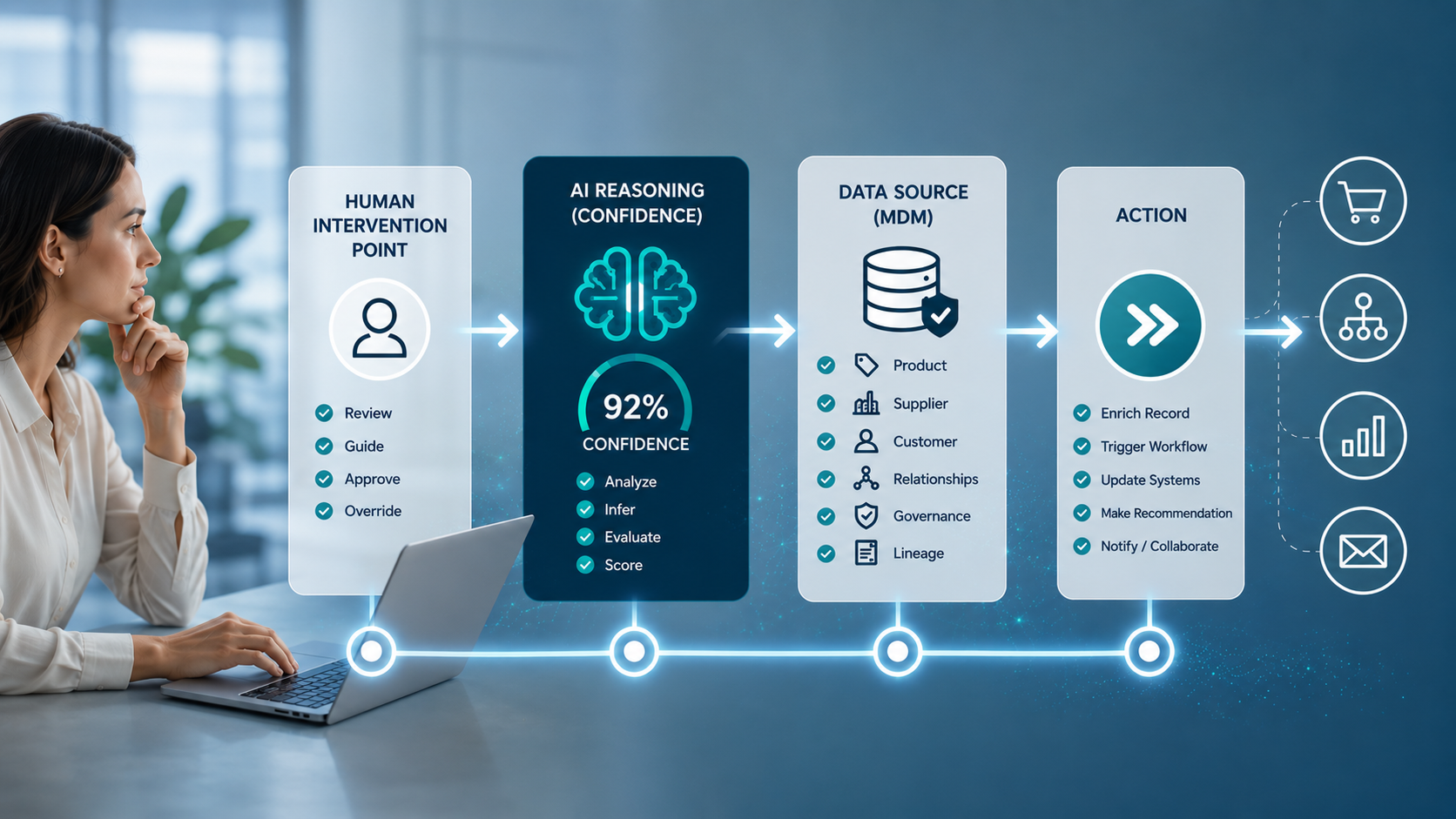
MDM provides the trusted context AI needs to produce better outcomes. AI models need to know which data is current, which record is authoritative, which relationships matter, and whether the data can be explained.
Growth
MDM helps organizations understand relationships more clearly: households, corporate groups, intermediaries, advisers, product holdings, and customer value. It creates better opportunities for personalization, cross-sell, retention, and smarter engagement.
The bottom line: Trusted data, better outcomes
With MDM, the business impact is practical:
- Better customer and client experience
- Faster onboarding and servicing
- Reduced duplication and manual reconciliation
- Stronger risk and regulatory confidence
- More reliable analytics and AI outcomes
- Clearer understanding of customer, product, and relationship value
This is why MDM still matters in modern data architecture like Snowflake or Databricks. It is there to make them more effective, not compete with them.
Snowflake can help scale access to data. Databricks can help turn data into analytics and AI. MDM provides the trusted data and business context that help those platforms produce more reliable, decision-ready intelligence.
Because in financial services, the winning team is not the one with the most data. It is the one that knows which data to trust.
FAQs
How does master data management improve customer experience in financial services?
MDM helps firms recognize the same customer consistently across channels, products, and brands — cutting down on duplicate records, repeated questions, and friction for the customer.
How does MDM help with onboarding and servicing?
It creates trusted customer, party, account, product, and relationship data up front, which reduces manual checks and speeds up approvals.
How does MDM support risk and compliance?
By connecting customers, counterparties, legal entities, policies, and products, MDM gives risk and compliance teams clear visibility into exposure, ownership, eligibility, and regulatory accountability.
Why does AI readiness depend on MDM?
AI models need to know which data is current, which record is authoritative, and whether the relationships between records can be explained — that's the trusted context MDM provides before AI is layered on top.