

I hear this question more often in conversations with banks, insurers, and financial services organizations: “We already have Snowflake and Databricks, so why do we still need master data management?”
It is a fair question. And also a very understandable one.
The short answer: Modern data platforms make data easier to access and analyze — but they don’t answer who or what that data actually represents. That’s a job for master data management (MDM), the foundation Stibo Systems’ trusted intelligence platform is built on.
What Snowflake and Databricks solve
Financial institutions have invested heavily in modern data platforms. Snowflake has helped organizations centralize, share, and analyze data at scale. Databricks has helped accelerate analytics, data science, and AI. Both are important parts of the modern data architecture.
But they do not remove the need for MDM.
What they don’t solve
Think of it like football. You can have a brilliant stadium, world-class analysts, sharp tactics, and the best training facilities. But if the team sheet is wrong, players are duplicated, nobody knows who owns which position, and half the squad is using last season’s formation, things get messy quickly.
Enterprise data management is similar.
A modern data platform can make data easier to access, faster to process, and more available for reporting, analytics, and AI. But it does not automatically answer the business questions executives still care about most:
- Which customer is this?
- Which product version is correct?
- Which legal entity owns this relationship?
- Which broker, adviser or intermediary is involved?
- Who owns the data?
- Can we trust it enough to use in a decision?
That is where the gap appears.
Where the gaps show in financial services
Although many organizations now have modern cloud platforms, they still face familiar pain points:
- Duplicate customers
- Inconsistent product definitions
- Unclear hierarchies
- Fragmented legal entity data
- Conflicting identifiers
- Manual reconciliation between systems
Even though the technology architecture looks modern, the business problem has not disappeared. It is the data equivalent of having a video assistant referee, GPS trackers, and a full analytics team analyzing your players’ performance, while still arguing over the official team sheet.
The impacts vary by industry:
- In banking, this can affect onboarding, Know Your Customer (KYC), credit decisions, counterparty exposure, regulatory reporting, and customer experience.
- In insurance, it can affect policyholder recognition, broker relationships, claims, product governance, and exposure management.
- In wealth and asset management, it can affect householding, adviser relationships, suitability, reporting, and client experience.
How MDM closes the gap
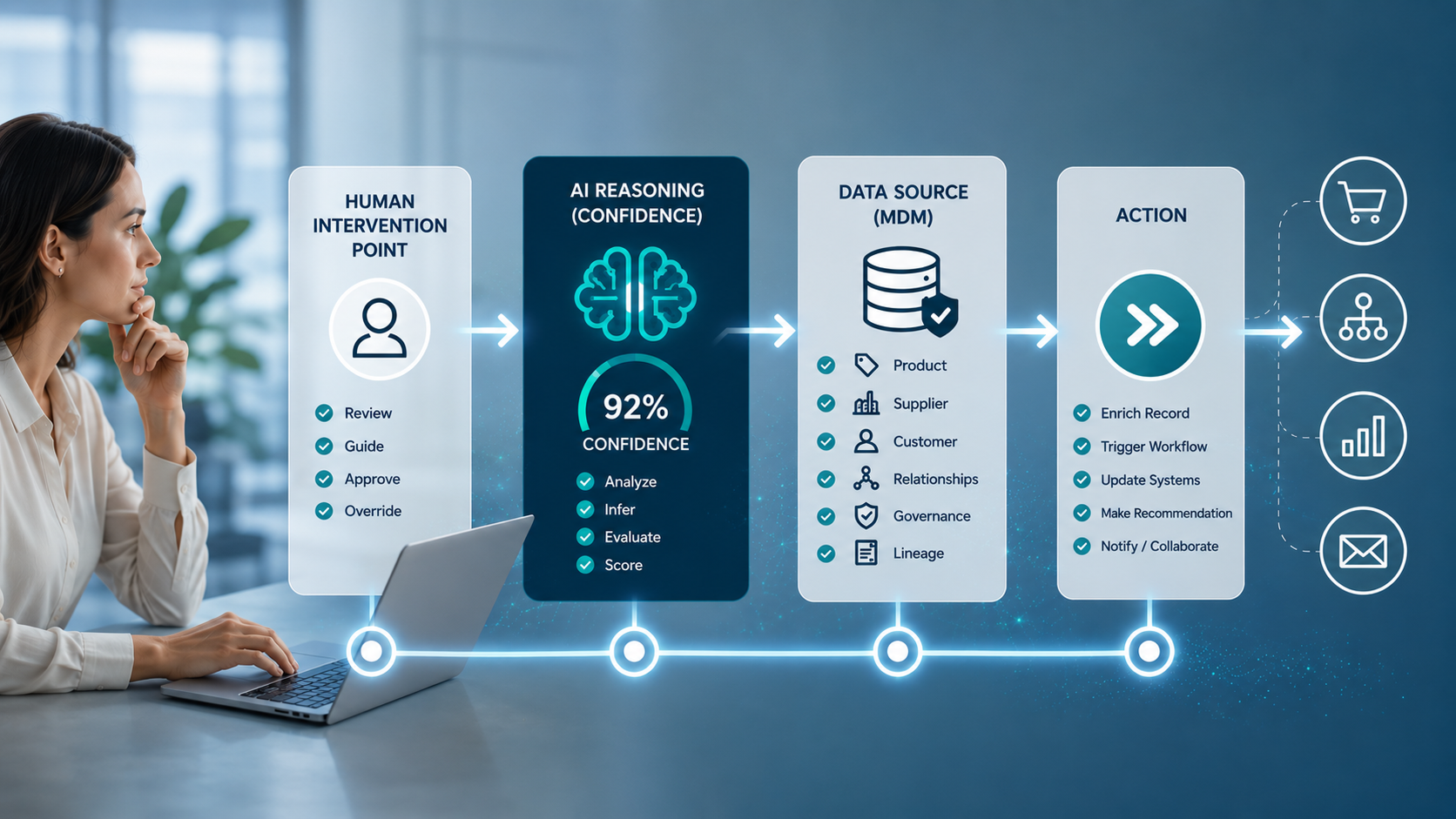
MDM creates trusted master records, resolves duplicates, governs relationships, manages hierarchies, applies business rules, and defines ownership. It provides the trusted data and business context that data platforms, analytics tools, and AI models need to produce reliable outcomes.
The key distinction is that Snowflake and Databricks help organizations do more with data. MDM helps make sure they are doing it with the right data.
Why this matters more as AI adoption accelerates
AI does not magically fix fragmented data. In many cases, it simply exposes it. If customer, product, policy, account or legal entity data is inconsistent, AI can produce faster answers — but not necessarily better ones.
For executives, this is a business value conversation, not a technical architecture debate. Trusted master data helps improve customer experience, reduce manual work, strengthen regulatory confidence, improve decision quality, and make AI investments safer and more effective.
And for regulated industries, this isn’t optional. Frameworks like DORA increasingly require financial services firms to demonstrate the lineage and governance behind the data feeding their AI systems.
While Snowflake can scale data access and Databricks can accelerate analytics and AI, MDM helps ensure the data available to Snowflake and Databricks is accurate, consistent, governed, and grounded in shared business definitions.
You need both because they do different jobs.
The better question to ask
Instead, companies need to be asking: “How do we make sure the data feeding our platforms, reports, analytics, and AI is trusted enough to make business-critical decisions?”
In part two of this blog series, I’ll look at where this creates real business value across onboarding and customer experience to risk, compliance, AI readiness, and growth for banking, insurance, and wealth and asset management organizations.
FAQs
Does Snowflake replace the need for master data management?
No. Snowflake centralizes and scales data access, but it doesn't resolve duplicate records, define ownership, or govern relationships. That's what MDM does.
Does Databricks replace the need for master data management?
No. Databricks accelerates analytics and AI, but it still depends on trusted, well-governed data from MDM to produce reliable outcomes.
What's the difference between a data platform and master data management?
A data platform makes data accessible and processable. MDM makes sure that data is accurate, deduplicated, and trustworthy before it's used.