

Agentic commerce is moving fast. AI agents can already interpret intent, compare products, and assemble decision-ready recommendations in seconds. What used to take dozens of clicks and multiple sessions can now happen inside a single conversation.
On the surface, it looks like the future of buying has arrived.
But when it comes to actually relying on those decisions, both consumers and businesses hesitate.
People are comfortable asking AI what to buy. They’re far less comfortable letting it make the final call. Brands can see AI influencing demand, but they still struggle to trust how their products are represented. They want agents to recommend and compare products, but many remain reluctant to surrender ownership of checkout and the customer relationship. Even when the recommendation looks right, something in the process still feels uncertain.
What’s often overlooked is that trust goes both ways. Customers need to trust agents to recommend, compare, and purchase on their behalf. At the same time, brands and retailers need to trust that agents are representing products fairly, making accurate comparisons, and handling transactions in a way that protects customer relationships and business outcomes.
The limiting factor is no longer capability. It’s trust.
Until that gap is closed, agentic commerce will remain powerful in discovery and comparison, but inconsistent where it matters most: decision-making.
The trust gap shows up at decision time
The most important thing to understand about the trust gap is where it appears.
It doesn’t show up when someone asks for recommendations. AI performs well there. It can interpret constraints, filter options, and present a shortlist that feels relevant and informed.
It doesn’t show up in early comparison either. AI can explain trade-offs and summarize reviews, as well as highlight differences across products.
The gap shows up when recommendation turns into decision.
That’s where confidence is required. For consumers, trust breaks when they're asked to hand over decision-making. For brands and retailers, trust breaks when they're asked to hand over control. Being recommended by an agent is one thing. Letting that same agent own comparison, checkout, returns, warranty questions, and the broader customer experience is another.
That level of confidence just isn’t quite there yet.
Instead, people pause. They double check. They visit a website to verify the details. They validate pricing, availability, brand claims, and policies like returns or warranty before moving forward. It’s true that AI may compress the journey, but it doesn’t remove the need for trust.
Why trust breaks in agentic commerce
No single issue causes the trust gap. It’s actually the result of many structural challenges that show up the moment a user asks AI to make or influence a decision. Let’s take a look at a few of them.
Data isn't decision-ready
AI agents rely on structured product data to evaluate options. They need clear attributes, consistent definitions, and comparable data across products.
Most product data was never built for this — it was built for browsing.
Descriptions are written for humans. Attributes are incomplete or inconsistent across categories. Important details are implied rather than explicit. Two products that should be directly comparable often use different terminology or omit key information.
When that happens, the agent can't make a clean comparison. It has to interpret, infer, or ignore gaps. Each of those introduces uncertainty.
If the data is unclear, the decision is no longer defensible.
There’s no clear source of truth
AI agents don’t rely on a single system. They synthesize information from multiple inputs: brand websites, marketplaces, third-party sources, and structured feeds, where available.
That creates a new problem. Which version of the truth should be trusted?
A product description on a brand site might differ from a marketplace listing. Specifications may be updated in one system but not another. Reviews and summaries may add context that is not verified by the brand.
From the outside, the answer looks complete. Under the surface, it’s made up of fragments. Without a clearly defined source of authority, confidence drops. Users are more likely to verify. Brands are less likely to trust how they are represented. And agents themselves become more conservative in what they recommend.
Retailers are reluctant to give up control
Even as brands improve data quality and become more comfortable with AI-driven discovery and comparison, many remain cautious about fully agent-mediated transactions. Checkout is where customer relationships, loyalty programs, service experiences, and revenue opportunities converge.
Agents also face challenges in areas that extend beyond product selection. Inventory availability, delivery promises, returns, warranty conditions, and post-purchase service all introduce complexity. A recommendation can be correct while the overall commerce experience still falls short.
Until agents consistently navigate both selection and execution, many organizations will remain comfortable with AI influencing purchases without fully owning them.
Brand intent doesn’t translate cleanly
Brand differentiation is rarely structured in a way machines can evaluate.
Messaging lives in campaigns, copy, and storytelling. Value propositions are expressed through tone, positioning, and creative. These elements carry meaning for humans, but they’re difficult for agents to translate into decision criteria.
As a result, AI often reduces products to what it can confidently evaluate: things like features, specs, and price. That leads to flattened summaries. Premium positioning becomes harder to justify. Subtle differentiation is lost. Products that should feel distinct start to sound the same.
When the story disappears, confidence drops with it.
Accountability is undefined
There’s also a more subtle issue at play: responsibility.
If an agent recommends the wrong product, who owns that outcome? The brand that provided the data? The platform that delivered the experience? The model that generated the recommendation?
Without clear accountability, trust becomes harder to establish.
Organizations hesitate to fully rely on agent-driven decisions because the consequences of being wrong are not clearly bounded. That hesitation slows adoption, even when the underlying technology performs well.
Trust exists — but not evenly
It would be a mistake to assume agentic commerce isn’t working. It’s already delivering value. But that value is uneven across different stages of the journey.
- Trust is strongest in discovery: Users are comfortable exploring options through AI. It reduces effort and surfaces relevant products quickly.
- Trust is growing in comparison: As AI improves its ability to explain trade-offs and summarize data, users are increasingly willing to rely on it for shortlisting. Brands and retailers are becoming more comfortable with this stage as recommendation quality improves.
- Trust weakens at decision: This is where verification still happens. Customers often want to confirm details before committing, especially for more complex, expensive, or emotionally significant purchases.
- Trust is limited in execution: Fully autonomous transactions remain rare. Customers may hesitate to let agents complete purchases on their behalf, while retailers remain cautious about giving up control of checkout, fulfillment, returns, and service experiences.
- Trust is not binary: It builds progressively. Today, trust is highest in discovery and comparison, weaker in decision-making, and still evolving in execution. The journey from guidance to authority is underway, but it hasn't fully happened yet.
How brands start closing the trust gap
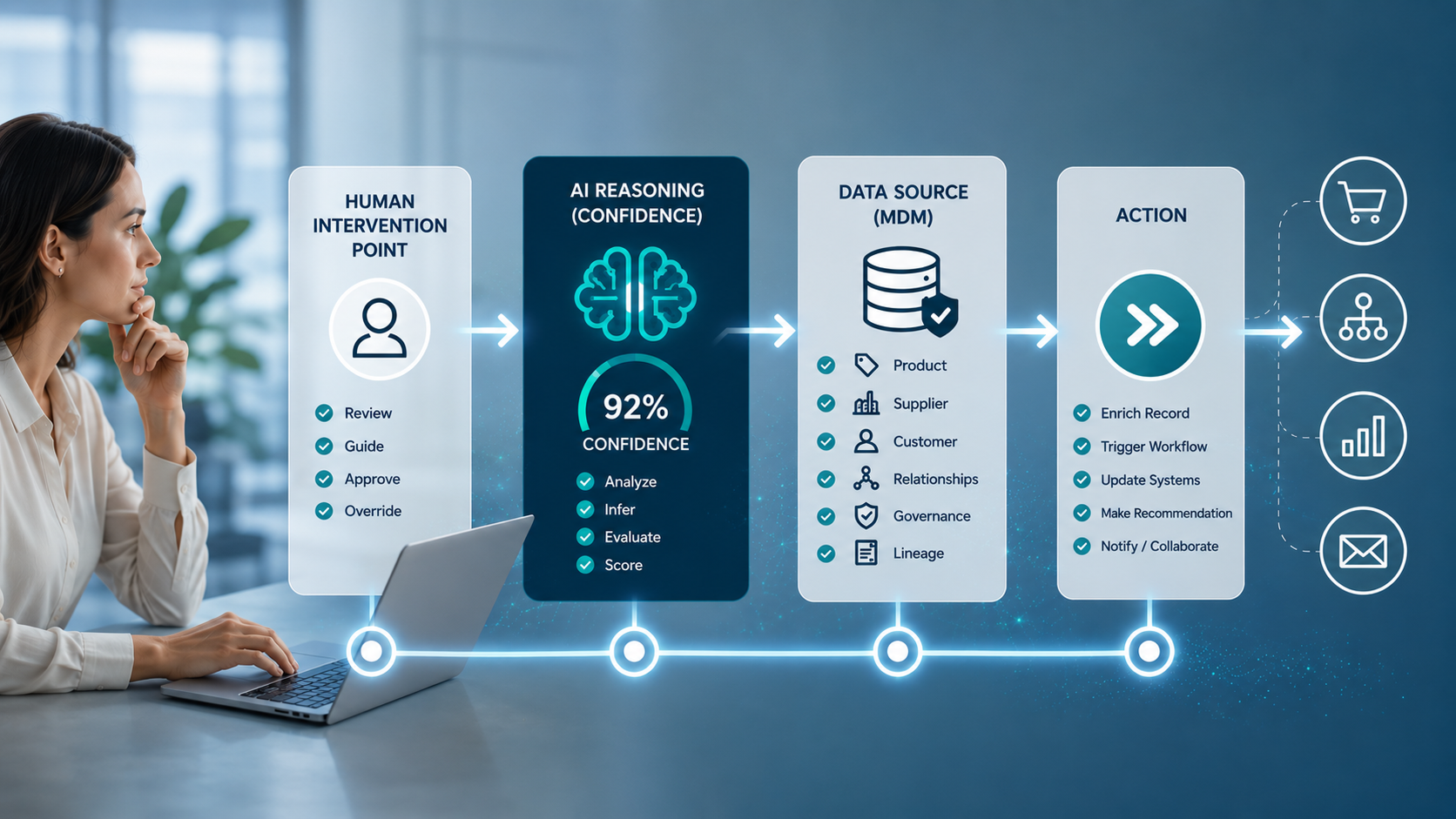
The shift to agentic commerce doesn’t require completely new systems. It requires a different standard for how product information is defined, structured, and governed.
The first step is making product data decision-ready. That means ensuring attributes are complete, consistent, and directly comparable across products. Agents can't reliably recommend products when critical details are missing, buried in text, or measured differently across categories. The stronger the evidence available to an agent, the easier it becomes to make confident recommendations.
The second step is making information trustworthy and verifiable. AI agents need to understand not only what’s being claimed, but where that information comes from and whether it can be trusted. Provenance, validation, certifications, reviews, and source attribution all contribute to confidence. Trust grows when claims are supported by evidence rather than assertions alone.
The third step is ensuring information stays current and ready for transactions. Even the best recommendation breaks down if inventory, pricing, delivery timelines, return policies, or warranty information are inaccurate or out of date. For both consumers and retailers, trust depends on confidence that an agent can move from recommendation to transaction without introducing friction or surprises.
The final step is aligning human and machine trust. Content can no longer serve a single audience. It has to work for both AI agents making recommendations and people validating those recommendations. That requires clarity for machines and confidence for humans, working together.
What happens when trust is solved
When trust reaches parity with capability, agentic commerce changes quickly.
More decisions move upstream. Fewer touchpoints are needed to reach an outcome. Recommendation sets narrow. And competition intensifies around being selected — not just being seen.
At that point, the role of product data becomes central, not just a supporting function. It becomes the foundation for how decisions are made.
But trust is unlikely to arrive all at once. Just as ecommerce became part of the shopping experience rather than replacing it outright, agentic commerce is likely to evolve alongside existing digital and physical channels. Brands and retailers will continue integrating agents into discovery, comparison, service, and purchasing journeys as confidence grows.
Customers are still looking for the same things they’ve always wanted: speed, convenience, easy discovery, good service, and confidence in their decisions. The brands that deliver those outcomes consistently — regardless of channel — will be best positioned as agentic commerce evolves.
And in an agent-mediated world, the question is no longer whether AI can guide the decision. It’s whether your products give it enough confidence to choose.
Frequently asked questions
What is the “trust gap” in agentic commerce?
The trust gap refers to the disconnect between what AI agents can do and what users and businesses are comfortable relying on them to do. While agents are effective at recommending and comparing products, confidence drops when those recommendations turn into actual decisions or transactions.
Why don’t people fully trust AI to make buying decisions yet?
Trust breaks when the information behind recommendations feels incomplete, inconsistent, or hard to verify. Most product data was not designed for automated decision-making, and users still want to confirm key details before committing, especially for higher-value or higher-risk purchases.
How does product data impact trust in AI recommendations?
AI agents rely on structured, consistent, and comparable data to evaluate products. When attributes are missing or unclear, or when information varies across sources, confidence drops. Clear and consistent product data makes recommendations easier to trust because the decision is easier to explain and validate.
Does agentic commerce eliminate the role of brand and content?
No. Brand and content still play a critical role, but their function shifts. AI agents use structured data to recommend products, while human-facing content helps validate and confirm those recommendations. Both need to work together to build trust across the decision process.
What can brands do today to improve trust in agentic commerce?
The most effective starting point is improving product data quality and consistency. Focus on making attributes complete and comparable, supporting claims with evidence, and ensuring information is consistent across all sources. Trust builds when both AI agents and humans can rely on the same clear, verifiable foundation.