

For decades, brands competed for visibility.
They invested in search rankings, advertising, website experiences, and conversion optimization. The goal was straightforward: get customers onto your property, capture their attention, and persuade them to buy.
That model shaped how organizations measured success. More traffic meant more opportunities. Better rankings led to greater visibility. Stronger campaigns drove more conversions. The battleground was the customer-facing experience.
That model has changed.
As AI agents take a larger role in how products are discovered, compared, and evaluated, more and more buying decisions happen before a customer even reaches a website. The competitive challenge, which used to be just attracting attention, is now earning selection.
For agentic commerce — where AI agents discover, compare, and choose products on a buyer's behalf — that means that the brands that win aren’t necessarily the most visible ones. Instead, they’re the ones that are the easiest for AI to understand, evaluate, and choose.
Competition used to happen at the interface
In the traditional digital commerce model, most competitive battles occurred where customers could see them.
Brands competed for search rankings, paid placement, shelf space, social engagement, and website traffic. Once customers arrived, the focus shifted to product pages, reviews, content, promotions, and conversion paths.
Visibility created opportunity. The more often a customer encountered a brand, the more likely they’d be influenced to purchase. It may have been an imperfect customer journey, but it was relatively visible. Brands could track traffic sources, monitor engagement, analyze conversion behavior, and optimize experiences over time.
Competition centered on getting into consideration and persuading customers to move forward. Those channels aren't going away, but they're no longer the only place where products compete.
A new battleground emerges
But agentic commerce is expanding where those decisions happen. Brands still compete through search, websites, marketplaces, stores, and customer experiences. What's changing is that an increasing share of comparison and evaluation now happens before customers reach those channels.
Instead of navigating multiple websites, product pages, and review sites, customers increasingly start with intent. They describe a goal, a need, or a set of constraints and ask an AI agent to help.
Someone getting ready for their first marathon might explain that they have sensitive feet and need something comfortable and with extra arch support. A business buyer might describe sustainability goals and ask for suppliers that align with them. A homeowner might explain the project they're tackling and ask for the best solution rather than a specific product.
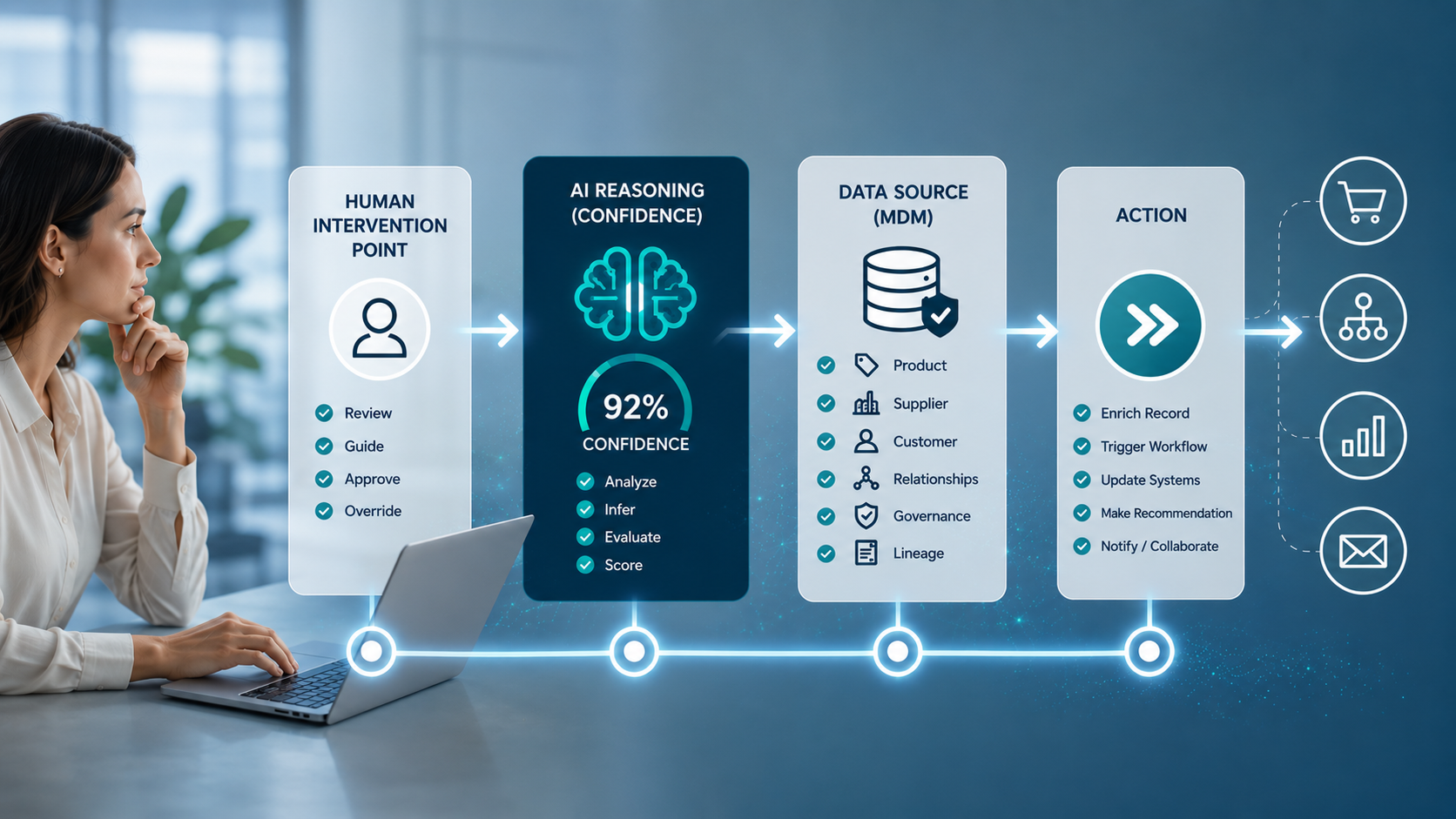
The agent performs much of the work that customers once did themselves. It interprets intent, identifies relevant options, evaluates alternatives, compares attributes, and narrows the field. This means that by the time a recommendation appears, many of the competitive decisions have already been made.
In this model, competition increasingly happens inside the recommendation process rather than on the destination website.
The brands that win aren't always the most visible
This shift introduces a new dynamic.
Remember how I said visibility used to create opportunity? Now, with agentic commerce, eligibility creates opportunity.
In other words, an AI agent can’t choose a product it can't confidently evaluate.
That means products compete on factors that many organizations have traditionally treated as operational concerns rather than strategic differentiators.
For example, clarity. If an agent can’t easily tell what a product is, what it does, or who it’s for, that product becomes significantly harder to recommend.
Or take comparability. Agents need to evaluate alternatives against one another. Products with incomplete, inconsistent, or difficult-to-compare attributes are harder to assess and may be excluded from consideration entirely.
Context also becomes competitive. The best recommendation is rarely the product with the longest feature list. In fact, it’s usually the product that best fits a specific need. Brands that provide richer context help agents make stronger decisions.
Maybe most importantly, trust is a huge differentiator. Information that is consistent and authoritative — and can be verified — gives agents greater confidence in their recommendations.
The result is a significant shift in how products compete. And the ones that get selected are often those that are easiest for AI to understand.
Product data becomes a competitive asset
Now we face a potentially uncomfortable reality.
For years, product data was viewed as supporting infrastructure. It powered catalogs, websites, marketplaces, and internal systems. It was important, yes — but rarely considered a source of competitive advantage.
Agentic commerce changes that mindset entirely.
Missing attributes can prevent products from appearing in comparisons. Inconsistent terminology can make it difficult for agents to evaluate alternatives accurately. Unverifiable claims can reduce confidence. Missing context can weaken recommendations even when the product is the right fit.
What were once operational issues now influence commercial outcomes.
When an AI agent evaluates products, it relies on the information available to it. If that information is incomplete, inconsistent, or difficult to interpret, the product becomes harder to recommend regardless of its actual quality.
In an agent-mediated world, product data stops being back-office infrastructure and starts shaping market outcomes.
New competition creates new winners
That said, this doesn’t mean traditional marketing, branding, or customer experience no longer matter. The core truths of brand marketing still apply: Strong brands still create demand. Great experiences still influence loyalty. Compelling content still helps build trust.
The difference now is that agentic commerce introduces a new layer of competition that sits alongside those investments.
To meet that challenge and make products easier for AI to work with, brands must:
- Ensure differentiation is structured and explicit, not implied
- Invest in consistency across channels and systems
- Recognize that recommendation engines and AI agents are becoming influential participants in the buying process
It also means that the challenge is not to become louder or more visible, but to make it easier for AI to choose your brand.
Welcome to a new era of competition
Brands may have competed for attention for years, but agentic commerce has introduced a new dynamic: competition for selection. To be chosen by AI in the first place, so that people learn a brand even exists.
As AI agents take on a larger role in discovery, comparison, and evaluation, products must be easy for AI to understand, evaluate, and choose. But above all, they must be ready to meet customers at decision-making time.
And the benefits extend beyond commerce itself. The same product data foundations that support agentic commerce can support a much broader range of AI-driven experiences, from internal shopping assistants and procurement agents to personalized loyalty programs and customer service experiences. Even organizations that never fully embrace agentic commerce will increasingly rely on AI systems that consume, interpret, and act on product information.
In this new era of competition, brands won't win by shouting the loudest. They'll win by being the easiest to choose.
Frequently asked questions
What is agentic commerce?
Agentic commerce is a model in which AI agents help discover, evaluate, compare, and sometimes purchase products on behalf of consumers or business buyers. Instead of manually navigating every step of the buying process, users can delegate portions of that process to AI.
How does agentic commerce change competition?
Traditional competition focused on attracting attention through channels such as search engines, websites, marketplaces, and advertising. Agentic commerce introduces a second challenge: ensuring products can be understood, compared, and selected by AI systems before customers ever visit a website.
Why does product data matter in agentic commerce?
AI agents rely on product data to evaluate alternatives and make recommendations. Complete, consistent, and structured information helps agents understand products more accurately and increases confidence in recommendations.
Does agentic commerce make branding less important?
No. Strong brands still influence preference and trust. However, brand differentiation increasingly needs to be supported by structured, machine-readable information so AI agents can evaluate and represent products accurately.
What should organizations focus on first?
Many organizations can start by assessing whether their product information is complete, consistent, and comparable across channels. Improving data quality, clarity, and trustworthiness creates a stronger foundation for both human buyers and AI-driven recommendations.