

Blog Post April 4, 2025 | 5 minutes read

Trust the Machine: Making AI Automation Reliable in Master Data Management

Learn how to use mathematical verification for machine learning results you can trust enough to confidently automate master data management processes.

We're powered by AI

Learn more

Explore this article with AI

Trust the Machine: Making AI Automation Reliable in Master Data Management

Master Data Management Blog by Stibo Systems logo
| 5 minutes read
April 04 2025
Trust the Machine: Making AI Automation Reliable in MDM
11:16

At any large organization, if you’re involved with master data management (MDM), you’re constantly wrestling with supplier data flows, regulatory compliance, sustainability metrics, marketplace sharing... while you need to keep costs down and satisfaction up.

With machine learning (ML), you can automate repetitive, time-consuming tasks at incredible speeds, but trusting AI predictions gives you a real challenge.

When your ML model suggests incorrect categories for products or misidentifies relationships, those errors create downstream problems that can erase your efficiency gains.

After all, if you need to manually verify every AI decision, are you really saving resources?

At Stibo Systems, we’re combining the speed of ML with mathematical verification, enabling you to achieve true automation with the level of accuracy your business needs.

And in this blog post, I’ll share how we arrived there and how it works. You’ll get the context AND the takeaways.

blog-making-ai-automation-reliable-in-mdm

Why do we need machines to help with MDM?

Your data management workload probably feels like it's expanding faster than your ability to handle it. You're not alone. Today's data managers navigate a complex landscape where accuracy, speed and volume all compete for priority.

  • Onboarding massive product assortments from suppliers with inconsistent data formats and quality
  • Maintaining governance processes that keep your data trustworthy across systems
  • Staying compliant with constantly evolving regulatory requirements
  • Managing an increasing array of sustainability and ESG data points
  • Distributing clean, consistent data to various channels and marketplaces

Traditional approaches to these challenges often rely heavily on manual processes, business rules and human verification.

This can work on a smaller scale, but when your data volumes grow – you get bottlenecks. A product manager who could once verify 50 new items per day now faces batches of thousands, making manual review impractical.

And it’s not just about saving time – it's about maintaining competitive advantage. When your competitors can onboard new products faster, update information more quickly and distribute data more effectively, they gain crucial market advantages. Manual processes simply can't scale to meet these demands without significant resource investments.

What makes these challenges particularly suited for technological intervention is their repetitive, pattern-based nature. It’s often about recognizing similarities, applying consistent rules and making evidence-based decisions.

Exactly the kind of work where ML excels.

How ML has changed the game completely

ML aligns perfectly with data management's most labor-intensive tasks.

At its core, ML excels at pattern recognition, categorization and prediction – precisely what you need when managing large volumes of complex data. Take these, for example:

  • Product categorization

    Automatically assigning new products to the correct categories in your taxonomy.
  • Data matching and deduplication

    Identifying when different records represent the same real-world entity.
  • Attribute mapping

    Connecting supplier-specific attributes to your standardized data model.
  • Data quality scoring

    Predicting completeness and accuracy levels without manual review.
  • Anomaly detection

    Flagging unusual data patterns that might indicate errors or opportunities.
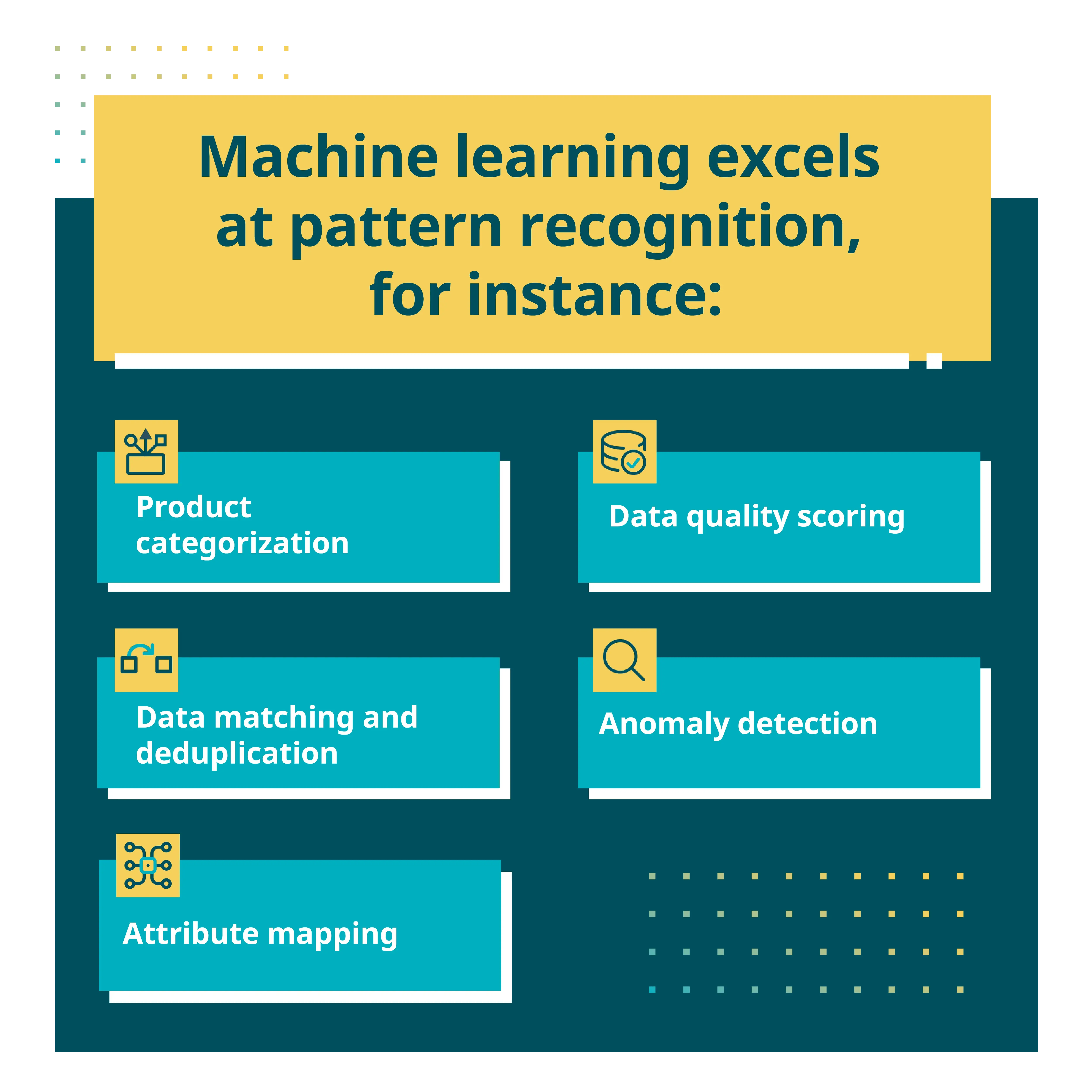
 

Infographic-machine-learning-pattern-recognition

The efficiency gains can be remarkable. Tasks that once took days, can be done in minutes. And it’s not just speed:

ML brings consistency

Human categorization naturally varies between individuals and even by the same person at different times. ML applies the same logic consistently (statistically). You limit the variability that causes data issues downstream.

ML adapts as your business evolves

With traditional, rule-based systems, you need explicit reprogramming when your business conditions change. ML models, on the other hand, can spot shifting patterns in your data and adjust accordingly. This adaptability means your data management processes stay current with minimal intervention.

But these benefits come with an important caveat: The predictions are only as good as the model's accuracy. And that's where many data management teams hit a roadblock on their automation journey.

If you can’t trust your ML, it all falls apart

ML predictions come with an inherent uncertainty. While ML models are good at recognizing patterns, they don't give you the certainty of mathematical proof. This creates a trust challenge that can significantly limit automation potential.

The accuracy dilemma

Every ML model produces some level of inaccuracy, typically manifesting in two forms:

  1. False negatives, where valid matches aren't recognized
  2. False positives, where incorrect matches are made

For data management, false positives create the bigger problem. When a model incorrectly categorizes a product or incorrectly matches two different customers, these errors propagate through your systems, giving you data quality issues that can affect business operations.

Partial automation isn't enough

Many organizations respond to this challenge with a hybrid approach: using ML for initial processing, then manually reviewing the results. While it still beats fully manual processes, this approach:

  • Creates review bottlenecks during high-volume periods
  • Still needs significant human resources
  • Limits the scalability advantages you’re looking for with ML
  • Delays time-sensitive processes

The verification gap

The core issue isn't that ML makes mistakes – it's the lack of a reliable mechanism to verify which predictions you can trust.

Without knowing which predictions are certainly correct, you're forced to verify everything or accept a level of error in your master data.

This verification gap represents the critical barrier between assisted processing and true automation. And to close the gap, you need a fundamentally different approach that combines ML's pattern recognition capabilities with methods that can provide mathematical certainty about prediction accuracy.

After all: You don't need to know that your model is 95% accurate overall. You need to know which 95% of predictions you can trust.

This is indeed a difficult problem to tackle – one that varies in nature across use cases. But at Stibo Systems we’re relentless in solving such challenges, and to tackle this one, we’re starting with verification of AI Assistance Classification Recommendations – in research also known as Ontology (classification) Mapping.


Webinar

All In or All Out with AI?

Navigating the Risks of AI Adoption
Watch the Webinar
in-or-all-out


How to build mathematical verification mechanisms into your ML model

Our research with the Technical University of Denmark (DTU) – one of the leading technical universities in Europe, also named best technical university in Denmark – has led to a breakthrough approach.

It combines the speed of ML with the certainty of mathematical verification.

The verification challenges we’re solving

When using AI to map between classification systems – for example, matching "Hand tools" in one product taxonomy to "Handheld tools" in another – ML models can make impressive predictions.

But those predictions always carry statistical uncertainty that can undermine trust. And trust, in this context, is kind of binary: Either you can trust your results, or you can’t (and have to double-check).

The key issue is consistency. How can you verify that the mapping relationships make logical sense across entire classification structures?

Mathematical certainty meets practical application

In our solution, we apply formal mathematical methods to validate that recommended mappings are logically consistent. Mathematical proof confirms which predictions are correct, not just statistically likely.

For this, we use specifically propositional logic and “Horn Clauses.”

What are Horn Clauses?

They might sound complex, but they're simply logical statements that follow an "if-then" pattern. For example, "if a product is a hammer AND hammers belong to hand tools, THEN the product belongs to hand tools." By applying these logical rules across classification systems, we can mathematically verify whether mappings make sense.

But you might wonder: If formal methods provide the certainty we need, why use ML at all?

The answer lies in computational efficiency. Applying formal methods alone to large classification structures would be too computationally expensive for practical use.

By combining approaches, we get the best of both worlds:

  • Fast ML predictions narrow down the possible mappings.
  • Mathematical verification confirms which predictions are definitively correct.
  • Only uncertain predictions need human review.

The hybrid approach dramatically reduces verification workload while maintaining accuracy, making true automation possible.

Understand all this at a deeper level: This work has been published in “The Practice of Formal Methods,” an essay in the honor of Cliff Jones.

At Stibo Systems, we’re applying this in real life

The mathematical foundations are rock-solid – formal logic is either correct or incorrect, with no middle ground. The exciting part involves applying these principles to real-world MDM challenges.

Our implementation currently focuses on high-volume scenarios where verification creates significant bottlenecks.

For example, for retailers onboarding thousands of supplier items regularly, the ability to automatically validate AI-suggested categorizations creates tremendous value throughout the process.

But we work with companies in many industries, with potential use cases everywhere:

  • Financial services firms matching transaction categories across different systems
  • Healthcare organizations aligning medical coding taxonomies
  • Manufacturing companies standardizing part classifications from multiple suppliers
  • Public sector agencies harmonizing service categories across departments
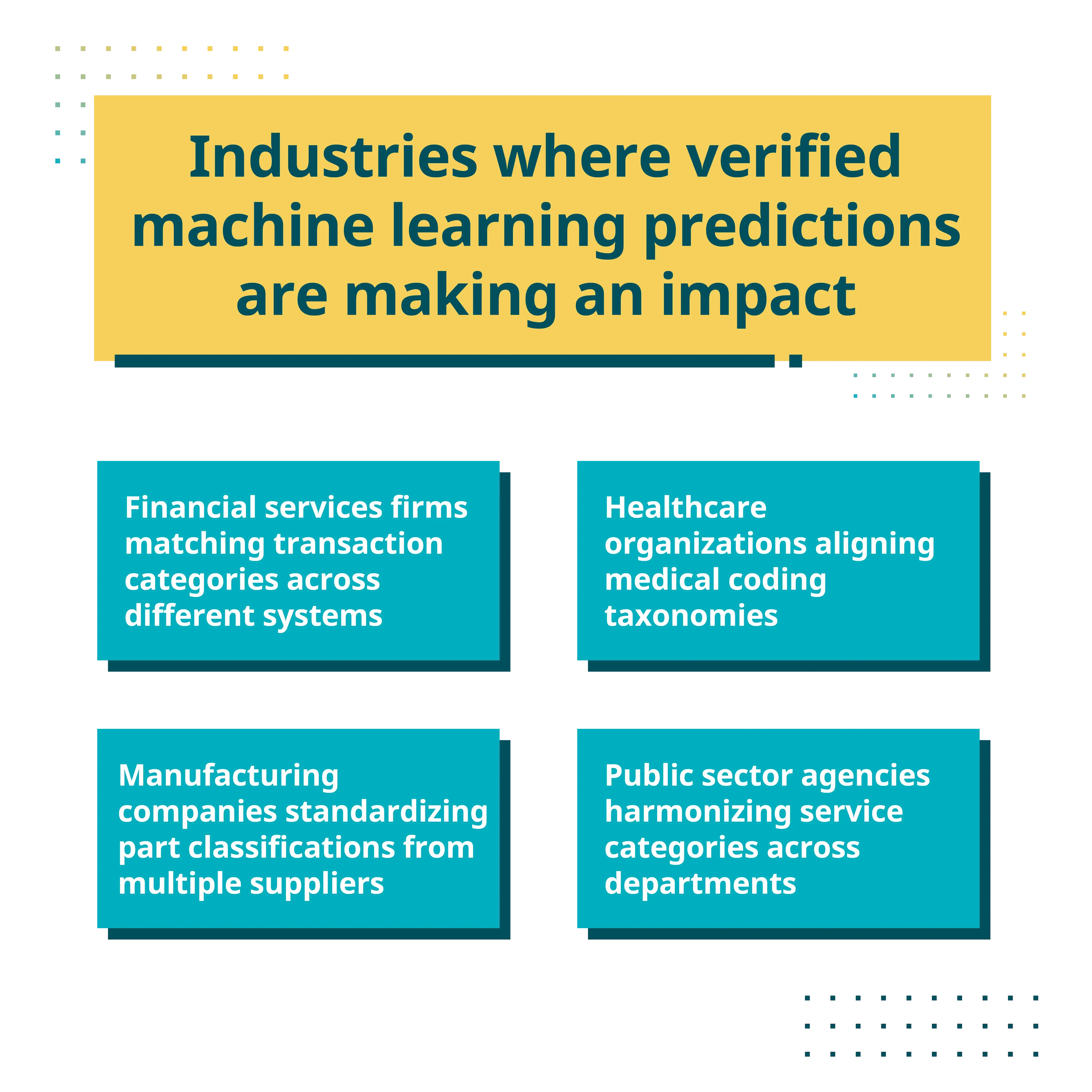
Infographic-industries-machine-learning

Any situation involving taxonomy alignment, classification matching or standardization across systems could benefit from verified predictions.

Current status on our implementation

We're currently testing prototypes in real environments.

While still early in implementation, the mathematical verification works exactly as expected – it correctly identifies which predictions can be trusted. The next phase involves refining the user experience and expanding the verification capabilities to more data management scenarios.

Let’s sum up

Trust remains the biggest hurdle to true automation in data management. Our combination of ML with mathematical verification gives us a practical path forward that doesn't force you to choose between speed and accuracy.

The human role will always matter in data management, but we can now direct that expertise where it adds the most value – not on routine tasks that verified AI can handle reliably.

When you can trust your ML predictions, you can finally automate with confidence.

Master Data Management Powered by AI

Unlock the power of AI in your MDM processes to navigate complex supply chain dynamics with greater agility and foresight.


Discover how today!
Powered-by-AI_Hero
Master Data Management Blog by Stibo Systems logo

Decades of experience within master data management, technologies, people and processes has led Jesper into his current role, heading Stibo Systems' innovation efforts. He has a particular focus on multidomain MDM, augmented MDM and technology adoption. Being responsible for company-wide strategic initiatives on product innovations, he is constantly seeking to increase the value of product offerings to customers and partners. Jesper comes from prior roles as Product Strategy Director, Section Head R&D, Director Professional Services, and Associate Professor at a Danish university.


Discover blogs by topic

  • See more
  • MDM strategy
  • Data governance
  • Retail
  • Customer and party data
  • Data quality
  • Product data and PIM
  • AI and machine learning
  • Manufacturing
  • Product Experience Data Cloud
  • Supplier data
  • Consumer packaged goods
  • Customer experience and loyalty
  • Data compliance
  • Sustainability
  • Data integration
  • Financial services
  • Compliance and risk management
  • Operational efficiency
  • Customer Experience Data Cloud
  • Location data
  • Product data syndication
  • Multidomain data
  • Product onboarding
  • Supplier Data Cloud
  • Business Partner Data Cloud
  • ERP success
  • Life sciences
  • Location Data Cloud
  • Automotive
  • Data modeling
  • Data sourcing
  • Digital asset management
  • Platform
  • Translation and localization
  • Data delivery
  • Data sharing
  • Digital shelf analytics
  • Enhanced content
March 9, 2026

Master Data Meets Microsoft Fabric: Building a Trusted Foundation for AI and Analytics

February 24, 2026

BIC's Blueprint for Conquering Complex Global Product Data Challenges

February 17, 2026

Product 360 After the Salesforce Acquisition: Why You Need to Map Out a Plan B

January 27, 2026

5 Hidden Costs of Bad Customer Data in Retail (and How to Avoid Them)

January 20, 2026

What is the difference between CPG and FMCG?

January 13, 2026

Discover the Value of Your Data: Master Data Management KPIs & Metrics

January 13, 2026

Solving Retail Data Fragmentation: The Key to Consistent Customer Journeys

January 5, 2026

What is a Data Domain? Meaning & Examples

January 2, 2026

Data Migration to SAP S/4HANA ERP: The Fast and Safe Approach with MDM

December 15, 2025

The Difference Between Master Data and Metadata

December 10, 2025

Is Your PIM Strategy Future-Ready? 3 Takeaways from the SPARK Matrix™ Report

December 9, 2025

Master Data Management Roles and Responsibilities

December 9, 2025

Product Listing Page Best Practices: How to Create Better Product Listings with PIM

December 8, 2025

The Board of Directors’ Guide to Selecting Product Experience Software (With Checklist)

December 5, 2025

5 PIM Trends That Will Define 2026 and the Near Future (And How to Prepare for Them)

December 4, 2025

Process Insurance Claims Faster with Trusted Data

December 4, 2025

10 Dangerous Myths About Managing Your B2B Partner and Account Data

December 3, 2025

Fixing Fragmented Customer Account Data: Stop Losing Revenue and Trust

December 2, 2025

A Quick Guide to Golden Customer Records and How to Create Them with Master Data Management

December 2, 2025

How Master Data Management Keeps Manufacturers Compliant — From Design to Delivery

November 20, 2025

What is Manufacturing-as-a-Service (MaaS)?

November 18, 2025

AI in Retail: How to Make Your Data Ready to Use in Microsoft Fabric

November 17, 2025

What is Party Data? All You Need to Know About Party Data Management

November 4, 2025

Consumers are Using AI-Powered Tools to Shop Smarter: Why Retail Data Trust Matters More than Ever

October 29, 2025

CDP and MDM: Complementary Forces for Enhancing the Customer Experience

October 27, 2025

How to Estimate ROI of Master Data Management

October 24, 2025

Model Context Protocol (MCP): The Missing Layer for AI Systems That Interact with Enterprise Data

October 20, 2025

Managing Product Complexity: Leveraging Custom Product Management with BOM-Level Precision

October 2, 2025

How CPG Brands Scale D2C Business Without Breaking What Already Works

September 24, 2025

How Leading Brands Built Trusted Data with Amplifi and Stibo Systems

September 11, 2025

Is Your Data the Cause of Flawed AI Outputs?

September 8, 2025

What’s Next for GenAI in Product Experiences?

August 27, 2025

PIM and MDM: Key Differences, Benefits and How They Work Together

August 13, 2025

The 5 Biggest Retail Trends in 2026

August 12, 2025

From Zero to Launch in Under 6 Months: A Quick Guide to Deploying Master Data Management

August 12, 2025

5 CPG Industry Trends and Opportunities for 2026

August 5, 2025

How Operations Leaders are Modernizing Manufacturing Data Without Halting Production

August 4, 2025

Digital Product Passports: The Data Management Mandate

August 1, 2025

How to Improve Back-End Systems Using Master Data Management

July 14, 2025

Product Attribution Strategies That Convert Searchers into Buyers

July 9, 2025

How to Get More Value from Your Data: The Benefits of Master Data Management

July 4, 2025

The Complete PIM Features Guide: The Capabilities You Need for Successful Data Strategies

June 26, 2025

PIM explained: How Product Information Management transforms data quality

June 25, 2025

What is master data management? A complete and concise answer

June 12, 2025

Better Together: CRM and Customer Master Data Management

June 11, 2025

How CPG Сompany Bonduelle Сentralized Product Data Across 37 Countries

June 10, 2025

Master Data Management Tools: A Complete Guide

May 23, 2025

How Signet Jewelers Built Trust in Its Retail Data

May 12, 2025

Manufacturing Trends and Insights in 2026

April 15, 2025

5 Key Trends in Product Experience Management

April 4, 2025

Trust the Machine: Making AI Automation Reliable in Master Data Management

April 2, 2025

How Agentic Workflows Are Changing Master Data Management at the Core

March 17, 2025

What is Smart Manufacturing and Why Does it Matter?

March 11, 2025

How to Implement Master Data Management: Steps and Challenges

March 7, 2025

MDM and AI: Real-World Use Cases and Learnings From OfficeMax and Motion Industries

February 27, 2025

Reyes Holdings' MDM Journey to Better Data

February 17, 2025

The Future of Master Data Management: Trends in 2026

February 3, 2025

8 Best Practices for Customer Master Data Management

February 3, 2025

4 Trends in the Automotive Industry

January 29, 2025

How to Choose the Right Data Quality Tool?

January 28, 2025

AI Adoption: A High-Stakes Gamble for Business Leaders

January 27, 2025

All You Need to Know About Supplier Information Management

January 27, 2025

How Kramp Optimizes Internal Efficiency with Data Strategy

January 27, 2025

From Patchwork to Precision: Moving Beyond Outdated and Layered ERP Systems

January 24, 2025

Thriving Beyond NRF 2025 with Trustworthy Product Data

January 23, 2025

Building the Future of Construction with AI and MDM

January 17, 2025

Why Addressing Data Complexity in Pharmaceutical Manufacturing Is Critical

January 17, 2025

How URBN Leverages Data Management to Support Its Sustainability Information  

January 14, 2025

An Introductory Guide to Supplier Compliance

January 6, 2025

How to Avoid Bad Retail Customer Data

December 17, 2024

How to Implement Data Governance

December 11, 2024

Gen Z: Seeking Excitement Beyond Amazon

December 10, 2024

A Modern Guide to Data Quality Monitoring: Best Practices

December 9, 2024

What is Supply Chain Analytics and Why It's Important

December 5, 2024

What is Supplier Lifecycle Management?

December 3, 2024

Using Machine Learning and MDM CBAM for Sustainability Compliance

November 25, 2024

AAPEX and SEMA: The Automotive Aftermarket Industry’s Mega-Showcase

October 22, 2024

Live Shopping: How to Leverage Product Information for Maximum Impact

October 16, 2024

Why Data Accuracy Matters for CPG Brands

October 15, 2024

Why Choose a Cloud-Based Data Solution: On-Premise vs. Cloud

September 23, 2024

How Master Data Management Can Enhance Your ERP Solution

September 20, 2024

Navigating Change: Engaging Business Users in Successful Change Management

September 11, 2024

What is Digital Asset Management?

September 3, 2024

How to Improve Your Data Management

August 30, 2024

Digital Transformation in the CPG Industry

August 27, 2024

Responsible AI Relies on Data Governance

August 19, 2024

Making Master Data Accessible: What is Data as a Service (DaaS)?

August 15, 2024

6 Features of an Effective Master Data Management Solution

August 13, 2024

Great Data Minds: The Unsung Heros Behind Effective Data Management

August 6, 2024

A Data Monetization Strategy - Get More Value from Your Master Data

August 4, 2024

Introducing the Master Data Management Maturity Model

July 31, 2024

What is Augmented Data Management? (ADM)

July 17, 2024

GDPR Data Governance and Data Protection, a Match Made in Heaven?

May 12, 2024

What Is Master Data Governance – And Why Do You Need It?

April 11, 2024

Guide: Deliver flawless rich content experiences with master data governance

April 10, 2024

Risks of Using LLMs in Your Business – What Does OWASP Have to Say?

April 9, 2024

Guide: How to comply with industry standards using master data governance

April 2, 2024

Guide: Get enterprise data enrichment right with master data governance

April 2, 2024

Guide: Getting enterprise data modelling right with master data governance

April 2, 2024

Guide: Improving your data quality with master data governance

March 25, 2024

How to Get Rid of Customer Duplicates

March 18, 2024

5 Tips for Driving a Centralized Data Management Strategy

March 18, 2024

What is Application Data Management and How Does It Differ From MDM?

February 20, 2024

5 Key Manufacturing Challenges in 2025

February 20, 2024

How to Enable a Single Source of Truth with Master Data Management

February 12, 2024

What is Data Quality and Why It's Important

February 7, 2024

Data Governance Trends 2026

February 6, 2024

What is Data Compliance? An Introductory Guide

January 18, 2024

How to Build a Master Data Management Strategy

January 16, 2024

The Best Data Governance Tools You Need to Know About

January 15, 2024

How to Choose the Right Master Data Management Solution

December 19, 2023

Building Supply Chain Resilience: Strategies & Examples

November 29, 2023

Shedding Light on Climate Accountability and Traceability in Retail

November 13, 2023

Location Analytics – All You Need to Know

October 16, 2023

Understanding the Role of a Chief Data Officer

October 5, 2023

5 Common Reasons Why Manufacturers Fail at Digital Transformation

September 29, 2023

How to Digitally Transform a Restaurant Chain

September 14, 2023

Three Benefits of Moving to Headless Commerce and the Role of a Modern PIM

July 6, 2023

12 Steps to a Successful Omnichannel and Unified Commerce

June 28, 2023

Navigating the Current Challenges of Supply Chain Management

April 6, 2023

Product Data Management during Mergers and Acquisitions

March 14, 2023

A Complete Master Data Management Glossary

March 1, 2023

Asset Data Governance is Central for Asset Management

February 21, 2023

4 Common Master Data Management Implementation Styles

February 14, 2023

How to Leverage Internet of Things with Master Data Management

February 13, 2023

Sustainability in Retail Needs Governed Data

January 4, 2023

Innovation in Retail

November 21, 2022

Life Cycle Assessment Scoring for Food Products

November 14, 2022

Retail of the Future

November 7, 2022

Omnichannel Strategies for Retail

November 5, 2022

Hyper-Personalized Customer Experiences Need Multidomain MDM

October 25, 2022

What is Omnichannel Retailing and What is the Role of Data Management?

October 18, 2022

Most Common ISO Standards in the Manufacturing Industry

October 17, 2022

How to Get Started with Master Data Management: 5 Steps to Consider

October 1, 2022

An Introductory Guide: What is Data Intelligence?

September 15, 2022

Revolutionizing Manufacturing: 5 Must-Have SaaS Systems for Success

August 25, 2022

Digital Transformation in the Manufacturing Industry

August 17, 2022

Master Data Management Framework: Get Set for Success

June 15, 2022

Supplier Self-Service: Everything You Need to Know

June 14, 2022

Omnichannel vs. Multichannel: What’s the Difference?

June 10, 2022

Create a Culture of Data Transparency - Begin with a Solid Foundation

May 31, 2022

What is Location Intelligence?

May 30, 2022

Omnichannel Customer Experience: The Ultimate Guide

May 24, 2022

Omnichannel Commerce: Creating a Seamless Shopping Experience

May 11, 2022

Top 4 Data Management Trends in the Insurance Industry

May 1, 2022

What is Supply Chain Visibility and Why It's Important

April 21, 2022

The Ultimate Guide to Data Transparency

April 20, 2022

How Manufacturers Can Shift to Product as a Service Offerings

April 16, 2022

How to Check Your Enterprise Data Foundation

April 14, 2022

An Introductory Guide to Manufacturing Compliance

March 31, 2022

Multidomain MDM vs. Multiple Domain MDM

March 23, 2022

How to Build a Successful Data Governance Strategy

March 22, 2022

What is Unified Commerce? Key Advantages & Best Practices

March 17, 2022

6 Best Practices for Data Governance

March 16, 2022

5 Advantages of a Master Data Management System

February 24, 2022

Supply Chain Challenges in the CPG Industry

February 14, 2022

Top 5 Most Common Data Quality Issues

February 10, 2022

What Is Synthetic Data and Why It Needs Master Data Management

February 8, 2022

What is Cloud Master Data Management?

January 28, 2022

Build vs. Buy Master Data Management Software

January 27, 2022

Why is Data Governance Important?

January 24, 2022

Five Reasons Your Data Governance Initiative Could Fail

January 21, 2022

How to Turn Your Data Silos Into Zones of Insight

January 16, 2022

How to Improve Supplier Experience Management

January 16, 2022

​​How to Improve Supplier Onboarding

January 11, 2022

What is a Data Quality Framework?

January 4, 2022

The Ultimate Guide to Building a Data Governance Framework

December 20, 2021

The Dynamic Duo of Data Security and Data Governance

December 20, 2021

How to Choose the Right Supplier Management Solution

December 6, 2021

How Data Transparency Enables Sustainable Retailing

December 1, 2021

What is Supplier Performance Management?

November 7, 2021

The Complete Guide: How to Get a 360° Customer View

October 29, 2021

How Location Data Adds Value to Master Data Projects

October 15, 2021

What is a Data Mesh? A Simple Introduction

September 2, 2021

10 Signs You Need a Master Data Management Platform

August 31, 2021

What Vendor Data Is and Why It Matters to Manufacturers

August 25, 2021

3 Reasons High-Quality Supplier Data Can Benefit Any Organization

August 9, 2021

What is Reference Data and Reference Data Management?

July 25, 2021

GDPR as a Catalyst for Effective Data Governance

May 12, 2021

How to Become a Customer-Obsessed Brand

April 27, 2021

How to Create a Master Data Management Roadmap in Five Steps

April 13, 2021

What is a Data Catalog? Definition and Benefits

April 8, 2021

How to Improve the Retail Customer Experience with Data Management

March 25, 2021

Business Intelligence and Analytics: What's the Difference?

March 21, 2021

What is a Data Lake? Everything You Need to Know

February 24, 2021

Are you making decisions based on bad HCO/HCP information?

December 15, 2020

5 Trends in Telecom that Rely on Transparency of Master Data

November 19, 2020

10 Data Management Trends in Financial Services

October 29, 2020

What Is a Data Fabric and Why Do You Need It?

October 14, 2020

Transparent Product Information in Pharmaceutical Manufacturing

August 23, 2020

How Retailers Can Increase Online Sales in 2025

August 14, 2020

Master Data Management (MDM) & Big Data

August 9, 2020

Key Benefits of Knowing Your Customers

July 21, 2020

Customer Data in Corporate Banking Reveal New Opportunities

July 18, 2020

4 Ways Product Information Management (PIM) Improves the Customer Experience

July 1, 2020

How to Estimate the ROI of Your Customer Data

June 17, 2020

How to Personalise Insurance Solutions with MDM

May 25, 2020

How to Get Buy-In for a Master Data Management Solution

July 18, 2019

How to Improve Your Product's Time to Market With PDX Syndication

June 1, 2019

8 Tips For Pricing Automation In The Aftermarket