

Too many banks and insurers assume their AI has a complete picture of the customer. It doesn't. It has whatever picture the underlying systems were able to give it.
Customer 360 is a complete, accurate, and current view of a customer across the products, accounts, policies, channels, and touchpoints relevant to the relationship. In banking, financial services, and insurance (BFSI), that view must also preserve roles, relationships, hierarchies, provenance, and the controls governing how data may be used. Without that context, AI is working from a customer who does not fully exist.
Establishing a trusted customer identity is the starting point, not the finish line. AI also needs the governed context around that identity: households and corporate hierarchies, roles and relationships, products and accounts, and evidence showing where each fact came from and why it is trusted.
What follows sets out four reasons this determines how far AI can go, and where it usually goes wrong.
1. No single system sees the whole customer
A single person can be a retail banking customer, a mortgage borrower, a wealth client, a policyholder, and a beneficial owner, all at once.
Each of those relationships usually lives in its own system, built at a different time and for a different purpose.
The mortgage platform was never designed to know about the wealth account. And the policy administration system was never built to recognize that its policyholder is also a beneficial owner somewhere else in the business.
Technically, these systems are not wrong; they all accurately reflect the piece of the customer they were built to manage.
The problem is when a person or AI needs to understand the customer in context — not only the products they hold, but the roles and relationships connecting them across the business:
- A relationship manager assessing the customer's total relationship and exposure across products and legal entities
- An insurer determining whether a policyholder, claimant, beneficiary, member, or household contact is the same person
- An AI system selecting a next action using the relevant and permitted customer, household, or corporate context
No single team, and no single system, was ever given that complete picture to work from.
2. When AI works from a partial view, no one can explain what it did
Instead of building its own view of a customer, an AI model learns from whatever view it's given.
When that view is fragmented, the model's output reflects the same fragmentation, at speed and at scale.
If you're an insurer using AI to prioritize retention or claims service, the same person might appear as a policyholder, insured, claimant, beneficiary, member, or household contact. Those role-based identities may sit in different systems, with no governed link between them.
The model recommends a next best action based on a partial relationship. The result is hard to explain, harder to defend, and sometimes wrong for the customer in front of it.
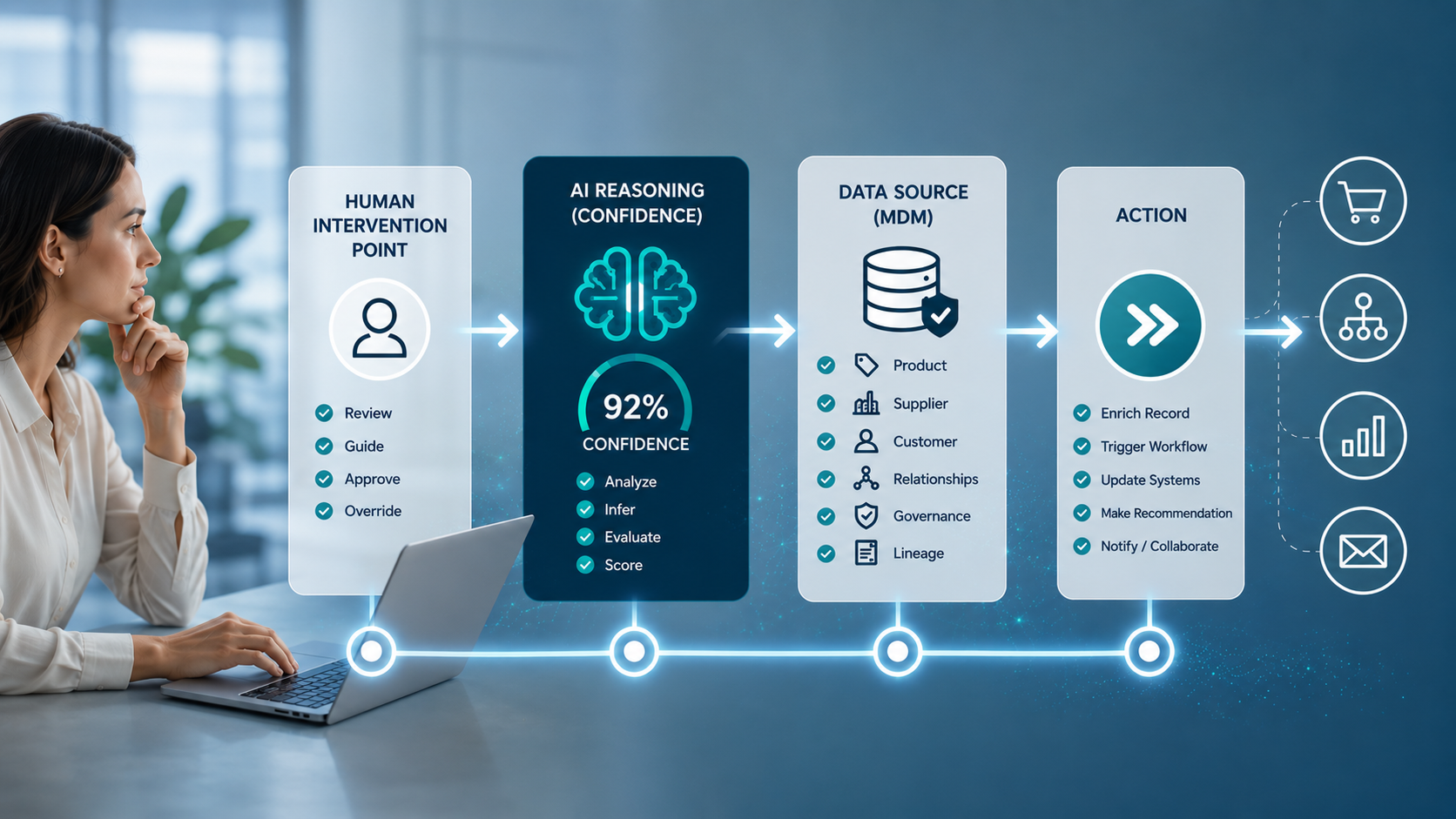
In a regulated environment, this is the part that gets tested. Complete data isn't enough on its own. You also need to explain:
- Which identity, relationship, and source data informed the decision
- Why that data was trusted
- Whether the information was current and permitted for that purpose
- How a data steward, auditor or regulator can review the decision and any human intervention
CRM manages interactions. Data lakes and lakehouses store, process, and analyze data at scale. Core banking, policy and claims platforms run operational processes.
Master data management (MDM) complements — not replaces — those systems by establishing the governed identities, relationships, hierarchies, and business definitions they can share and reuse. That is what makes Customer 360 consistent, traceable, and decision-ready for people, analytics, and AI.
3. The customer view breaks again with every business change
New customers, products, and system changes constantly add new fragments. So, even a business that resolves this today faces it again tomorrow, due to factors like:
- Mergers and acquisitions bring in systems built to different standards by different teams
- New channels and products create profiles the existing view never accounted for
- System migrations move data into new structures and break the logic old matching rules relied on
- New AI use cases pull customer data into combinations no one designed for
These changes are routine in BFSI, and each can reintroduce fragmentation unless identity, relationships, and governance are maintained continuously. That's why, for a complete customer view, you need an ongoing, governed way to stay accurate as the business changes. If you treat it as a project with a finish line, all your work comes undone the moment the business moves again.
4. The stakes rise as AI decisions move from days to seconds
Decisions that used to take days now happen in seconds. Credit decisions, fraud alerts, claims triage, underwriting referrals, and next-best actions increasingly run through automated processes, leaving less time for a person to identify missing or misleading context.
That speed changes what a complete customer view is for.
Before, a data problem slowed a decision down. Someone usually caught it before it went further.
Now, a data problem moves through the same automated process as everything else and produces an outcome before anyone reviews it.
Speed removes the safety net that slower, manual processes used to provide.
A complete, trustworthy customer view used to be something firms worked toward over time. Today, it's a prerequisite for safe AI in BFSI.
When identity resolution is missing, the Frankenstein customer shows up
In our ebook, Meet Your Frankenstein Customer – a useful read for anyone involved in BFSI customer data management – you will see this pattern: a customer record stitched together from fragments, duplicates, and conflicting data points.
The data looks plausible enough to pass a quick check, but it falls apart the moment it's put to use in a decision that counts.
Without a governed way to establish identity and connect the relevant context around it, AI risks acting on that same stitched-together customer — whether anyone notices immediately or only after a decision has been made.
How STEP addresses this
Stibo Systems' trusted intelligence platform, STEP, gives BFSI firms an independent, governed master data foundation that works alongside CRM, core banking, policy, claims, cloud data, and AI platforms. It establishes trusted identities and connects the business context AI needs without replacing the systems that run transactions:
- Trusted identity: Matches, consolidates, and governs customer and party records while preserving source, lineage, and persistent identifiers
- Relationships and hierarchies: Connects households, legal entities, beneficial owners, brokers and intermediaries, roles, and organizational structures
- Semantic business context: Applies shared definitions, classifications, and governance so people and AI understand what the entities and relationships mean
- Enterprise connection and control: Publishes governed identity and context to CRM, core platforms, cloud data, analytics and AI, with traceability, automated controls, and human stewardship for exceptions
Together, these capabilities turn fragmented records into trusted, context-rich intelligence that people and AI can use with greater confidence — and that BFSI firms can explain, govern, and defend. To see how we at Stibo Systems support Financial Services and Insurance organizations, visit the industry pages on our website.
Frequently asked questions
What is a trusted Customer 360?
A trusted Customer 360 is a governed, current view of a person or organization that connects identity with relevant products, accounts, policies, roles, households, legal entities, and relationships across systems. It also preserves provenance, so users know where information came from and why it is trusted.
Does Customer 360 mean collecting more data?
No. The objective is not indiscriminate data collection. It is to connect and govern data already held for a defined purpose, subject to appropriate privacy, purpose, and access controls.
What role does identity resolution play in Customer 360?
Identity resolution matches and reconciles records that may refer to the same person or organization and establishes a trusted party identity. It is foundational, but it is not the whole of Customer 360, which also includes relationships, hierarchies, business meaning, and governance.
How is MDM different from CRM or a data lakehouse?
CRM manages customer interactions, while data lakes and lakehouses support storage, processing, analytics, and AI. MDM establishes shared, governed identities, relationships, hierarchies, and business definitions that these systems can use consistently.
Does this apply to business customers as well as individuals?
Yes, business customers often require more complex relationship intelligence. A corporate customer may include a parent or ultimate parent, subsidiaries, beneficial owners, brokers or intermediaries, roles, locations, and multiple contacts. MDM keeps legal entities distinct while connecting them through governed hierarchies and relationships.
What happens when matching gets it wrong?
A false match can combine two different parties, while a missed match can leave the same party fragmented across systems. Both can distort KYC, risk, claims, servicing, and personalization decisions. Match and relationship decisions should be governed, traceable, and explainable, with automation for clear cases and human review or remediation for exceptions.
Who in a BFSI organization typically owns this problem?
Customer 360 is a shared business and data accountability. Business domain owners define the outcomes and rules, data governance and stewardship teams maintain quality and accountability, technology teams integrate the systems, and the privacy, risk, and compliance functions establish appropriate controls. AI teams consume this trusted foundation; they should not own it alone.