

I’ve experienced this firsthand as both an owner and leader of metal fabrication companies. An alert comes in from the sales group that our production scheduler is anticipating a ship date well outside the promised lead time. Or someone says we are out of stock on a critical item.
That’s confusing – I’ve literally walked past the material in question. I clearly stated the importance of being on time. How did procurement or operations let this slip through the cracks?
I investigate and find that it’s being held in purgatory at the dock, yet to be “received.”
Why?!
The smoking gun is a 38-page PDF spec sheet from a supplier where half seems like a fax sent in 2011.
The inventory clerk rolls their eyes and adds it to next week's pile to manually enter in. By the time those data points get onboarded, the production team has been asking about this part for three weeks.
The window was missed.
Welcome to the great supplier onboarding bottleneck
You’ll find scenarios like the above in most enterprises. Supplier onboarding isn’t broken, but slow, expensive and quietly draining the margin off every product that depends on it downstream.
And one stalled part starts a domino effect felt through all departments on the way to your customer.
Agentic AI won't fix everything – but it removes the main taxes you pay every day
Agentic AI to help with onboarding will be touted as a savior. But let’s be transparent:
It isn't a magic wand by itself.
It does, however, directly address what I call the silent taxes of supplier onboarding. If you’ve caught some of my other blogs, presentations and webinars, you’ll be familiar with these taxes.
The silent taxes of supplier onboarding are the operational costs that never show up on a P&L but drain margin every day. It’s what you literally burn through when fires get put out daily in a manufacturing environment. The delays, fixes and workarounds that happen but nobody ever permanently fixes.
Here are four main supplier onboarding taxes and how to fix them with agentic AI.
Tax #1: Format chaos your portal was never built to handle
Every enterprise has a supplier portal with a template. And this is usually how it goes:
- The suppliers send their data in whatever format was easiest for them (Excel, PDF, email, photographs of product labels, a 200-row table buried inside a PPT deck...)
- The portal rejects it
- The supplier resubmits
- The portal rejects it again
- Eventually, somebody manually translates
A capable agent reads what the supplier sent. It scrapes, scans, parses PDFs, locks in on spreadsheets – and routes the attributes into the right fields on its own.
Your suppliers stop being rejected, and your team is relieved of their job as an interpreter.
When you set the agent up, make sure to keep the question in mind: What does your agent match up to? Without normalized fields evaluated against an authoritative record, you've just moved the problem one step downstream.
Tax #2: Resubmission cycles that turn missing fields into weeks of delay
A supplier sends a submission. Something is missing, or their upload doesn't match the SKU naming convention. Same rejection.
After three tries, the supplier just stops caring and your team is on the phone trying to get the data manually.
In most ops environments, that's three to five business days. In a high-volume new-product onboarding cycle, it's weeks.
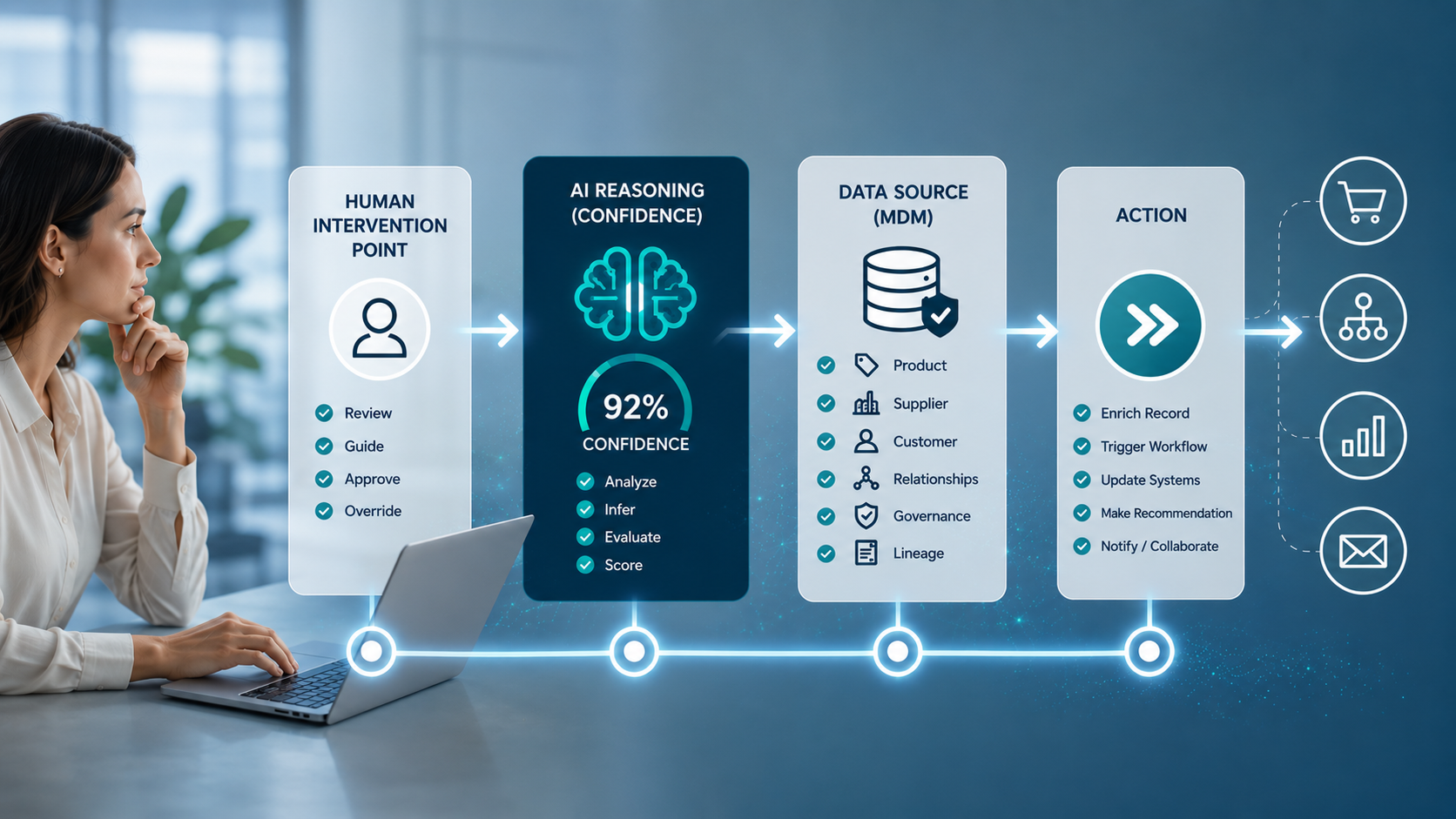
A scoped agent flags every first-pass issue at once instead of one issue per round. Confidence is scored on extraction, revealing exactly which fields need a reviewer.
That’s three or four rounds compressed into one targeted review.
When you want AI agents to do this, it’s important to ask yourself: Does the agent have clearly defined tolerances? Does it know when to flag for review, reject, or allow to pass?
Without that, you've just sped up a broken loop.
Tax #3: Structured data trapped in documents your system can't read
I like to call this one “PDF and scan purgatory.”
- MTRs
- COAs
- MSDSs
- GHS labels
- Third-party certifications
Every one of these arrives as a PDF, a scan or a photograph. A bad one.
Most onboarding flows treat them as attachments. They get filed, and the structured data inside never makes it into the master record. That’s operationally fine, until an audit, a recall or a sustainability report.
An agent that can really read a document pulls the structured data on intake and routes it into the right places.
The PDF still gets filed, but the values that matter are captured, searchable and available downstream the day the document arrives. Not the week somebody finally has time to dig.
When 80% complete isn't complete enough
Even when documents are processed, new supplier records are rarely fully complete.
The 20% that's missing is almost always what downstream systems need. Dimensions the warehouse requires, the hazard class shipping needs before loading a carrier or the country of origin that flags every trade compliance transaction without it.
Instead of inventing the missing data, a capable agent reads more sources at once and flags exactly which field is missing and which downstream system needs it.
That's a much more actionable conversation with your supplier than a flat rejection.
Tax #4: Stalled SKUs that throw off your whole production schedule
Every day a new SKU, component or raw material isn't fully onboarded is a day it's not on the shelf, in the catalog, available to quote or syndicated to a channel partner.
- In automotive, a late launch runs about a million dollars a day
- In electronics, a 9–12 month delay can cost half of expected revenue
- In CPG, it shows up as missed seasonal windows
Most of that drag isn't in the production decision, but the data handoff after the decision was made.
Agentic onboarding compresses that gap. It keeps your schedules intact and removes the need to constantly re-optimize for delays that should never have happened.
Get that right and the rest of the supply chain runs faster without anyone changing their job description.
Two things agentic onboarding needs to work in production, and not just in a demo
You need governance
Agents that read supplier documents and write to your master record need rules, validation, stewardship and an audit trail.
Without those, you've added a fast intake layer on top of a system that can't tell you where a value came from. That's a different problem than slow onboarding – and arguably even worse.
You need downstream wiring
The point of cleaning up supplier data is to make the systems on the other side – PIM, ERP, syndication, commerce, regulatory reporting – see a single governed truth.
Don't look for an agent that ingests in isolation.
With Stibo Systems, your agent plugs into a platform that knows what to do with the data
Stibo Systems was named a Leader in the 2026 Gartner® Magic Quadrant™ for Master Data Management Solutions. In our view, we are recognized for an AI-ready data foundation that’s built to support agentic workflows.
Upload Anything is the Stibo Systems agent built for format-agnostic intake – PDFs, scans, spreadsheets, emails and product images.
Every extracted value is confidence-scored, with low-confidence items flagged for human review. Nothing writes to the master record without passing through the platform's existing governance.
The trusted intelligence platform is what makes that governance part possible:
- Rules engine and validation at the point of entry
- Full stewardship and audit trail
- Live connections to PIM, ERP, syndication, commerce and regulatory reporting
If you're evaluating agentic onboarding, start with the platform question. Any agent can read a document. But not every platform can tell you where the value came from, who approved it and which downstream system it's headed to.
Gartner does not endorse any company, vendor, product or service depicted in its publications, and does not advise technology users to select only those vendors with the highest ratings or other designation. Gartner publications consist of the opinions of Gartner’s business and technology insights organization and should not be construed as statements of fact. Gartner disclaims all warranties, expressed or implied, with respect to this publication, including any warranties of merchantability or fitness for a particular purpose.
GARTNER is a trademark of Gartner, Inc. and/or its affiliates. Magic Quadrant is a registered trademark of Gartner, Inc. and/or its affiliates and is used herein with permission. All rights reserved.
Gartner, Magic Quadrant for Master Data Management Solutions, By Stephen Kennedy et. al, 6 April 2026.