

For years, master data management (MDM) has worked largely behind the scenes.
MDM solutions create trusted records, establish consistent definitions, connect information across systems, and help organizations govern their most important data. That work is essential, but its value has historically been viewed through an operational lens: better data quality, more efficient processes, fewer inconsistencies, and less manual work.
But now agentic enterprise is expanding that role.
As AI agents get bigger roles across supply chain, commerce, marketing, finance, risk, and other business functions, they need reliable data and business context. When agents draw trusted data and business context from a master data platform, MDM evolves from a system that supports the teams managing data into a fundamental part of how the enterprise produces trustworthy decisions and actions.
That shift gives more people a stake in master data. It also changes how organizations should govern, prioritize, and measure the value of their MDM investments.
From specialist platform to shared enterprise infrastructure
Traditionally, responsibility for MDM has been concentrated among data, IT, merchandising, and other operational teams. The platform already supports core processes such as product and supplier onboarding, product publication, and data distribution. These teams maintain the underlying data, govern how it's used, and guide the platform's development.
Other business functions might consume the data without having a direct role in the MDM strategy behind it. But AI agents are changing that dynamic.
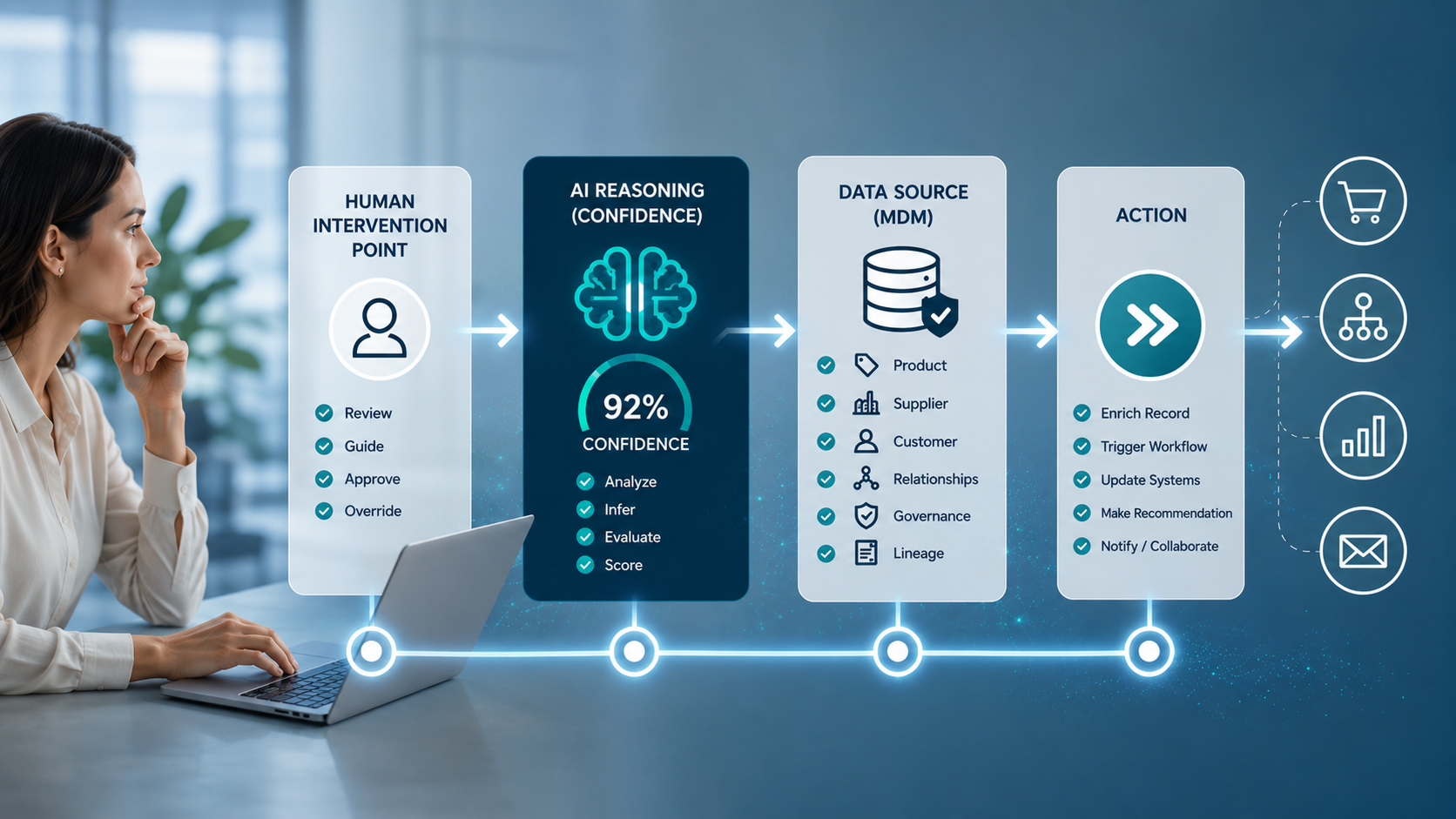
Consider an AI supply chain agent designed to identify alternatives when a product is unavailable. To make a useful recommendation, the agent may need more than an accurate product record. It may need to understand which suppliers provide the product, where inventory is located, which substitutes meet the same requirements, and which contractual or regulatory rules apply.
And consider other AI agents: A commerce agent may need product, customer, location, and pricing context. A risk agent may rely on governed relationships among suppliers, corporate entities, and regions. A service agent may need consistent information about customers, products, warranties, and support entitlements.
The common theme here is that value comes not only from individual records, but from the relationships, classifications, policies, and business definitions surrounding them. Reliable AI agents need governed, trusted business data they can use consistently across decisions and workflows.
This is where multidomain MDM becomes especially important. Enterprise processes rarely fit neatly within a single data domain, and neither do the agents supporting them. A supply chain decision may depend on connected product, supplier, location, and asset data. A commerce interaction may require product, customer, pricing, and location context. By bringing these domains and their relationships together, MDM gives agents a more complete view of the business environment in which they operate.
As agents use this context to support more business processes, the master data platform takes on a broader role. It remains responsible for creating and governing trusted data, but that data now contributes to decisions made well beyond the teams operating the platform.
MDM becomes shared infrastructure for the trustworthy decisions and actions AI agents help produce across the enterprise.
More stakeholders create new questions about ownership
This expanded role doesn't mean every department should start managing master data independently. But it does mean more departments have a legitimate stake in the decisions made about it.
If an agent supporting a finance process depends on customer and supplier data, the finance team has an interest in the quality, meaning, and availability of that data. If a supply chain agent needs new product-to-location relationships, the supply chain team has an interest in how those relationships are modeled and prioritized.
Organizations will need to decide how these stakeholders participate without fragmenting ownership or weakening governance. That starts with four important questions.
Who is accountable for the data behind an agent's action?
AI agents can bring several existing areas of responsibility together.
A data team may maintain the mastered record, and a business function may define the rules or relationships that give it meaning. IT may manage how the agent accesses the data, while an AI team may design the agent and determine how it uses the information.
If that agent recommends or takes an action, accountability can't simply fall to whichever system supplied one part of the answer.
Organizations need a clear view of who owns the data, who owns the business rules, who owns the agent, and who is accountable for the outcome. These responsibilities may be centralized or distributed across the organization, but the rules, decision rights, and lines of accountability shouldn't be ambiguous.
Who approves new uses of master data?
Each new agentic use case introduces questions about purpose, access, risk, and expected value. Which data does the agent require? Is the requested information appropriate for the process? Are the relationships and definitions sufficiently complete? Should the agent only read the data, or should it also be able to propose or make changes?
A defined approval path helps the organization evaluate these questions before data is put into use, rather than after a problem appears. After all, a technical connection doesn't automatically create an approved business use.
Who sets the priorities?
As more teams identify opportunities to use master data, they'll place new demands on the MDM roadmap.
One department may request an additional data domain. Another may need new relationships between existing domains. A third may require more detailed classifications, permissions, or business rules.
These requests won't all carry the same value, urgency, or complexity. Prioritization will need to consider more than technical feasibility, but it will also need to reflect the importance of the business process, the expected contribution of the use case, and the work required to make the underlying data ready for agents.
In other words, the MDM roadmap will increasingly become part of the enterprise AI roadmap.
Can the organization trace the data behind the outcome?
When an agent contributes to a business decision, the organization needs to understand the information and context behind it.
That requires more than knowing that the agent connected to a system. This becomes especially important in agent-to-agent workflows, where data and decisions pass between systems without continuous human review.
Leaders may need to see which records, relationships, classifications, and policies informed the action. Data and AI teams may need that evidence to investigate unexpected results or improve future performance.
Traceability also helps the organization connect the use of master data to the outcome it supported. That becomes important not only for governance, but for understanding value.
The business case for MDM is expanding
This shift creates organizational complexity, but it also creates an opportunity.
MDM value has traditionally been measured through improvements like better data quality, fewer duplicate records, faster onboarding, lower operational effort, and more reliable compliance. Those benefits remain important.
But when governed master data supports an agent working in a core business process, the value of the platform can also be connected to the outcome that process produces.
A supply chain agent might use product, supplier, and location data to identify fulfillment alternatives. Faster access to trusted context could help the organization reduce delayed orders, avoid expedited costs, or improve product availability.
A commerce agent might use governed product and customer information to deliver more relevant recommendations. The resulting outcome could be higher conversion, stronger customer engagement, or fewer returns caused by incomplete information.
A service agent might draw on connected customer, product, and warranty data to resolve cases more quickly and consistently. A risk agent might identify problematic supplier relationships before they create a compliance issue or operational disruption.
MDM isn't the sole source of these outcomes. The agent, model, application, workflow, and people involved all contribute. But when trusted master data makes the action possible, the platform is part of the value chain.
That gives organizations a broader way to evaluate MDM. And it expands the question from, "How efficiently are we managing our data?" to "What can the business accomplish because this data and context are available?"
Measure value where the business impact occurs
Connecting MDM to AI ROI doesn't always mean you have to claim credit for every result an agent produces. As with measuring the broader ROI of MDM, the goal is to connect the investment to tangible benefits and total costs. Which means you need to make a clear connection between the business objective and the data that supports it.
Start by asking five questions:
- What process or decision are we trying to improve? Start with the business need, not the technical connection.
- What role will the agent play? Define whether the agent will retrieve information, make a recommendation, initiate a workflow, or take an action.
- What data and context does the agent require? Identify the records, domains, relationships, hierarchies, classifications, and business rules required for the use case.
- What should improve? Establish the expected change, such as faster decisions, less manual validation, fewer errors, or more consistent execution.
- Which business outcome should reflect that improvement? Connect the use case to an appropriate revenue, cost, productivity, risk, compliance, or customer experience measure.
This creates a practical value chain:
Business process → agent use case → master data dependency → operational improvement → business outcome
Consider an agent that helps resolve supply disruptions. The agent may use governed product, supplier, and location data to find viable alternatives. The immediate improvement could be a reduction in the time required to evaluate options. The broader business outcome might be fewer delayed orders, lower emergency shipping costs, or improved service levels.
The full outcome can't be attributed to MDM alone, but the impact of giving the agent trusted, connected business context can still be identified and measured.
This approach gives leaders a more credible understanding of the platform's contribution than a broad assertion that better data produces better AI.
Put cost in the context of value
AI also introduces new costs.
Organizations may pay for model usage, agent execution, infrastructure, applications, integrations, governance, and access to enterprise data. As agentic use cases grow, leaders will need a clearer picture of where those costs originate and what they produce.
That scrutiny should strengthen the case for disciplined MDM investment, not reduce the platform to another line item.
For each use case, consider:
- Which agents depend on governed master data?
- How often do they consume or update it?
- Which domains and relationships must be maintained?
- What additional governance or oversight does the use case require?
- Which business outcome is the agent expected to influence?
- What validation, reconciliation, or remediation would be needed without trusted data?
- Does the expected value justify the cost of preparing, governing, delivering, and consuming the data?
These questions help organizations select the right use cases and build the right data foundations for them.
They also reinforce an important point: the least expensive connection isn't necessarily the most valuable one. Giving an agent access to incomplete, poorly defined, or disconnected data can shift costs elsewhere through manual verification, rework, inconsistent decisions, or unnecessary risk.
ROI depends on both the value of the outcome and the reliability of the intelligence used to achieve it.
A more strategic role requires a more connected operating model
As MDM becomes part of the enterprise AI foundation, its operating model will need to reflect its broader reach.
The exact approach will vary by organization, but several capabilities will become increasingly important:
- Clear accountability for the data and context behind AI-driven actions
- Defined decision rights for new use cases and access requests
- A structured way to prioritize cross-functional demands
- Traceability between agent actions and their underlying data
- Shared measures connecting MDM investment to business outcomes
- Coordination among data, IT, AI, finance, risk, and the business functions using the agents
The goal here is to make sure the organization can expand the use of master data without losing clarity, control, or focus.
Business leaders need a way to shape the use cases that affect their functions. Data leaders need to protect the consistency and integrity of shared information. Technology leaders need to manage access, architecture, and cost. Finance and executive teams need to understand whether these investments are producing meaningful returns.
MDM sits at the intersection of those priorities.
MDM is the bedrock of enterprise intelligence
The fundamental purpose of MDM isn't changing. Organizations will still need trusted records, consistent definitions, connected domains, and strong governance.
What is changing is the reach of that foundation.
Enterprise AI will make multidomain context increasingly important. Business decisions rarely depend on a product, customer, supplier, location, or asset in isolation. Agents need to understand how those entities relate, which definitions and policies apply, and what those connections mean within a specific business process.
When AI agents can draw on that connected master data, MDM contributes to more than efficient data operations. It supplies the business context behind decisions, recommendations, and increasingly autonomous actions.
That makes the platform more widely used, strategically governed, and directly connected to business value.
It also elevates MDM from a solution working behind the business to a core element of the intelligence moving the business forward.
The next step is to begin asking:
- Which AI agents already depend on our master data?
- Which business processes will depend on it next?
- Who is accountable for the data and context behind their actions?
- How should those use cases influence our MDM roadmap?
- Which outcomes will show us the value of the decisions and actions enabled by that trusted data?
The answers will look different for every organization, but the direction is clear: as AI becomes more deeply embedded in the business, MDM becomes more central to how the enterprise operates, decides, and creates value.
Master data provides the trusted foundation. The decisions and actions it powers are where trustworthy intelligence comes to life.