

Blog Post October 15, 2026 | 7 minutes read

Where the PIM market is headed: Trusted product intelligence for content, AI, and more

Five shifts are redefining PIM as AI raises the bar for governed, trusted product data across content, commerce, and agents.

Select an AI tool to explore this article

Where the PIM market is headed: Trusted product intelligence for content, AI, and more

Master Data Management Blog by Stibo Systems logo
| 7 minutes read
October 15 2026
Where the PIM market is headed: Trusted product intelligence for content, AI, and more
12:46

Product information management (PIM) has always been about more than storing product attributes. At its best, PIM gives organizations the structure, governance, and processes needed to turn fragmented product data into reliable information for customers, channels, and business teams.

It’s a foundation that is becoming more important.

Product data now moves through a growing network of systems, marketplaces, applications, business processes, and AI technologies. It supports everything from digital commerce and supplier collaboration to regulatory compliance and operational decision-making. And more than ever, it must also provide the context AI systems and agents need to generate accurate outputs and take appropriate actions.

As these expectations expand, so does the role of PIM. The market is evolving to connect trusted product data, compelling content, and governed AI across the full product data lifecycle.

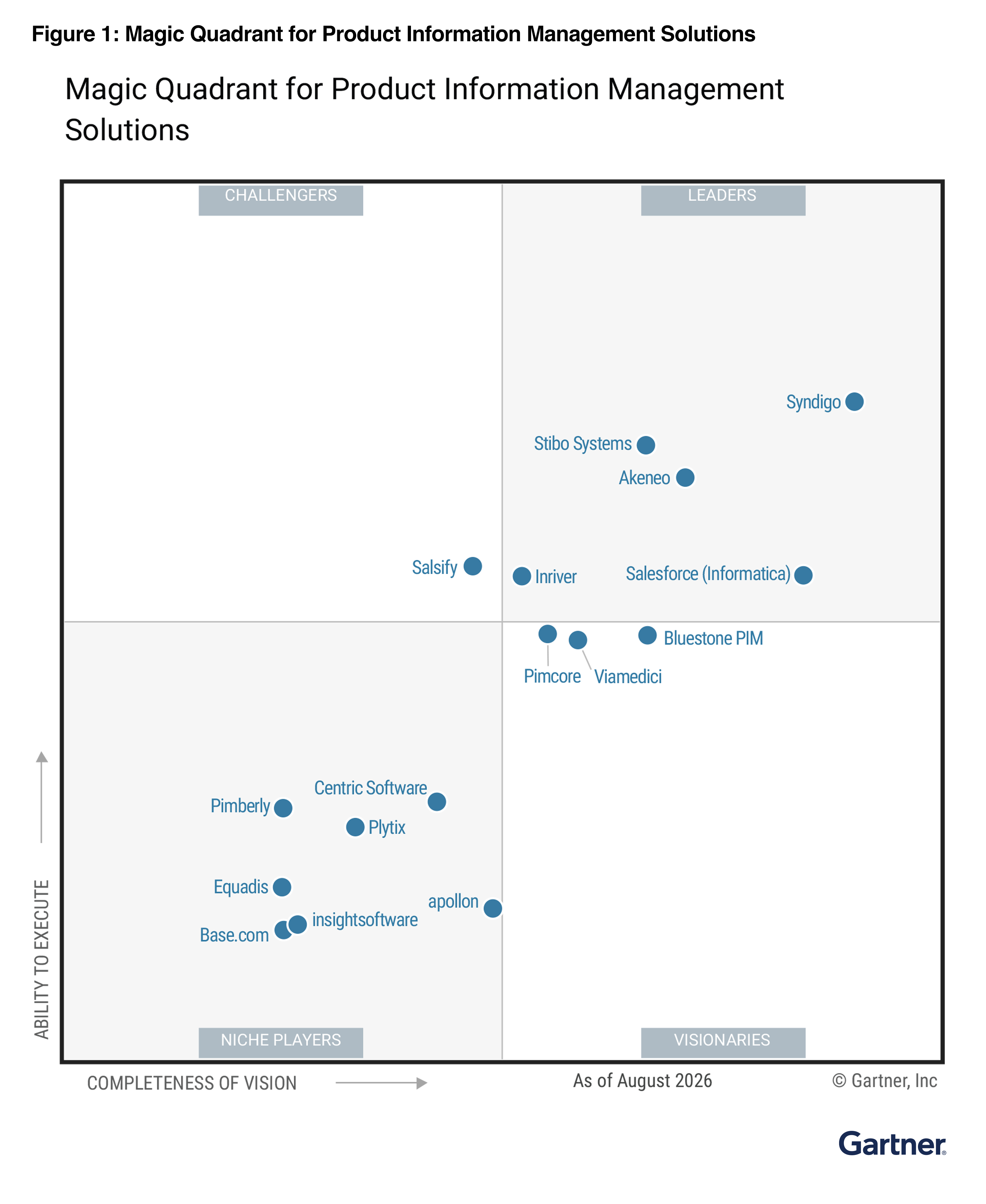
As a Leader in the 2026 Gartner® Magic Quadrant™ for Product Information Management Solutions, we believe the next generation of PIM will combine strong product data foundations, high-performing product content, and governed AI, extending product data’s value across commerce, operational, regulatory, and agentic use cases. And we see five important shifts shaping the future of PIM.

1. AI is raising the bar for product data foundations

The rapid adoption of AI may make it tempting to focus on what the technology can generate. But reliable AI outcomes begin long before the prompt, model, or agent enters the picture.

AI systems need product data that is structured, accurate, machine readable, and rich in context. PIM provides the foundational capabilities that give AI that context, including the ability to manage complex hierarchies, classifications, attributes, relationships, governance, and rich data models.

These functions give meaning to individual pieces of product data. They establish how products relate to one another, which attributes apply to specific categories, what information is required in different markets, and which rules should govern how data is created, approved, and used.

Without that structure, AI may have access to product information without fully understanding what the information means or how it should be applied.

This is why the rise of AI will bring renewed attention to the product data foundation. Organizations need to create and publish content faster, but they also need to ensure that content remains connected to accurate, governed data across multiple sources, domains, markets, channels, and use cases.

Simplified or highly specialized point solutions may help address one stage of the journey. But as product data becomes more closely connected to enterprise operations and AI initiatives, organizations will need governance that extends across the entire lifecycle. Hierarchies, classifications, relationships, governance, and rich data models provide the context AI needs to operate accurately. When the underlying data is wrong or incomplete, AI can repeat the problem at scale.

In short, rather than AI replacing the core disciplines of PIM, we see it making them prerequisites for using product data at greater speed and scale.

2. Great product content starts with product truth

For many organizations, product content has traditionally been one of the most visible outputs of PIM. Complete specifications, compelling descriptions, and channel-ready digital assets remain vital to creating effective customer experiences.

Content activates product data in the moments that shape customer experiences and drive revenue.

The same product information may need to convince a shopper, support an engaging and on-brand description, and give an AI agent enough detail to act. An agent may need to determine whether a product meets a particular requirement, can be sold in a specific market, is compatible with another item, or should be included in a business process.

Both customer-facing content and AI-driven actions depend on governed truth.

Product truth brings together the verified attributes, classifications, relationships, rules, and context that define a product. It helps people, systems, and AI understand not only what a piece of information says, but also what it means, where it came from, how it relates to other information, and whether it can be trusted.

This distinction becomes increasingly important as product data supports a broader range of outcomes. Moving information from one system to another isn’t the same as governing it. Publishing a product description does not, on its own, establish that the specifications behind it are accurate, current, approved, and appropriate for every intended use.

A governed product record can serve many purposes. The same trusted foundation might support an ecommerce listing, a localized description, a regulatory process, an operational workflow, or an action taken by an AI agent. Each output may look different, but all of them depend on consistent product truth.

We’re seeing that AI agents need trusted, machine-readable product data with semantic context, while customer-facing content remains one of several valuable outputs built from that governed foundation. This means that the future of PIM will depend on connecting both needs, governing the product truth behind the content, experiences, decisions, and actions that drive business results.

3. AI needs to operate from governed product data

Generative AI is already changing how organizations enrich, translate, localize, and create product information. This can help teams handle growing content demands across products, channels, languages, and markets.

But the value of AI in PIM won’t come from generation alone.

The more consequential consideration is whether AI is operating from an authoritative product data foundation. If generated outputs are disconnected from governed records, organizations may gain speed without gaining confidence. Teams still need to know which information was used, whether it was approved, and whether the output accurately reflects the product.

Governed AI connects AI tooling to trusted product data, established business rules, and relevant context. This allows organizations to accelerate work while maintaining the controls that protect product data quality and consistency.

For example, within our approach, our ProductGen AI solution activates the governed data in Stibo Systems Product Experience Data Cloud to create PDP descriptions, translations, localization, and channel-specific content directly from the governed golden record, helping content scale without drifting from product truth.

AI agents add another dimension to this evolution. Instead of generating an output for a person to review, agents may discover information, interpret context, or act on product data as part of a broader workflow. Stibo Systems MCP Server allows AI agents to discover and act on governed product data with its semantic context.

As these technologies advance, governance can’t end when product data leaves the PIM system. It must extend from the moment data enters the enterprise through enrichment, distribution, consumption, and AI-driven use.

Ultimately, people and AI need a shared, trusted product data foundation from which to work.

4. PIM’s value is expanding across the product data lifecycle

Product data doesn’t begin in a product detail page, nor does its value end once content has been syndicated to a channel.

Before product information can be enriched and published, it must be collected from suppliers, manufacturers, internal systems, and other sources. The data may need to be normalized, validated, and mapped to the target schema before it becomes part of an authoritative product record.

Once governed, the information must be adapted for different markets, languages, channels, and business requirements. It may also need to support downstream operational, regulatory, analytical, and AI-driven processes.

Managing these stages through separate point solutions can make it harder to maintain the governance, context, and consistency established at the center. As the PIM market evolves, organizations will increasingly look for connected capabilities that support product data from acquisition through consumption.

Product Experience Data Cloud is our solution for PIM and the broader product data lifecycle. It connects product data onboarding, governance, enrichment, and syndication, helping organizations turn product data into trusted product intelligence. ProductGen AI extends that foundation with AI-powered enrichment, translation, and localization.

This connected approach reflects a broader change in how organizations think about PIM. Rather than treating product data acquisition, governance, enrichment, and distribution as isolated activities, businesses can bring them together as parts of one continuous lifecycle.

That continuity will become increasingly valuable as the same product data serves more users and use cases. Reliable AI outcomes, effective product experiences, regulatory processes, and operational decisions all depend on maintaining trust as data moves through the enterprise.

5. Organizations need flexibility to pursue their own AI roadmaps

As the AI landscape evolves, models, platforms, applications, and enterprise priorities will likewise change. But organizations shouldn’t have to rebuild their product data strategy every time the technology surrounding it changes.

This makes open architecture an important consideration for the next generation of PIM. Product data must connect with commerce platforms, enterprise applications, analytics environments, supplier ecosystems, and AI technologies. Organizations also need the freedom to choose the models and platforms that fit their requirements.

An open, independent, and model-agnostic architecture allows the product data foundation to remain stable while the surrounding technology ecosystem evolves. Organizations can connect product data with different ecosystems and AI platforms, giving them the flexibility to pursue their own AI roadmaps on their own terms and timelines. The enduring strategic asset is not any one AI model. It is the governed data, relationships, business context, and organizational knowledge that AI uses.

Models may change, use cases may expand, and new agents and applications will emerge. A trusted and adaptable product data foundation allows organizations to evolve alongside those technologies without losing control of the intelligence that powers them.

Building the product data foundation for what comes next

The future of PIM begins with trusted product data.

When that foundation powers compelling content and governed AI, organizations can create better experiences, support more accurate decisions, and turn product truth into business value.

We see a future where hierarchies, classifications, relationships, governance, and rich data models provide the structure AI needs. Lifecycle governance maintains trust as data moves through the enterprise, governed AI helps organizations enrich and apply product information at scale, and open architecture provides the flexibility to adapt as ecosystems and AI strategies evolve.

Together, these capabilities move PIM toward a broader role: creating trusted product intelligence that can support customer experiences, regulatory requirements, operational processes, business decisions, and AI-driven actions.

As AI increases the number of ways product data can be used, organizations will need to ask more of their PIM platforms, not less.

From our perspective, success will come to those that invest not only in what AI can produce, but in the product data foundation that makes those outputs reliable.

Stibo Systems named a PIM Leader by Gartner

Stibo Systems was named a Leader in the 2026 Gartner® Magic Quadrant™ for Product Information Management Solutions. We believe this recognition reflects our ability to govern trusted product intelligence, the foundation for compelling content, trusted product experiences, and more accurate AI outcomes.

Download the report to explore the Gartner assessment of recognized vendors, review the evaluation identified for Stibo Systems, and learn more about the evolving PIM market.
Get the report
2026-gartner-pim-magic-quadrant

Gartner, Magic Quadrant for Product Information Management Solutions, Jason Daigler, Greg Carlucci, Nicholas Mortensen, 12 October 2026

Gartner and Magic Quadrant are trademarks of Gartner, Inc. and/or its affiliates.

This graphic was published by Gartner, Inc. as part of a larger research document and should be evaluated in the context of the entire document. The Gartner document is available upon request from Stibo Systems.

Gartner does not endorse any company, vendor, product or service depicted in its publications, and does not advise technology users to select only those vendors with the highest ratings or other designation. Gartner publications consist of the opinions of Gartner’s business and technology insights organization and should not be construed as statements of fact. Gartner disclaims all warranties, expressed or implied, with respect to this publication, including any warranties of merchantability or fitness for a particular purpose.


Master Data Management Blog by Stibo Systems logo

Fueled by curiosity and cafecitos, Calianne helps organizations go to market with product strategies that deliver impact and drive competitive advantage. With global experience in enterprise data management organizations, she specializes in translating complex technologies into clear, compelling business value.


Connect on:

Discover blogs by topic

  • See more
  • AI
  • Automotive
  • Business Partner Data Cloud
  • Compliance and risk management
  • Consumer packaged goods
  • Customer Experience Data Cloud
  • Customer and party data
  • Customer experience and loyalty
  • Data compliance
  • Data delivery
  • Data governance
  • Data integration
  • Data modeling
  • Data quality
  • Data sharing
  • Data sourcing
  • Digital asset management
  • Digital shelf analytics
  • ERP success
  • Enhanced content
  • Financial services
  • Insurance
  • Life sciences
  • Location Data Cloud
  • Location data
  • MDM strategy
  • Manufacturing
  • Multidomain data
  • Operational efficiency
  • Platform
  • Product Experience Data Cloud
  • Product data and PIM
  • Product data syndication
  • Product onboarding
  • Retail
  • Supplier Data Cloud
  • Supplier data
  • Sustainability
  • Translation and localization
  • User experience
October 15, 2026

Where the PIM market is headed: Trusted product intelligence for content, AI, and more

September 23, 2026

Why business partner relationships complicate master data management

September 16, 2026

Turn your SAP S/4HANA migration into an AI-ready data foundation

September 4, 2026

Turning data platforms into business value with master data management

September 3, 2026

5 master data failures that turn reliable AI models into unreliable agents

September 2, 2026

If we have Snowflake and Databricks, why do we still need master data management?

August 27, 2026

Why fragmented customer data is now a major compliance risk for financial services firms

August 26, 2026

4 reasons banks and insurers cannot scale AI without trusted Customer 360

August 19, 2026

Why good policies are no longer enough to prove compliance

August 11, 2026

Buyers are better informed than ever — but are they making better decisions?

August 10, 2026

Why enterprise AI stalls at scale — and why data is the barrier leaders must solve

August 5, 2026

Introducing the master data management maturity model

August 3, 2026

Digital product passports: The data management mandate

July 31, 2026

How to build data governance that holds up across agent-to-agent AI workflows

July 30, 2026

Why master data management is critical to reliable AI agents

July 27, 2026

Is your data ready for AI agents? 5 tests to find out

July 24, 2026

From zero to launch in under 6 months: A quick guide to deploying master data management

July 23, 2026

5 key trends in product experience management

July 23, 2026

The new rules of competition in agentic commerce

July 22, 2026

Why the data standard that powers your reports will let your AI agents down

July 21, 2026

The 5 data standards that determine whether your AI agents succeed or fail

July 20, 2026

Why most AI initiatives fail before the model ever runs

July 20, 2026

Solving retail data fragmentation: The key to consistent customer journeys

July 20, 2026

What’s next for GenAI in product experiences?

July 20, 2026

Is your PIM strategy future-ready? 3 takeaways from the SPARK Matrix™ report

July 19, 2026

CDP and MDM: Complementary forces for enhancing the customer experience

July 17, 2026

Reyes Holdings' MDM journey to better data

July 17, 2026

PIM explained: How product information management transforms data quality

July 16, 2026

Why trust is the real bottleneck in agentic commerce

July 16, 2026

How to avoid bad retail customer data

July 16, 2026

10 dangerous myths about managing your B2B partner and account data

July 16, 2026

Master data management tools: A complete guide

July 15, 2026

How agentic workflows are changing master data management at the core

July 14, 2026

How to implement master data management: Steps and challenges

July 13, 2026

How Signet Jewelers built trust in its retail data

July 13, 2026

A modern guide to data quality monitoring: Best practices

July 13, 2026

Guide: Get enterprise data enrichment right with master data governance

July 10, 2026

Guide: How to comply with industry standards using master data governance

July 9, 2026

How to evaluate MDM vendors in a market full of acquisitions

July 9, 2026

Guide: Improving your data quality with master data governance

July 9, 2026

How operations leaders are modernizing manufacturing data without halting production

July 9, 2026

Guide: Getting enterprise data modelling right with master data governance

July 9, 2026

How URBN leverages data management to support its sustainability information 

July 8, 2026

Why agentic AI demands a digital twin of the business

July 8, 2026

AAPEX and SEMA: The automotive aftermarket industry’s mega-showcase

July 7, 2026

Trust the machine: Making AI automation reliable in master data management

July 7, 2026

Is your data the cause of flawed AI outputs?

July 7, 2026

Risks of using LLMs in your business – what does OWASP have to say?

July 6, 2026

Navigating change: Engaging business users in successful change management

July 6, 2026

Consumers are using AI-powered tools to shop smarter: Why retail data trust matters more than ever

July 6, 2026

Building Supply Chain Resilience: Strategies & Examples

July 4, 2026

Gen Z: Seeking excitement beyond Amazon

July 3, 2026

How CPG company Bonduelle centralized product data across 37 countries

July 2, 2026

AI adoption: A high-stakes gamble for business leaders

July 2, 2026

Why data accuracy matters for CPG brands

July 1, 2026

Building the future of construction with AI and MDM

July 1, 2026

Why choose a cloud-based data solution: On-premise vs. cloud

June 19, 2026

AI systems want clean data – but they NEED governed intelligence

June 17, 2026

Bosch and Stibo Systems partner for enterprise data transformation

June 17, 2026

With semantic master data, your AI stops guessing and starts understanding what you want

June 17, 2026

5 hidden costs of bad customer data in retail (and how to avoid them)

June 12, 2026

The complete PIM features guide: The capabilities you need for successful data strategies

June 12, 2026

5 product data problems that make your brand invisible in AI search

June 11, 2026

4 common master data management implementation styles

June 11, 2026

Designing trust in agentic enterprise systems

June 8, 2026

AI and master data: The business powerhouse

June 8, 2026

Master data meets Microsoft Fabric: Building a trusted foundation for AI and analytics

June 4, 2026

7 signs your brand is losing ground in agentic commerce

June 1, 2026

The future of master data management: Trends in 2026

June 1, 2026

What is a data domain? Meaning and examples

May 28, 2026

8 best practices for customer master data management

May 27, 2026

Data migration to SAP S/4HANA ERP: The fast and safe approach with MDM

May 25, 2026

Model context protocol (MCP): The missing layer for AI systems that interact with enterprise data

May 21, 2026

Better together: CRM and customer master data management

May 21, 2026

4 supplier onboarding taxes that drain margin every day – and how agentic AI fixes them

May 20, 2026

The 7 types of customer data your AI agents can't ever act without

May 19, 2026

What is master data governance – and why do you need it?

May 18, 2026

The difference between master data and metadata

May 13, 2026

Product attribution strategies that convert searchers into buyers

May 12, 2026

How to choose the right master data management solution

May 12, 2026

PIM and MDM: Key differences, benefits and how they work together

May 12, 2026

5 CPG industry trends and opportunities for 2026

May 11, 2026

A quick guide to golden customer records and how to create them with master data management

May 11, 2026

What is master data management? A complete guide

May 11, 2026

Master data management roles and responsibilities

May 8, 2026

What is application data management and how does it differ from MDM?

April 30, 2026

6 features of an effective master data management solution

April 22, 2026

What is the difference between CPG and FMCG?

April 17, 2026

Most common ISO standards in the manufacturing industry

March 18, 2026

A complete master data management glossary

February 24, 2026

BIC's blueprint for conquering complex global product data challenges

February 17, 2026

Product 360 after the Salesforce acquisition: Why you need to map out a plan B

February 16, 2026

What is digital asset management?

January 13, 2026

Discover the value of your data: Master data management KPIs and metrics

January 12, 2026

5 key manufacturing challenges in 2026

December 9, 2025

Product listing page best practices: How to create better product listings with PIM

December 8, 2025

The board of directors’ guide to selecting product experience software (with checklist)

December 5, 2025

5 PIM trends that will define 2026 and the near future (and how to prepare for them)

December 4, 2025

Process insurance claims faster with trusted data

December 3, 2025

Fixing fragmented customer account data: Stop losing revenue and trust

December 2, 2025

How master data management keeps manufacturers compliant — from design to delivery

November 20, 2025

What is manufacturing-as-a-service (MaaS)?

November 18, 2025

AI in retail: How to make your data ready to use in Microsoft Fabric

November 17, 2025

What is party data? All you need to know about party data management

October 27, 2025

How to estimate ROI of master data management

October 20, 2025

Managing product complexity: Leveraging custom product management with BOM-level precision

October 2, 2025

How CPG brands scale D2C business without breaking what already works

September 24, 2025

How leading brands built trusted data with Amplifi and Stibo Systems

August 19, 2025

10 signs you need a master data management platform

August 14, 2025

How to get started with master data management: 5 steps to consider

August 13, 2025

The 5 biggest retail trends in 2026

August 12, 2025

What vendor data is and why it matters to manufacturers

August 5, 2025

What is reference data and reference data management?

August 3, 2025

3 reasons high-quality supplier data can benefit any organization

August 1, 2025

How to improve back-end systems using master data management

July 9, 2025

How to get more value from your data: The benefits of master data management

May 12, 2025

Manufacturing trends and insights in 2026

March 17, 2025

What is smart manufacturing and why does it matter?

March 7, 2025

MDM and AI: Real-world use cases and learnings from OfficeMax and Motion Industries

February 3, 2025

4 trends in the automotive industry

January 29, 2025

How to choose the right data quality tool?

January 27, 2025

All you need to know about supplier information management

January 27, 2025

How Kramp optimizes internal efficiency with data strategy

January 27, 2025

From patchwork to precision: Moving beyond outdated and layered ERP systems

January 24, 2025

Thriving beyond NRF 2025 with trustworthy product data

January 17, 2025

Why addressing data complexity in pharmaceutical manufacturing is critical

January 14, 2025

An introductory guide to supplier compliance

December 17, 2024

How to implement data governance

December 9, 2024

What is supply chain analytics and why it's important

December 5, 2024

What is supplier lifecycle management?

December 3, 2024

Using machine learning and MDM CBAM for sustainability compliance

October 22, 2024

Live shopping: How to leverage product information for maximum impact

September 23, 2024

How master data management can enhance your ERP solution

September 3, 2024

How to improve your data management

August 30, 2024

Digital transformation in the CPG industry

August 27, 2024

Responsible AI relies on data governance

August 19, 2024

Making master data accessible: What is data as a service (DaaS)?

August 13, 2024

Great data minds: The unsung heros behind effective data management

August 6, 2024

A data monetization strategy – get more value from your master data

July 31, 2024

What is augmented data management? (ADM)

July 17, 2024

GDPR data governance and data protection – a match made in heaven?

April 11, 2024

Guide: Deliver flawless rich content experiences with master data governance

March 25, 2024

How to get rid of customer duplicates

March 18, 2024

5 tips for driving a centralized data management strategy

February 20, 2024

How to enable a single source of truth with master data management

February 12, 2024

What is data quality and why it's important

February 7, 2024

Data governance trends 2026

February 6, 2024

What is data compliance? An introductory guide

January 18, 2024

How to build a master data management strategy

January 16, 2024

The best data governance tools you need to know about

November 29, 2023

Shedding light on climate accountability and traceability in retail

November 13, 2023

Location analytics – all you need to know

October 16, 2023

Understanding the role of a chief data officer

October 5, 2023

5 common reasons why manufacturers fail at digital transformation

September 29, 2023

How to digitally transform a restaurant chain

September 14, 2023

3 benefits of moving to headless commerce and the role of a modern PIM

July 6, 2023

12 steps to a successful omnichannel and unified commerce

June 28, 2023

Navigating the current challenges of supply chain management

April 6, 2023

Product data management during mergers and acquisitions

March 1, 2023

Asset data governance is central for asset management

February 14, 2023

How to leverage Internet of Things with master data management

February 13, 2023

Sustainability in retail needs governed data

January 4, 2023

Innovation in retail

November 21, 2022

Life cycle assessment scoring for food products

November 14, 2022

Retail of the future

November 7, 2022

Omnichannel strategies for retail

November 5, 2022

Hyper-personalized customer experiences need multidomain MDM

October 25, 2022

What is omnichannel retailing and what is the role of data management?

October 1, 2022

An introductory guide: What is data intelligence?

September 15, 2022

Revolutionizing manufacturing: 5 must-have SaaS systems for success

August 25, 2022

Digital transformation in the manufacturing industry

August 17, 2022

Master data management framework: Get set for success

June 15, 2022

Supplier self-service: Everything you need to know

June 14, 2022

Omnichannel vs. multichannel: What’s the difference?

June 10, 2022

Create a culture of data transparency – begin with a solid foundation

May 31, 2022

What is location intelligence?

May 30, 2022

Omnichannel customer experience: The ultimate guide

May 24, 2022

Omnichannel commerce: Creating a seamless shopping experience

May 11, 2022

Top 4 data management trends in the insurance industry

May 1, 2022

What is supply chain visibility and why it's important

April 21, 2022

The ultimate guide to data transparency

April 20, 2022

How manufacturers can shift to product as a service offerings

April 16, 2022

How to check your enterprise data foundation

April 14, 2022

An introductory guide to manufacturing compliance

March 31, 2022

Multidomain MDM vs. multiple domain MDM

March 23, 2022

How to build a successful data governance strategy

March 22, 2022

What is unified commerce? Key advantages and best practices

March 17, 2022

6 best practices for data governance

March 16, 2022

5 advantages of a master data management system

February 24, 2022

Supply chain challenges in the CPG industry

February 14, 2022

Top 5 most common data quality issues

February 10, 2022

What is synthetic data and why it needs master data management

February 8, 2022

What is cloud master data management?

January 28, 2022

Build vs. buy master data management software

January 27, 2022

Why is data governance important?

January 24, 2022

5 reasons your data governance initiative could fail

January 21, 2022

How to turn your data silos Into zones of insight

January 16, 2022

How to improve supplier experience management

January 16, 2022

How to improve supplier onboarding

January 11, 2022

What is a data quality framework?

Let’s get started

Ready to see how trustworthy intelligence turns data into confident decisions? Let’s chat.

2