

It's a time of big ambition for AI agents. There's a huge demand for systems that can complete tasks, coordinate workflows, make decisions, and keep operations moving with less human intervention.
The appetite for autonomy is clear, but the confidence required to grant it is still developing.
New Stibo Systems research found that 37% of U.S. business leaders allow AI to act autonomously only when human-review checkpoints are in place. Another 26% permit autonomous action in select business-critical workflows. Just 12% allow it broadly across core processes.
These findings point to an autonomy gap. Organizations can see the potential of agentic AI, but most aren't ready to let it act freely across the business.
Closing that gap will take better evidence, not just capable agents.
What would make businesses grant AI more autonomy?
When asked what would increase their willingness to give AI greater autonomy, leaders focused on three areas:
- 42% want greater confidence in AI accuracy
- 36% want better data quality
- 31% want stronger explainability and traceability
Together, these findings reveal what enterprise autonomy depends on. Leaders need confidence that an agent is working with reliable information, understands the relevant business context, and can show how it reached a conclusion. This starts with understanding why master data management is critical to reliable AI agents, particularly when agents move from generating answers to taking action.
That evidence matters because enterprise decisions rarely depend on one isolated piece of data.
An agent making a product recommendation might need accurate product attributes, supplier terms, inventory availability, customer preferences, location-specific requirements, and regulatory information. It may also need to understand the relationships among them.
Reliable records provide an essential foundation. Connected data gives the agent a fuller view of the decision it's being asked to make.
Agents need context, not just access
Giving an agent access to more data doesn't automatically give it greater understanding.
Enterprise data carries meaning through relationships, hierarchies, definitions, policies, and rules. A product may be approved for one market and restricted in another. A supplier may be preferred for one category but unavailable in a particular region. A customer may qualify for an offer based on a combination of account history, location, consent, and contractual terms.
An agent needs those connections to interpret the information correctly.
This is where multidomain data becomes especially important. The challenge grows in multi-agent processes, where data governance needs to hold up across every agent-to-agent handoff. Product, customer, supplier, location, and asset data may be managed by different functions, but the decisions AI supports often span several of them.
When those domains remain disconnected, the agent may have access to individual facts without understanding the full business picture. Teams are then left to gather the missing context, reconcile conflicting information, and validate the result before anyone can act on it.
Connected, contextualized data gives agents stronger evidence. It also gives people a clearer basis for deciding how much authority an agent should have.
Build autonomy in stages
AI autonomy doesn't need to be an all-or-nothing decision. Organizations can expand it gradually as the evidence, controls, and confidence around a use case improve.
A practical progression might look like this:
1. Recommendation
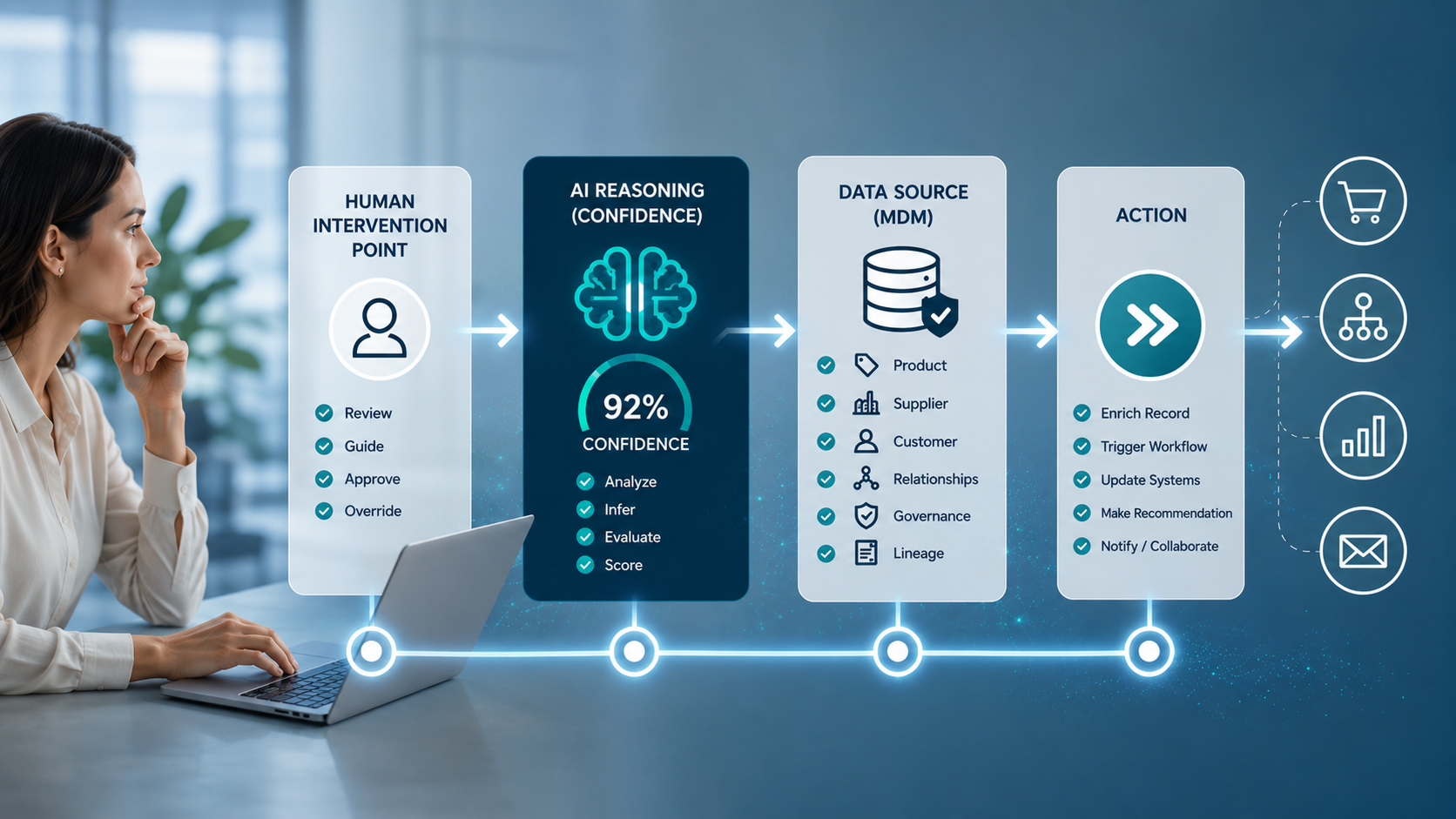
The agent analyzes information and recommends an action. A person reviews the evidence and makes the decision.
This level can help organizations test the quality and usefulness of an agent's reasoning while maintaining direct human control. It also provides an opportunity to identify missing data, unclear business rules, or recurring exceptions.
2. Human-approved action
The agent recommends an action and prepares the next step, but a person must approve it before execution.
Human approval remains a defined part of the workflow, while the agent takes on more of the analysis and preparation. Traceability becomes especially important here because reviewers need to understand the data, context, and rules informing the recommendation.
3. Bounded autonomous action
The agent acts independently within a defined set of conditions. Those boundaries may include specific workflows, data domains, transaction values, confidence thresholds, user groups, or exception rules.
People continue to govern the process through permissions, monitoring, escalation paths, and reviewing exceptions. The agent gains more freedom within an environment the organization can explain and control.
This phased approach lets organizations build confidence through real operating experience. Each step creates evidence about where the agent performs reliably, where human judgment adds value, and where the underlying data or controls need to improve.
Make every action traceable
As agents take on more responsibility, organizations need to understand the basis for their actions.
That includes being able to answer questions like these:
- Which records and sources informed the decision?
- Was the data current, complete, and approved?
- Which relationships and business rules did the agent apply?
- What action did the agent take?
- Who or what authorized it?
- When should the decision be escalated for human review?
Traceability gives teams a way to investigate unexpected outcomes, demonstrate compliance, refine agent behavior, and defend consequential decisions. It can also make human review more efficient.
Without traceability, reviewers must reconstruct the reasoning themselves. Missing lineage is one of five master data failures that can turn reliable AI models into unreliable agents. They search for source records, compare information across systems, and investigate whether the agent applied the right context. That detective work adds to the AI Trust Tax: the hidden preparation, reconciliation, validation, and rework required before AI output can be used with confidence.
With traceable data and decisions, people can focus their attention on the exceptions and judgments that genuinely require their expertise.
Give agents better evidence before greater freedom
AI agents will play a larger role in enterprise workflows. The pace of that expansion will depend on how confidently organizations can stand behind the resulting actions.
Accurate data is part of the answer. Agents also need connected business context, clear governance, explainable reasoning, and traceable decisions. Together, those elements help organizations move from AI recommendations toward carefully bounded autonomous action.
Rather than aiming for maximum autonomy in every process, the objective here is to achieve the right level of autonomy for each decision, supported by evidence the business can understand, govern, and trust.
Before agents get more freedom, give them better evidence.
Learn more about what U.S. enterprise leaders are saying about the time, rework, and confidence lost when AI can’t be trusted
Explore findings