

Product onboarding should be straightforward. Suppliers provide their information, teams check it against their requirements, and new products move into the systems and workflows that bring them to market.
In practice, the journey is rarely that simple.
Every supplier has their own way of working. One sends a spreadsheet with custom column headers, while another shares technical specifications in a PDF. The information may be organized differently, use different terminology, or arrive with attributes that do not map neatly to the receiving company’s product data model.
While it’s true that a product information management system can provide the structure needed to govern that information once it arrives, teams are still on the hook to get supplier data into the right structure first. That often means manually identifying categories, mapping attributes, validating values, fixing errors, and going back to suppliers for clarification.
That makes intake one of the most stubborn bottlenecks in product onboarding, even for organizations with mature data management processes.
Why is product onboarding still so difficult?
Retailers, manufacturers, distributors, and wholesalers need more product information from a growing number of suppliers. At the same time, customers expect detailed specifications, accurate descriptions, images, videos, and other content wherever they encounter a product.
The demand for information keeps increasing, but the supplier onboarding process often begins with files that weren’t created for the receiving organization’s data model.
A supplier may be asked to:
- Reformat existing product information
- Learn a new portal or template
- Match unfamiliar attribute names
- Identify the correct product categories
- Fill gaps against the recipient’s requirements
- Correct errors through repeated email exchanges
The receiving team faces the other side of the same problem. Data stewards and onboarding specialists must interpret each submission, determine where the products belong, map supplier terminology to internal attributes, and identify missing or invalid information.
That manual work makes it difficult to increase the number of suppliers, categories, and products being onboarded — without also increasing the effort required to support them.
Templates shift the work instead of removing it
Traditional onboarding processes frequently place the burden of transformation on the supplier.
The supplier receives a template, transforms existing information to match it, and submits the result. If the format, categories, or values are incorrect, the file goes back for rework. That creates friction for the supplier and more support work for the organization collecting the data.
Templates can create consistency once suppliers follow them correctly. But they don’t eliminate the work required to translate existing information into an unfamiliar structure. They simply determine who has to do it.
Why intake is the real onboarding bottleneck
Incoming supplier information must be interpreted before it can be governed. Teams need to understand the file structure, identify the products and categories involved, connect supplier terminology to internal attributes, and determine whether the information meets established requirements.
When those steps depend heavily on manual work, every new supplier or data source introduces another mapping and validation exercise. The process may be manageable for one file, but it becomes difficult to scale across growing assortments, categories, and supplier networks.
The role of AI in product onboarding
Agentic AI can take on repetitive interpretation work without removing established controls from the onboarding process.
An AI agent can examine the format, structure, and contents of an incoming supplier file, compare that information with the receiving organization’s schema, and help determine how the data should be categorized and mapped. Validation can then surface missing or incorrect information before products move into downstream processes.
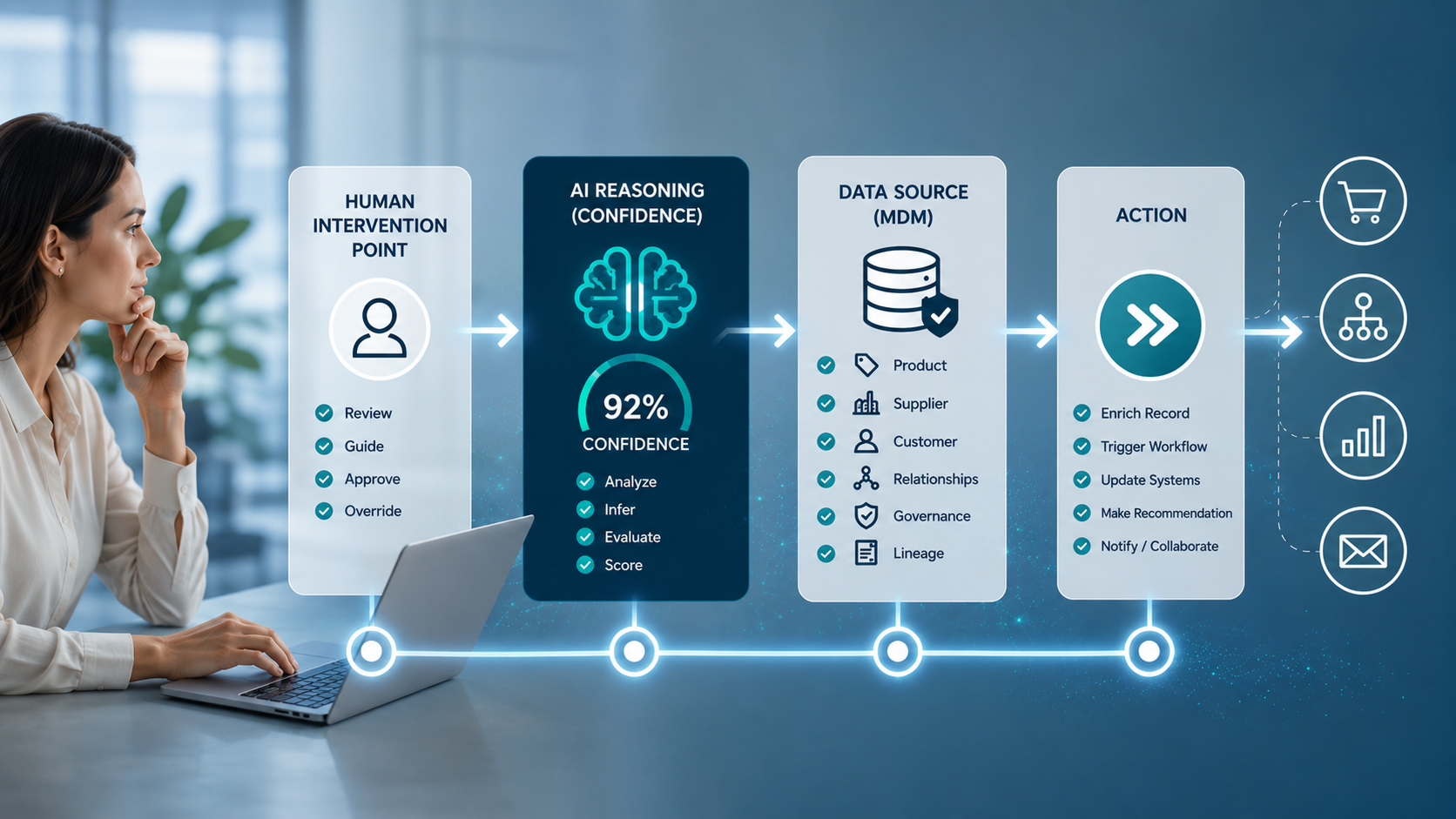
The objective here isn’t autonomous onboarding without oversight, but a more efficient division of work. In this scenario, AI handles repetitive interpretation and mapping while people retain visibility into the decisions, issues, and exceptions that require attention.
What value can AI-assisted onboarding deliver?
Applied effectively, AI-assisted onboarding can help supplier information move from its existing format into a governed workflow faster, with less manual interpretation and fewer exchanges between suppliers and onboarding teams.
The potential benefits extend across the onboarding process:
Less supplier back-and-forth
Suppliers can begin with familiar files rather than repeatedly reformatting information to fit a new template.
Less manual mapping
The agent helps interpret supplier attributes and connect them to the receiving organization’s data model.
Earlier issue identification
Validation helps surface missing or incorrect information before products move further downstream.
Fewer support demands
A more guided process can reduce the hands-on effort required from supplier onboarding and support teams.
More scalable assortment growth
Organizations can onboard more suppliers, products, categories, and content without increasing manual work at the same rate.
These outcomes support a larger objective: helping businesses expand their assortments and bring products to market faster without sacrificing data quality or control.
How can teams prepare for agent-assisted onboarding?
Organizations don’t need to wait for an implementation project to start examining whether this approach could create value.
Begin by mapping the current onboarding process and identifying where it breaks down:
- How long does it take for a new product or item to go live?
- Where does the process slow down?
- How much time is spent transforming or correcting supplier files?
- How often do teams go back to suppliers for missing information?
- Which formats, categories, or attributes create the most support work?
- What prevents the organization from onboarding more suppliers or products?
Teams should also speak with the people who manage supplier relationships. They often see friction that isn’t visible from a workflow diagram, such as suppliers struggling with unfamiliar templates, broken files, unclear requirements, or tools they rarely use.
Mapping those pain points creates a practical baseline. It helps the organization identify where an agent could reduce repetitive work and where human expertise, review, or supplier collaboration will still matter.
This assessment helps distinguish where the problem lies. It may be the file formats suppliers use, unclear requirements, repeated mapping work, missing information, or the tools suppliers are expected to navigate. Identifying that friction provides a practical baseline for deciding where AI can reduce repetitive work and where human expertise still matters.
Meet the Upload Anything Agent
Our Upload Anything Agent is a productized AI agent designed to help organizations onboard new product data sources faster.
Instead of requiring suppliers to restructure product information before submitting it, the agent automatically maps incoming files to the receiving organization’s schema and requirements. Upload Anything helps:
- Map supplier attributes to the receiving data model
- Validate whether the product information meets defined requirements
- Identify issues that need attention before submission
- Move the prepared product data into the established onboarding workflow
The agent meets suppliers where they are while helping the receiving organization move their information into the structure the business needs.
How does Upload Anything work?
Within our Product Data Onboarding solution, suppliers submit product information using common spreadsheets or PDF documents. The agent interprets the file, suggests categories and attribute mappings, and helps identify data issues. Users can then review the results, address exceptions, and continue through established validation and submission processes.
The assisted intake process ends where the standard governed onboarding workflow begins. That helps reduce repetitive preparation work without separating the incoming data from existing quality controls.
Keep people involved where judgment is needed
Faster onboarding shouldn’t mean removing control.
The agent can suggest categories and attribute mappings, but human users can always review the results and address issues before the data moves forward.
This is particularly important for product information. An incorrect category or attribute mapping can affect search, navigation, compliance, syndication, and the customer experience. Automating the early interpretation work can reduce manual effort, while review and validation help keep the resulting data aligned with business requirements.
The end goal goes beyond simple autonomous onboarding without oversight. The true vision is a more efficient division of work in which AI handles repetitive interpretation and mapping, while people retain visibility into the decisions and exceptions that require attention.
From supplier files to market-ready product information
Agentic AI becomes most useful when it addresses work teams already know is slow, repetitive, and difficult to scale.
Product onboarding is a strong example. Supplier information may already be useful and well managed, but it still needs to be interpreted, categorized, mapped, and aligned with the receiving organization’s requirements before it can power listings, content, syndication, and other downstream processes.
Upload Anything helps take on that early interpretation and mapping work while keeping review, validation, and established onboarding workflows in place.
Suppliers can begin with the information and formats they already use. The agent helps align that information with the receiving business’s data model and requirements, while people remain involved in resolving issues and guiding the process forward.
The result is more than a faster file upload. It’s a more scalable way to bring new catalog sources online, create market-ready product information, and accelerate speed to shelf.
Frequently asked questions
What is the Upload Anything Agent?
Upload Anything is a productized AI agent that helps onboard new product data sources faster. It interprets incoming supplier files and maps supplier attributes to the target data model, helping onboard new catalog sources faster to accelerate speed to shelf.
What file formats does the Upload Anything Agent support?
The initial release focuses on common spreadsheets and PDF documents, including supplier files and technical specifications. Support for additional formats is on the roadmap.
Does the Upload Anything Agent replace human review?
No. The agent suggests categories and attribute mappings, while users can review the results, address issues, and validate the data before submission. This reduces repetitive interpretation and mapping work while keeping people involved where judgment is needed.
How does the Upload Anything Agent work with existing onboarding processes?
The agent helps interpret, categorize, and map incoming supplier information before it moves into standard validation and submission processes. The agent works within our Product Data Onboarding solution, with established onboarding workflows continuing after the agent prepares the data.
What are the benefits of AI-assisted product onboarding?
AI-assisted onboarding can reduce manual attribute mapping, supplier back-and-forth, support demands, and the time required to identify data issues. It can also help organizations onboard more suppliers, products, and categories without increasing manual effort at the same rate.
How can retailers reduce time to market with better product data onboarding?
Retailers can reduce time to market by making it easier to collect, map, and validate supplier product data before it's published and enters downstream workflows. Accepting information in familiar supplier formats, identifying categories and attribute mappings earlier, and surfacing missing or incorrect values before submission can reduce manual work, repeated corrections, and supplier back-and-forth. This creates a more scalable path from incoming supplier information to trusted, governed product data that is ready for commerce.