

Product content has always helped customers understand what they are buying. But increasingly, customers aren’t the only audience evaluating that information.
AI answer and generative engines, shopping assistants, and other agents are beginning to interpret product data on a buyer’s behalf. They may use it to answer questions, compare alternatives, explain trade-offs, or determine which products satisfy a detailed request.
This changes the question brands need to ask.
It’s no longer just, “Can customers find this product?” It’s also, “Can an AI system understand it, compare it, and include it in an answer?”
Meeting this new demand takes more than producing additional product copy. Teams need to identify the facts, relationships, and business context that help shoppers and AI systems understand when, where, and why a product fits.
The challenge is that this context may be scattered across product records, brand guidelines, technical documentation, regulatory requirements, and knowledge held by internal teams. Bringing it together accurately and consistently becomes even harder across large catalogs, markets, languages, and channels.
Why product attributes alone may not be enough
It starts with the product record. This is something that can be technically complete but still fail to answer the questions an AI system needs to resolve.
Consider a washing machine. Its governed product record may contain:
- Dimensions
- Capacity
- Energy rating
- Materials
- Available programs
- Installation requirements
- Country of origin
- Packaging information
These facts matter. But a buyer may ask a more contextual question: “Which washing machine is best for a small apartment, frequent laundry, and low energy use?”
To answer confidently, an AI system needs more than isolated attribute values. It needs enough context to understand how those attributes relate to the buyer’s intended use.
That context may include use cases, compatibility, certifications, audience needs, brand guidance, regulatory constraints, or other approved business knowledge. Without it, an AI system may have accurate data but still lack the information required to compare products meaningfully.
This creates a new content challenge. Businesses must maintain product truth while making that truth more useful to systems that interpret questions, evaluate options, and generate answers.
AEO and GEO require continuous improvement
Answer engine optimization (AEO) and generative engine optimization (GEO) are not one-time content exercises.
An organization can’t optimize a handful of product descriptions, consider the work finished, and assume its products will remain visible and accurately represented across AI-generated answers.
Instead, AEO and GEO require a continuous loop:
- Understand how customers ask questions
- Assess whether each product can answer those questions
- Identify missing facts, relationships, or context
- Improve the governed product information
- Turn that information into clear, channel-ready content
- Distribute the updated content
- Monitor how products are represented in AI-driven experiences
- Apply those learnings to the next round of improvement
Supporting this loop requires a repeatable way to turn governed attributes and approved business knowledge into clearer, richer product representations.
But the underlying foundation still matters. If compatibility, certification, availability, or use-case information is missing from the governed product record, polished copy can’t reliably compensate for it.
AEO and GEO may reveal the weakness, but the real task is improving the product information itself.
From AI search to agentic commerce
AEO focuses on whether an AI system can find, interpret, and accurately represent a product in an answer.
Agentic commerce raises the stakes.
As AI systems take on more of the discovery, comparison, and evaluation process, product information may influence not just what appears in an answer but also what remains under consideration for future action.
Better product data can’t guarantee that an AI system will recommend a product. But it can make that product:
- More answerable
- More comparable
- More accurately represented
- Easier to evaluate against customer intent
- More governable across the content lifecycle
The broader shift is from competing only for human attention to competing for accurate interpretation and selection by AI.
A product may never reach a customer’s consideration set if the system acting on the customer’s behalf can’t establish basic compatibility, interpret an important certification, or retrieve the context needed to compare it with alternatives.
That lost opportunity may also be difficult to see. There may not be an abandoned cart, website bounce, or failed search to analyze because the product was excluded before the customer visited a brand-owned channel. That’s because the market is shifting from traditional website signals toward AI-mediated evaluation, recommendation, and purchasing.
The question every product team should ask
Every product team should ask one practical question:
If an AI agent evaluated one of your most important products today against a detailed customer need, which missing fact might remove it from consideration?
Would it be:
- A compatibility detail?
- Current availability?
- A certification?
- A use case?
- A material or ingredient?
- A relationship between the product and an accessory?
- Business knowledge that exists somewhere in the organization but never reaches the product record?
This is a useful exercise because it moves the conversation beyond producing more content.
The objective here is to identify the facts and context that help customers and AI systems determine whether a product fits a specific need.
How can teams prepare product content for AI?
Businesses can start by selecting a small but important group of products and comparing the governed product information against the questions customers actually ask.
For each product, consider:
- Are the core attributes complete and current?
- Is compatibility clearly represented?
- Are relevant certifications structured and accessible?
- Does the record include meaningful use-case context?
- Can different products be compared using consistent attributes?
- Are relationships to accessories, variants, or complementary products explicit?
- Is the content grounded in approved brand and business knowledge?
- Can teams trace generated content back to trusted product information?
This process can reveal whether the problem is primarily content quality or whether essential facts are missing from the product foundation.
If the underlying information is absent, the first priority isn’t a better prompt. It’s better governed product data.
Strengthening the product data foundation is always the first priority. Once that’s established, teams then need a practical way to turn governed facts and approved business knowledge into content for shoppers, channels, and answer engines.
That’s where our Content Optimizer Agent comes in.
Meet the Content Optimizer Agent
Our Content Optimizer Agent generates product content from governed master data and approved business context.
The agent uses product attributes already mastered in STEP, our trusted intelligence platform, to generate product descriptions, AEO/GEO content, and marketing copy directly from those governed attributes. It adds the use-case context AI engines need to recommend the right product for the right request, helping brands create AEO-ready content that can reach every market without being rewritten by hand for each one.
The agent works with:
- Governed product truth: The trusted attributes already managed in STEP.
- Approved business knowledge: The guidelines, rules, and contextual information that shape how those facts should be represented.
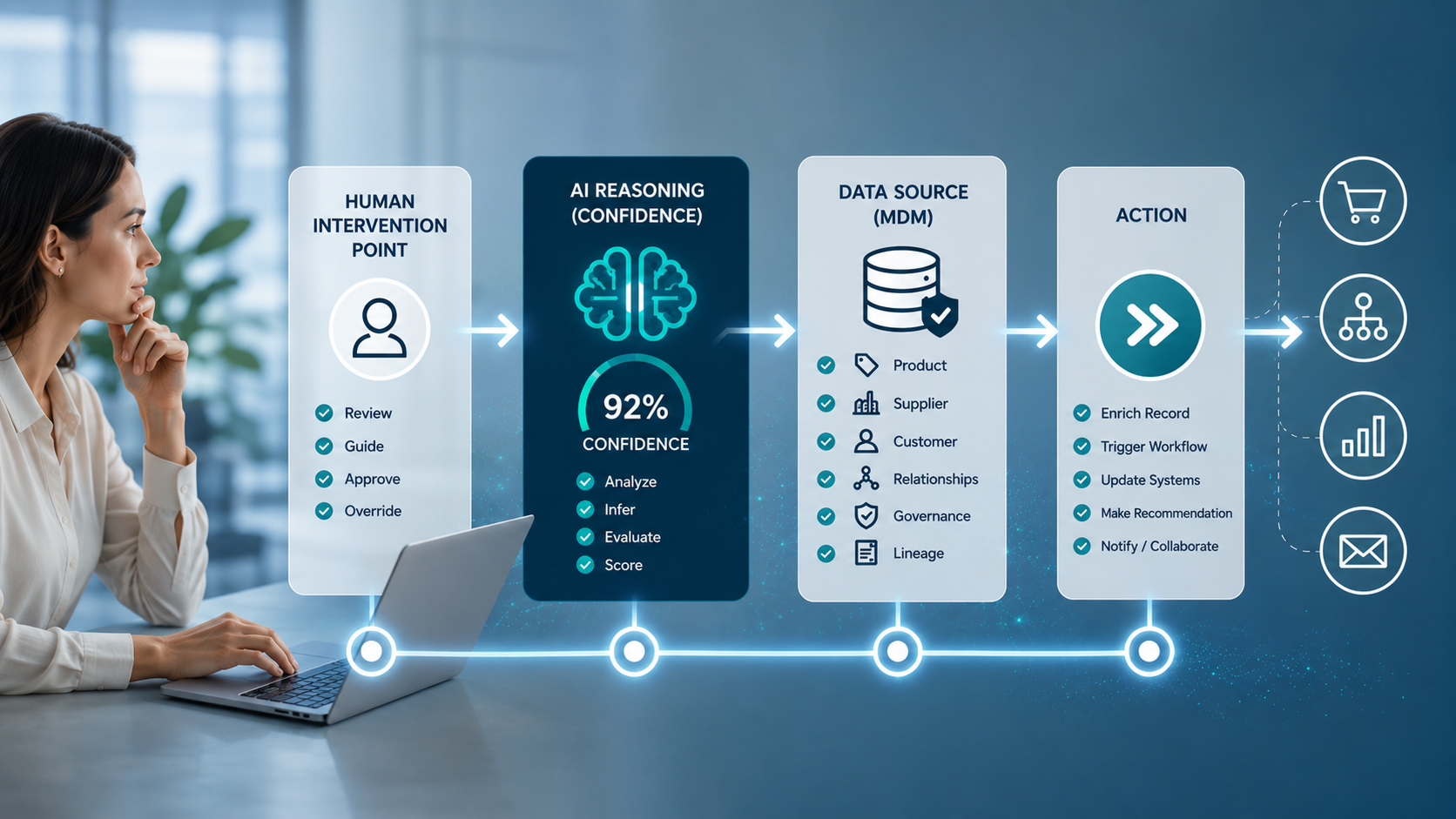
- A defined workflow: A process through which people can review, refine, approve, and distribute the generated content.
The agent uses the available evidence to improve how the product is represented, while leaving the final approval to the human user.
This is different from a general-purpose AI tool, which only knows what someone types into the prompt. If the prompt leaves out the country of origin or the allergen statement, the tool may fill the gap with something plausible. Our Content Optimizer Agent starts from the attributes already mastered and governed in STEP, so the copy reflects product truth.
How does Content Optimizer Agent work?
Within Product Experience Data Cloud, the workflow starts with product records in STEP at different stages of preparation before publication. Each record contains governed master data, space for additional AEO-oriented context, and references to relevant business knowledge.
Content Optimizer combines those inputs to generate contextual content that could then move through a review and approval process.
The resulting content can include:
- Product descriptions
- Channel-specific marketing copy
- AEO-, GEO-, and SEO-ready content
- Rich product details
- Use-case context that helps AI evaluate and recommend a product
The goal isn’t content generation for its own sake, but to turn mastered product facts into content that remains accurate, consistent, and useful across digital channels and AI-mediated experiences. And to keep content governed and traceable, with human review before publication.
Why human review still matters
AI can accelerate content creation, but speed isn’t the only requirement.
Product content must accurately represent the underlying product. It may also need to follow brand standards, channel requirements, regulatory constraints, or market-specific rules. A fluent answer isn’t automatically an accurate or approved one.
Content Optimizer keeps the final decision with the user. This means teams can review, refine, approve, and distribute generated content through an established workflow.
This creates a practical division of work:
- STEP provides governed product truth
- Business knowledge adds brand and operational context
- The agent generates or improves content using available evidence
- People review and approve the final output
That balance helps teams move faster without separating content generation from the data and governance processes behind it.
From a blank prompt to governed content
Generative AI has made content production faster. But the more consequential opportunity is making content production trustworthy, contextual, and connected to enterprise data.
Content Optimizer shows us what that model can look like in practice.
Rather than asking AI to invent a product story from scratch, the agent begins with governed product truth. It applies approved business knowledge, identifies where context can improve the representation, and helps produce content for channels, search engines, and AI-assisted discovery. People remain involved in the final decision.
That model supports more than efficiency. It helps organizations maintain a reliable connection between what the business knows about a product and what customers or AI systems ultimately see.
AEO is the visible requirement, while agentic commerce is the broader shift. And trusted, contextual product information is the foundation for both — and something businesses can strengthen today.
Frequently asked questions"
What is the Content Optimizer Agent?
Content Optimizer is a productized AI agent that creates product descriptions, channel-specific marketing copy, AEO-, GEO-, and SEO-ready content, and richer product details from governed STEP attributes and approved business knowledge.
How is Content Optimizer different from a general-purpose AI writing tool?
Content Optimizer Agent doesn’t begin with a blank prompt like other AI writing tools. Instead, it uses governed product data to create content grounded in trusted information. Users retain the final decision by reviewing, refining, and approving content before publication.
What types of product content can Content Optimizer Agent create?
Content Optimizer can create product descriptions, channel-specific marketing copy, AEO-, GEO- and SEO-ready content, rich product details, and use-case context that helps AI systems understand and evaluate products.
Does Content Optimizer Agent replace human review?
No. People remain responsible for reviewing, refining, approving, and distributing generated content. This helps ensure that content accurately represents the product and follows applicable brand standards, channel requirements, regulatory constraints, and market-specific rules.
How does Content Optimizer Agent support AEO and agentic commerce?
Content Optimizer helps turn governed attributes and approved business context into product content that AI systems can interpret and use when answering questions, comparing alternatives, and evaluating products against customer needs. Better product data cannot guarantee a recommendation, but it can make products more answerable, comparable, accurately represented, and governable.
How can brands optimize product content for AI search and answer engines?
Start with complete, governed product data, then add the context AI systems need to interpret that data against a customer’s question. This may include compatibility, certifications, availability, intended uses, product relationships, and approved business knowledge. Content should answer specific customer needs clearly while remaining traceable to trusted product information.
How do AI search engines discover and evaluate products, and what data do they need?
AI search and answer engines use available product information to answer questions, compare alternatives, and evaluate products against specific needs. Complete specifications remain important, but systems may also need structured relationships, use-case context, compatibility details, certifications, and other facts that clarify when and why a product fits. Better product information cannot guarantee inclusion in an AI-generated answer, but it can make products easier to understand, compare, and represent accurately.
How can consumer brands prepare product data for the AI-powered digital shelf?
Brands should assess whether their product records can answer the questions customers ask across search, commerce, and AI-assisted experiences. That means maintaining accurate attributes, filling important contextual gaps, applying consistent taxonomy and terminology, and connecting product content to approved brand, market, and regulatory knowledge. Teams should also establish a continuous process for reviewing questions, identifying missing information, improving governed records, distributing updated content, and measuring results.
How should product data be structured for Amazon, Google, and other digital marketplaces?
Product data should be structured consistently enough to support the requirements of each destination while remaining grounded in one governed product record. Clear attributes, identifiers, categories, variants, relationships, specifications, and channel-ready content make it easier to adapt information without recreating the product story for every destination. Content Optimizer can help turn governed STEP attributes and approved business knowledge into channel-specific product descriptions, marketing copy, and AEO- and SEO-ready content, with human review before publication.