
AI has moved from experimentation to productivity.
Which now forces us to grapple with one big question: What's the business getting back?
At this point, most organizations have invested in models, infrastructure, applications, and agents. Those investments are beginning to produce faster workflows, new capabilities, and promising use cases. But they can also create another layer of work around the AI itself.
Teams prepare data, reconcile conflicting records, gather missing context, validate outputs, and investigate how the AI reached its conclusions. The technology may accelerate one part of a process while creating a new validation workflow around it.
That hidden effort is the AI Trust Tax. And it can quietly consume some of the value AI was meant to create.
To combat this tax, the next step is to reduce the preventable work surrounding AI. That way, more of the investment translates into measurable value.
Start with the decision the agent needs to improve
It's tempting to begin an AI initiative by asking where you could deploy an agent. Starting with the decision or workflow you want to improve gives the project a clearer purpose.
What should happen faster? Where could greater consistency create value? Which manual steps slow the process today? What would a better outcome mean for the business?
From there, determine what the AI will need to make or support that decision:
- Which data domains are involved?
- What business rules and policies apply?
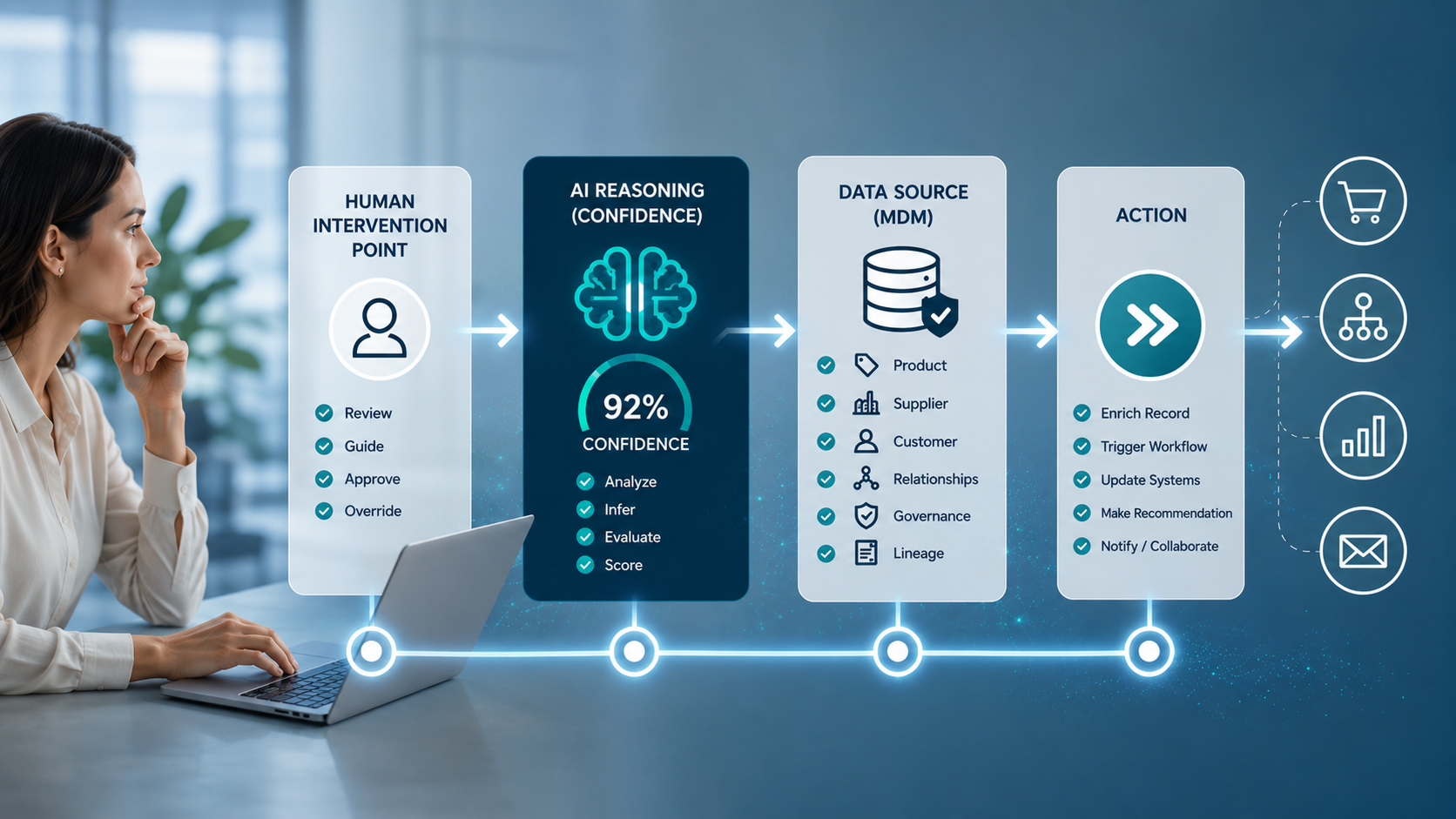
- What level of human review is appropriate?
- What evidence would someone need to explain or defend the result?
- How will the business measure whether the workflow has improved?
An agent creates value by improving a meaningful process with the right combination of speed, consistency, context, and control. Autonomy may be part of that equation, but it shouldn't be the only measure of success.
Give AI the full business picture
Data quality remains fundamental. As AI takes on decisions that span the enterprise, it also needs the relationships and context connecting individual records.
Consider an agent supporting a product decision. Product data may be central, but the agent could also need supplier information, customer expectations, inventory conditions, location data, contractual terms, or regulatory requirements.
Without those connections, the AI may produce an answer that appears reasonable but lacks the context needed to use it confidently.
The AI data challenge now extends across quality, relationships, context, and control.
That means giving AI access to accurate records and the business meaning around them. It needs to understand:
- How products, customers, suppliers, locations, and assets relate
- Which definitions, classifications, and hierarchies the business uses
- Which policies and rules govern a decision
- Who can access, change, approve, or act on information
- Where the underlying data came from
- How the result can be traced and explained
Together, these elements turn a collection of records into business context. They can also reduce the preparation, reconciliation, and investigation teams perform after an AI output has already been generated.
Choose where to consume AI and where to create it
There's no single path for bringing agents into the enterprise.
Some use cases are common and repeatable. A ready-to-use capability that can be configured around your data model may provide the fastest path to value.
Other workflows might reflect your distinctive processes, data, and expertise, which in turn may call for custom agents designed around how the business actually operates.
Most organizations will likely use a combination of both.
In either case, the agents should operate within the same governance and enterprise controls as the data they use.
Permissions, security, orchestration, traceability, and review requirements need to be part of the agent's design from the beginning. Adding them later creates more work and can limit how confidently the business uses the capability.
That becomes even more important as agents work across domains. An agent drawing from product, customer, supplier, and location data should follow the rules, ownership, and permissions governing those records.
Greater autonomy calls for stronger guardrails.
Measure the return and the work required to trust it
Measuring AI adoption is relatively easy. Organizations can count deployments, users, interactions, completed tasks, and time saved.
A fuller measure of AI value also considers the work surrounding those outcomes.
Consider tracking:
- Time spent preparing data for AI
- Time spent validating or correcting outputs
- Records and sources reconciled manually
- Outputs that require human intervention
- Ability to trace an output to its underlying data
- Time required to complete the target workflow
- Productivity, cost, revenue, or experience improvements created
Taken together, these measures provide a clearer picture of the return.
A workflow may appear faster until a data team spends hours resolving inconsistencies before anyone can use the output. An agent may complete more tasks without creating more value if employees must repeatedly check and correct its work.
Human judgment will remain essential, particularly when decisions carry significant financial, regulatory, operational, or customer consequences. Better data, context, and governance help people focus that judgment where it adds the most value.
The goal is fewer preventable problems to correct and better evidence for the decisions people still need to make.
Evolve AI activity into trustworthy intelligence
AI has already demonstrated that it can generate more intelligence. The next phase is making that intelligence reliable enough to support meaningful action.
That progression starts with trusted data. It advances through connected business context, clear governance, explainability, and traceability. Together, those elements create trustworthy intelligence: intelligence that people and AI can act on with confidence.
The AI invoices are already adding up. To improve the return, it's time to examine what AI is producing, what it takes to trust its results, and how much value remains after the validation work is done.
The real measure of AI progress goes beyond how many agents get deployed.
It's how confidently those agents can contribute to decisions that hold up.