

Blog Post November 25, 2026 | 8 minutes read

Why AI needs multidomain MDM to understand your business

Learn why enterprise AI needs multidomain MDM to connect trusted data, business context, governance, and relationships across critical data domains.

Select an AI tool to explore this article

Why AI needs multidomain MDM to understand your business

Master Data Management Blog by Stibo Systems logo
| 8 minutes read
November 25 2026
Why AI needs multidomain MDM to understand your business
14:18

At Stibo Systems Connect 2026, Forrester Principal Analyst Shylaja Nathan joined us as a guest speaker for a session exploring the future of master data management (MDM) in the age of AI. This blog combines key themes from that discussion with our own perspective on what organizations should consider as they prepare MDM for enterprise AI.

AI can access more enterprise data than ever. But access doesn't necessarily guarantee understanding.

An AI system may retrieve an accurate customer record, product specification, supplier profile, or financial figure and still reach the wrong conclusion. The problem may not be the individual data point. It could actually be everything the AI doesn't know about the business around it.

For example, what does "customer" mean to the business? Which source should be trusted? How are two entities related? Which policies apply? Does the user or agent have permission to access the information or act on it?

These questions become more important as organizations move beyond isolated AI experiments. AI is increasingly expected to support decisions, automate processes, generate content, answer complex questions, and act across the enterprise.

That requires more than just endless data — it also requires trusted data in business context.

Multidomain MDM can help establish that foundation by connecting the critical entities AI needs to understand, including customers, products, suppliers, locations, assets, and more. It also provides the definitions, relationships, hierarchies, quality signals, and governance that help AI interpret those entities correctly.

What works for one AI pilot may not scale

Many AI pilots begin with a narrow use case and a carefully prepared dataset. A project team identifies the relevant sources, creates direct connections, resolves obvious data issues, and gives the AI enough context to perform one defined task.

That approach can produce a successful pilot. But it's a lot harder to repeat across dozens of use cases, systems, data domains, and AI agents.

Each new use case may require teams to answer the same fundamental questions:

  • Which data sources should the AI use?
  • Which information is authoritative?
  • How does the organization define the entities and metrics involved?
  • Which relationships and rules affect the answer?
  • Who can access the data?
  • What actions can an agent take?
  • How can teams trace the information behind the output?

Solving those questions independently for every AI project creates additional complexity. Definitions may vary from one use case to another. Agents may draw from different sources or interpret the same information inconsistently. Point-to-point connections can become difficult to govern and maintain as the number of AI applications grows.

Enterprise AI needs a reusable data foundation: trusted information and consistent business context that don't need to be rebuilt for every new initiative.

AI needs trusted data in business context

Accurate data is essential, but accuracy alone may not be enough.

Imagine an AI system analyzing business performance. The underlying revenue figures may be correct, but the analysis could still be unreliable if the system doesn't understand the company's reporting definitions, geographic structure, accounting policies, customer relationships, or recent business events.

The AI can produce a fluent and credible answer while missing the context that gives the data meaning.

The same problem appears across enterprise use cases.

A product identifier doesn't explain whether two products are compatible. A customer record doesn't automatically reveal the household, account, or organizational relationships surrounding it. A supplier record doesn't capture every policy, risk factor, or contractual constraint that affects how the business works with that supplier.

For AI to interpret enterprise data reliably, it may also need:

  • Shared business definitions
  • Entity relationships
  • Hierarchies and classifications
  • Rules and constraints
  • Data-quality and trust indicators
  • Provenance and authoritative sources
  • Access rights and usage policies
  • Enterprise-specific knowledge

This context helps turn isolated data points into information that reflects how the business actually operates.

Instead of placing every definition, rule, or piece of knowledge inside a master data platform, the goal is to establish trusted entities and relationships that provide consistent reference points across the enterprise.

AI decisions cross data domains

Many business questions can't be answered within a single data domain.

Consider an AI agent supporting a product return. The agent may need to understand the customer, the purchased product, the original order, the supplier, the sales channel, the return location, and the applicable policy. Each record may be accurate on its own, but the decision depends on the relationships among them.

Other use cases require similar connections:

  • A product recommendation may depend on product attributes, customer context, inventory location, and supplier availability.
  • A compliance review may require product, supplier, market, and regulatory information.
  • A service interaction may involve a customer, account, product, asset, warranty, and location.
  • A supply chain decision may combine supplier, product, facility, location, and risk data.

This is where multidomain MDM becomes particularly valuable.

Traditional MDM establishes trusted records for critical business entities. Multidomain MDM also connects those entities, giving applications and AI systems a more complete view of the relationships that shape business decisions.

But that doesn't mean every piece of enterprise data must be mastered. Transactions, interactions, documents, sensor data, and other operational information will continue to live in the systems best suited to manage them.

The role of multidomain MDM is to help establish the trusted entities and relationships that give this broader information context.

Governance can't end at the golden record

Creating an accurate golden record is a foundational MDM objective. For enterprise AI, governance must also extend to the moment data is accessed and used.

An AI application may need different information depending on the user, business process, jurisdiction, and intended action. An agent authorized to answer a product question should not automatically have permission to modify a regulated attribute, approve a supplier, or expose restricted customer information.

This surfaces a few more considerations:

  • Which data the AI can access
  • Which source should be treated as authoritative
  • Which business definitions and policies apply
  • Which quality requirements must be met
  • Which actions an agent can take
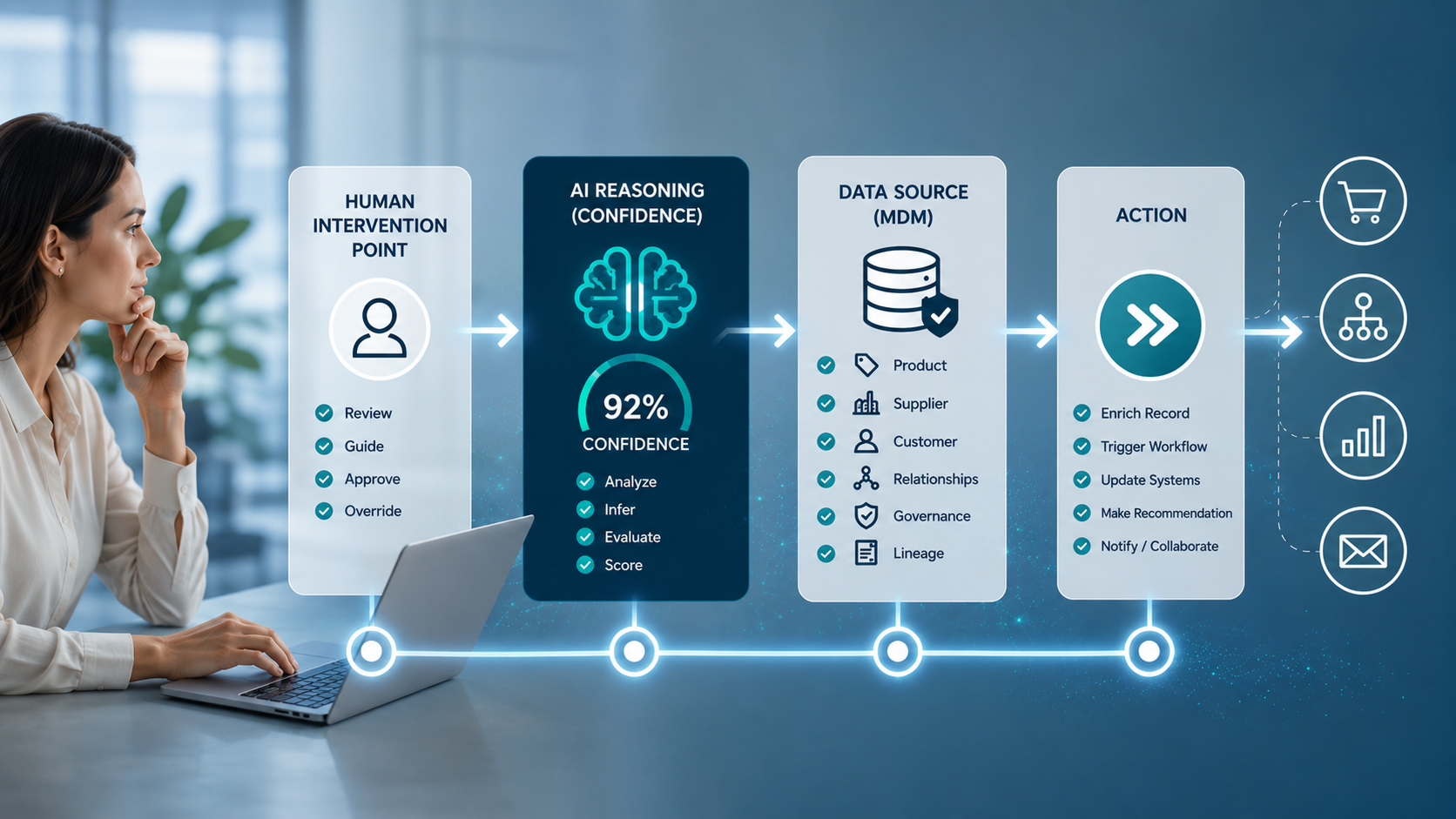
  • Where human review or approval is required
  • How the inputs, decisions, and actions can be traced

These controls become especially important with agentic AI. Unlike a traditional application following a predetermined sequence, an agent may interpret a goal, choose among available tools, retrieve information, and act dynamically.

The opportunity is significant, but so is the need for clear boundaries.

Trusted master data can provide AI with authoritative records, entity relationships, classifications, quality signals, and approved context. Governance can help ensure that information is used within the policies and permissions established by the organization.

MDM needs to work beyond the MDM platform

AI will rarely rely on master data alone.

A useful answer or action may require mastered entities alongside transactions, documents, interactions, analytical data, and real-time operational information. This means trusted master data must be available within a broader enterprise data and AI ecosystem.

MDM can contribute several critical elements:

  • Consistent entity identity
  • Agreed business definitions
  • Trusted relationships and hierarchies
  • Data-quality indicators
  • Classifications and business metadata
  • Governance rules and policies
  • Connections across data domains

Other systems can provide the transactions, events, documents, and operational details surrounding those entities.

Together, these sources give AI both the trusted reference points and the situational information needed to interpret a question accurately.

This makes architecture an important part of AI readiness. Organizations need ways to make governed master data and business context available to different applications, models, and agents without requiring every use case to build a separate connection or recreate the same logic.

An open, flexible approach also gives organizations greater freedom as their AI technology, providers, and priorities change.

AI will change how MDM work gets done

MDM can help create a stronger foundation for AI. AI can also change how you manage master data.

Many MDM activities involve large volumes of data and repeated decisions. Teams classify records, review suggested matches, resolve exceptions, enrich attributes, assess quality issues, and apply policies across complex datasets.

AI can assist with this work by:

  • Recommending classifications and matches
  • Identifying potential duplicates or anomalies
  • Suggesting enrichment based on approved information
  • Supporting onboarding and validation
  • Learning from patterns in stewardship decisions
  • Helping teams locate relevant rules and context
  • Generating content from governed product data

Rather than removing people from governance, the objective here is to reduce repetitive effort. This helps stewards focus on decisions that require business expertise and accountability.

Human review remains important, particularly when a decision affects regulated data, customer outcomes, financial reporting, product safety, or another high-impact process.

The strongest approach combines AI assistance with established rules, workflows, permissions, and approvals.

What AI-ready MDM looks like in practice

Preparing MDM for enterprise AI doesn't require mastering everything or redesigning the entire data estate at once. It starts with the business outcomes that matter and the context required to support them.

1. Start with the decision or outcome

Define what the AI should help the organization accomplish. A product recommendation, supplier-risk assessment, customer-service action, and compliance review will each require different data and context.

Beginning with the outcome helps prevent teams from collecting or mastering information without a clear purpose.

2. Identify the entities and relationships involved

Determine which customers, products, suppliers, locations, assets, accounts, or other entities the AI needs to understand.

Then document the relationships that shape the use case. An isolated record may provide a fact, but the relationship often provides the meaning.

3. Define the business context

Identify the definitions, policies, hierarchies, classifications, rules, and quality thresholds that affect how the information should be interpreted.

This is where business participation becomes essential. Technical access to data cannot substitute for agreement on what the data means.

4. Connect the relevant domains

Establish consistent identity and relationships across the data domains involved in the outcome. Multidomain MDM can provide a connected foundation without forcing every source or data point into one system.

5. Extend governance into AI use

Define which information the AI can access, which sources it should trust, which actions it can take, and where review or approval is required.

Traceability should also be considered from the start. Teams need to understand which data and context influenced an important output or action.

6. Make trusted context accessible

Integrate mastered entities and approved context into the broader data and AI architecture. The goal is to make trusted information reusable across applications and agents rather than rebuilding the same connections and definitions for each project.

7. Learn and improve

Monitor how AI uses the data, where quality issues appear, and which decisions require additional context. Feed those insights back into data governance, stewardship, and MDM processes.

After all, AI readiness is an ongoing discipline, not a one-time data-cleaning exercise.

Turn trusted records into trusted intelligence

AI readiness is more than just a question of whether a model can access enterprise data. True AI readiness depends on whether the model can interpret that data within the definitions, relationships, rules, and context of the business.

Multidomain MDM gives organizations a way to establish that foundation across the critical entities AI must understand. It connects trusted records and relationships while preserving the governance required to use them responsibly.

As AI moves from isolated pilots into business processes and agentic workflows, trusted data and trusted context will increasingly need to travel together.

That's the opportunity for MDM in the age of AI: not to master every piece of enterprise information, but to provide the trusted entities, relationships, and business context that help AI understand what the information means.


Forrester does not endorse any company, product, brand, or service included in its research publications and does not advise any person to select the products or services of any company or brand based on the ratings included in such publications. Information is based on the best available resources. Opinions reflect judgment at the time and are subject to change. This report is part of a broader collection of Forrester resources, including interactive models, frameworks, tools, data, and access to analyst guidance. For more information, read about Forrester’s objectivity here.


Frequently asked questions

Why do AI initiatives fail without strong master data?

AI initiatives can produce unreliable results when enterprise data is incomplete, inconsistent, duplicated, or disconnected from the definitions and relationships needed to interpret it. Strong master data provides trusted records, entity resolution, hierarchies, relationships, quality signals, and governance. These capabilities give AI a more dependable foundation for answering questions, supporting decisions, and taking action.


Not every AI use case depends on master data to the same degree. Master data becomes particularly important when AI works with critical enterprise entities, operates across business processes, or makes decisions involving customers, products, suppliers, locations, assets, or accounts.


Which MDM solution is best for multidomain MDM across product, customer, and supplier data?

The best multidomain MDM solution depends on the data domains, relationships, governance requirements, architecture, scale, and business outcomes an organization needs to support.

Buyers should evaluate whether a platform can:

  • Govern product, customer, supplier, location, and other critical enterprise data
  • Preserve the distinct requirements of each domain
  • Connect relationships across domains
  • Support complex hierarchies, classifications, and business rules
  • Apply governance and data-quality controls at scale
  • Integrate trusted data and context with enterprise applications and AI
  • Adapt as business requirements and technology ecosystems evolve

Stibo Systems is designed for complex multidomain requirements, connecting trusted enterprise data and business context across products, customers, suppliers, locations, and other critical entities.

Master Data Management Blog by Stibo Systems logo

Ankit Holani, Director of Analyst Relations at Stibo Systems, leads the company’s global engagement with leading analyst firms including Gartner, Forrester, IDC and others. He drives analyst relations and strategic market positioning, helping strengthen Stibo Systems’ visibility, influence and recognition across the global analyst community. With over 15 years of experience, he brings a strong understanding of how data, AI and market perception shape business impact and growth for global technology organizations.

Discover blogs by topic

  • See more
  • AI
  • Automotive
  • Business Partner Data Cloud
  • Compliance and risk management
  • Consumer packaged goods
  • Customer Experience Data Cloud
  • Customer and party data
  • Customer experience and loyalty
  • Data compliance
  • Data delivery
  • Data governance
  • Data integration
  • Data modeling
  • Data quality
  • Data sharing
  • Data sourcing
  • Digital asset management
  • Digital shelf analytics
  • ERP success
  • Enhanced content
  • Financial services
  • Insurance
  • Life sciences
  • Location Data Cloud
  • Location data
  • MDM strategy
  • Manufacturing
  • Multidomain data
  • Operational efficiency
  • Platform
  • Product Experience Data Cloud
  • Product data and PIM
  • Product data syndication
  • Product onboarding
  • Retail
  • Supplier Data Cloud
  • Supplier data
  • Sustainability
  • Translation and localization
  • User experience
November 25, 2026

Why AI needs multidomain MDM to understand your business

November 23, 2026

Why the teams that trust AI most still check it

November 17, 2026

How to raise the trust ceiling of AI autonomy

November 17, 2026

What is the difference between CPG and FMCG?

November 16, 2026

When AI agents depend on master data, MDM becomes everyone’s business

November 12, 2026

AI has entered the ROI phase

October 22, 2026

How to make product content ready for AI search and agentic commerce

October 20, 2026

How AI agents can accelerate product onboarding

October 19, 2026

Pioneers, cowboys, and settlers: Our days at Connect in Austin

October 15, 2026

Where the PIM market is headed: Trusted product intelligence for content, AI, and more

September 23, 2026

Why business partner relationships complicate master data management

September 16, 2026

Turn your SAP S/4HANA migration into an AI-ready data foundation

September 4, 2026

Turning data platforms into business value with master data management

September 3, 2026

5 master data failures that turn reliable AI models into unreliable agents

September 2, 2026

If we have Snowflake and Databricks, why do we still need master data management?

August 27, 2026

Why fragmented customer data is now a major compliance risk for financial services firms

August 26, 2026

4 reasons banks and insurers cannot scale AI without trusted Customer 360

August 19, 2026

Why good policies are no longer enough to prove compliance

August 11, 2026

Buyers are better informed than ever — but are they making better decisions?

August 10, 2026

Why enterprise AI stalls at scale — and why data is the barrier leaders must solve

August 5, 2026

Introducing the master data management maturity model

August 3, 2026

Digital product passports: The data management mandate

July 31, 2026

How to build data governance that holds up across agent-to-agent AI workflows

July 30, 2026

Why master data management is critical to reliable AI agents

July 27, 2026

Is your data ready for AI agents? 5 tests to find out

July 24, 2026

From zero to launch in under 6 months: A quick guide to deploying master data management

July 23, 2026

5 key trends in product experience management

July 23, 2026

The new rules of competition in agentic commerce

July 22, 2026

Why the data standard that powers your reports will let your AI agents down

July 21, 2026

The 5 data standards that determine whether your AI agents succeed or fail

July 20, 2026

Why most AI initiatives fail before the model ever runs

July 20, 2026

Solving retail data fragmentation: The key to consistent customer journeys

July 20, 2026

What’s next for GenAI in product experiences?

July 20, 2026

Is your PIM strategy future-ready? 3 takeaways from the SPARK Matrix™ report

July 19, 2026

CDP and MDM: Complementary forces for enhancing the customer experience

July 17, 2026

Reyes Holdings' MDM journey to better data

July 17, 2026

PIM explained: How product information management transforms data quality

July 16, 2026

Why trust is the real bottleneck in agentic commerce

July 16, 2026

How to avoid bad retail customer data

July 16, 2026

10 dangerous myths about managing your B2B partner and account data

July 16, 2026

Master data management tools: A complete guide

July 15, 2026

How agentic workflows are changing master data management at the core

July 14, 2026

How to implement master data management: Steps and challenges

July 13, 2026

How Signet Jewelers built trust in its retail data

July 13, 2026

A modern guide to data quality monitoring: Best practices

July 13, 2026

Guide: Get enterprise data enrichment right with master data governance

July 10, 2026

Guide: How to comply with industry standards using master data governance

July 9, 2026

How to evaluate MDM vendors in a market full of acquisitions

July 9, 2026

Guide: Improving your data quality with master data governance

July 9, 2026

How operations leaders are modernizing manufacturing data without halting production

July 9, 2026

Guide: Getting enterprise data modelling right with master data governance

July 9, 2026

How URBN leverages data management to support its sustainability information 

July 8, 2026

Why agentic AI demands a digital twin of the business

July 8, 2026

AAPEX and SEMA: The automotive aftermarket industry’s mega-showcase

July 7, 2026

Trust the machine: Making AI automation reliable in master data management

July 7, 2026

Is your data the cause of flawed AI outputs?

July 7, 2026

Risks of using LLMs in your business – what does OWASP have to say?

July 6, 2026

Navigating change: Engaging business users in successful change management

July 6, 2026

Consumers are using AI-powered tools to shop smarter: Why retail data trust matters more than ever

July 6, 2026

Building Supply Chain Resilience: Strategies & Examples

July 4, 2026

Gen Z: Seeking excitement beyond Amazon

July 3, 2026

How CPG company Bonduelle centralized product data across 37 countries

July 2, 2026

AI adoption: A high-stakes gamble for business leaders

July 2, 2026

Why data accuracy matters for CPG brands

July 1, 2026

Building the future of construction with AI and MDM

July 1, 2026

Why choose a cloud-based data solution: On-premise vs. cloud

June 19, 2026

AI systems want clean data – but they NEED governed intelligence

June 17, 2026

Bosch and Stibo Systems partner for enterprise data transformation

June 17, 2026

With semantic master data, your AI stops guessing and starts understanding what you want

June 17, 2026

5 hidden costs of bad customer data in retail (and how to avoid them)

June 12, 2026

The complete PIM features guide: The capabilities you need for successful data strategies

June 12, 2026

5 product data problems that make your brand invisible in AI search

June 11, 2026

4 common master data management implementation styles

June 11, 2026

Designing trust in agentic enterprise systems

June 8, 2026

AI and master data: The business powerhouse

June 8, 2026

Master data meets Microsoft Fabric: Building a trusted foundation for AI and analytics

June 4, 2026

7 signs your brand is losing ground in agentic commerce

June 1, 2026

The future of master data management: Trends in 2026

June 1, 2026

What is a data domain? Meaning and examples

May 28, 2026

8 best practices for customer master data management

May 27, 2026

Data migration to SAP S/4HANA ERP: The fast and safe approach with MDM

May 25, 2026

Model context protocol (MCP): The missing layer for AI systems that interact with enterprise data

May 21, 2026

Better together: CRM and customer master data management

May 21, 2026

4 supplier onboarding taxes that drain margin every day – and how agentic AI fixes them

May 20, 2026

The 7 types of customer data your AI agents can't ever act without

May 19, 2026

What is master data governance – and why do you need it?

May 18, 2026

The difference between master data and metadata

May 13, 2026

Product attribution strategies that convert searchers into buyers

May 12, 2026

How to choose the right master data management solution

May 12, 2026

PIM and MDM: Key differences, benefits and how they work together

May 12, 2026

5 CPG industry trends and opportunities for 2026

May 11, 2026

A quick guide to golden customer records and how to create them with master data management

May 11, 2026

What is master data management? A complete guide

May 11, 2026

Master data management roles and responsibilities

May 8, 2026

What is application data management and how does it differ from MDM?

April 30, 2026

6 features of an effective master data management solution

April 17, 2026

Most common ISO standards in the manufacturing industry

March 18, 2026

A complete master data management glossary

February 24, 2026

BIC's blueprint for conquering complex global product data challenges

February 17, 2026

Product 360 after the Salesforce acquisition: Why you need to map out a plan B

February 16, 2026

What is digital asset management?

January 13, 2026

Discover the value of your data: Master data management KPIs and metrics

January 12, 2026

5 key manufacturing challenges in 2026

December 9, 2025

Product listing page best practices: How to create better product listings with PIM

December 8, 2025

The board of directors’ guide to selecting product experience software (with checklist)

December 5, 2025

5 PIM trends that will define 2026 and the near future (and how to prepare for them)

December 4, 2025

Process insurance claims faster with trusted data

December 3, 2025

Fixing fragmented customer account data: Stop losing revenue and trust

December 2, 2025

How master data management keeps manufacturers compliant — from design to delivery

November 20, 2025

What is manufacturing-as-a-service (MaaS)?

November 18, 2025

AI in retail: How to make your data ready to use in Microsoft Fabric

November 17, 2025

What is party data? All you need to know about party data management

October 27, 2025

How to estimate ROI of master data management

October 20, 2025

Managing product complexity: Leveraging custom product management with BOM-level precision

October 2, 2025

How CPG brands scale D2C business without breaking what already works

September 24, 2025

How leading brands built trusted data with Amplifi and Stibo Systems

August 19, 2025

10 signs you need a master data management platform

August 14, 2025

How to get started with master data management: 5 steps to consider

August 13, 2025

The 5 biggest retail trends in 2026

August 12, 2025

What vendor data is and why it matters to manufacturers

August 5, 2025

What is reference data and reference data management?

August 3, 2025

3 reasons high-quality supplier data can benefit any organization

August 1, 2025

How to improve back-end systems using master data management

July 9, 2025

How to get more value from your data: The benefits of master data management

May 12, 2025

Manufacturing trends and insights in 2026

March 17, 2025

What is smart manufacturing and why does it matter?

March 7, 2025

MDM and AI: Real-world use cases and learnings from OfficeMax and Motion Industries

February 3, 2025

4 trends in the automotive industry

January 29, 2025

How to choose the right data quality tool?

January 27, 2025

All you need to know about supplier information management

January 27, 2025

How Kramp optimizes internal efficiency with data strategy

January 27, 2025

From patchwork to precision: Moving beyond outdated and layered ERP systems

January 24, 2025

Thriving beyond NRF 2025 with trustworthy product data

January 17, 2025

Why addressing data complexity in pharmaceutical manufacturing is critical

January 14, 2025

An introductory guide to supplier compliance

December 17, 2024

How to implement data governance

December 9, 2024

What is supply chain analytics and why it's important

December 5, 2024

What is supplier lifecycle management?

December 3, 2024

Using machine learning and MDM CBAM for sustainability compliance

October 22, 2024

Live shopping: How to leverage product information for maximum impact

September 23, 2024

How master data management can enhance your ERP solution

September 3, 2024

How to improve your data management

August 30, 2024

Digital transformation in the CPG industry

August 27, 2024

Responsible AI relies on data governance

August 19, 2024

Making master data accessible: What is data as a service (DaaS)?

August 13, 2024

Great data minds: The unsung heros behind effective data management

August 6, 2024

A data monetization strategy – get more value from your master data

July 31, 2024

What is augmented data management? (ADM)

July 17, 2024

GDPR data governance and data protection – a match made in heaven?

April 11, 2024

Guide: Deliver flawless rich content experiences with master data governance

March 25, 2024

How to get rid of customer duplicates

March 18, 2024

5 tips for driving a centralized data management strategy

February 20, 2024

How to enable a single source of truth with master data management

February 12, 2024

What is data quality and why it's important

February 7, 2024

Data governance trends 2026

February 6, 2024

What is data compliance? An introductory guide

January 18, 2024

How to build a master data management strategy

January 16, 2024

The best data governance tools you need to know about

November 29, 2023

Shedding light on climate accountability and traceability in retail

November 13, 2023

Location analytics – all you need to know

October 16, 2023

Understanding the role of a chief data officer

October 5, 2023

5 common reasons why manufacturers fail at digital transformation

September 29, 2023

How to digitally transform a restaurant chain

September 14, 2023

3 benefits of moving to headless commerce and the role of a modern PIM

July 6, 2023

12 steps to a successful omnichannel and unified commerce

June 28, 2023

Navigating the current challenges of supply chain management

April 6, 2023

Product data management during mergers and acquisitions

March 1, 2023

Asset data governance is central for asset management

February 14, 2023

How to leverage Internet of Things with master data management

February 13, 2023

Sustainability in retail needs governed data

January 4, 2023

Innovation in retail

November 21, 2022

Life cycle assessment scoring for food products

November 14, 2022

Retail of the future

November 7, 2022

Omnichannel strategies for retail

November 5, 2022

Hyper-personalized customer experiences need multidomain MDM

October 25, 2022

What is omnichannel retailing and what is the role of data management?

October 1, 2022

An introductory guide: What is data intelligence?

September 15, 2022

Revolutionizing manufacturing: 5 must-have SaaS systems for success

August 25, 2022

Digital transformation in the manufacturing industry

August 17, 2022

Master data management framework: Get set for success

June 15, 2022

Supplier self-service: Everything you need to know

June 14, 2022

Omnichannel vs. multichannel: What’s the difference?

June 10, 2022

Create a culture of data transparency – begin with a solid foundation

May 31, 2022

What is location intelligence?

May 30, 2022

Omnichannel customer experience: The ultimate guide

May 24, 2022

Omnichannel commerce: Creating a seamless shopping experience

May 11, 2022

Top 4 data management trends in the insurance industry

May 1, 2022

What is supply chain visibility and why it's important

April 21, 2022

The ultimate guide to data transparency

April 20, 2022

How manufacturers can shift to product as a service offerings

April 16, 2022

How to check your enterprise data foundation

April 14, 2022

An introductory guide to manufacturing compliance

March 31, 2022

Multidomain MDM vs. multiple domain MDM

March 23, 2022

How to build a successful data governance strategy

March 22, 2022

What is unified commerce? Key advantages and best practices

March 17, 2022

6 best practices for data governance

March 16, 2022

5 advantages of a master data management system

February 24, 2022

Supply chain challenges in the CPG industry

February 14, 2022

Top 5 most common data quality issues

February 10, 2022

What is synthetic data and why it needs master data management

Let’s get started

Ready to see how trustworthy intelligence turns data into confident decisions? Let’s chat.