

Multidomain master data management gives personalization strategies a better start in life
Customer experience starts with understanding what customers want. Multidomain master data management (Multidomain MDM) is a key discipline to help in the successful development of a personalization strategy. Multidomain master data management can help you build a 360° view of the customer that is needed to fuel personalization and hyper-personalization strategies with the right insights.
What is hyper-personalization?
Hyper-personalization is a marketing strategy that involves tailoring content, products or services to the specific needs and preferences of individual customers using data and artificial intelligence (AI) technology to create a highly personalized experience.
This approach goes beyond traditional personalization techniques, which typically involve segmenting customers into broad groups based on demographics or behavior and instead focuses on understanding each customer's unique characteristics and delivering highly customized experiences at every touchpoint.
Hyper-personalization leverages data such as purchase history, browsing behavior, social media activity and other customer interactions to create a comprehensive profile of each individual customer. AI algorithms then use this data to deliver personalized recommendations, offers and content in real-time across multiple channels, such as email, social media, websites and mobile apps.
The goal of hyper-personalization is to create a seamless and engaging customer experience that increases customer loyalty, improves retention and drives revenue growth for businesses.
Definition on hyper-personalized customer experiences: A customer is able to use technologies to find the exact product or service they are looking for, while also having a personalized experience that reflects their specific interests and preferences throughout the buyers journey.
How does hyper-personalization differ from traditional personalization?
Hyper-personalization is different from traditional personalization in several key ways:
-
Scope: Traditional personalization typically involves segmenting customers into broad groups based on demographics or behavior, whereas hyper-personalization involves tailoring content, products or services to the specific needs and preferences of individual customers.
-
Data usage: Hyper-personalization leverages a wider range of data sources than traditional personalization, such as purchase history, browsing behavior, social media activity and other customer interactions, to create a comprehensive profile of each individual customer.
-
Real-time delivery: Hyper-personalization uses AI algorithms to deliver personalized recommendations, offers and content in real-time across multiple channels, such as email, social media, websites and mobile apps, whereas traditional personalization may rely on static rules-based approaches that are not as responsive to customer needs.
-
Granularity: Hyper-personalization is more granular than traditional personalization, focusing on delivering highly customized experiences at every touchpoint, whereas traditional personalization may be limited to a few basic personalization elements, such as product recommendations or personalized greetings.
Overall, hyper-personalization is a more sophisticated and targeted approach to personalization that uses data and AI technology to deliver highly personalized experiences at every touchpoint, with the goal of increasing customer loyalty, improving retention, and driving revenue growth for businesses.

What are the elements of a winning hyper-personalization strategy?
A winning hyper-personalization strategy includes several key elements:
-
Data collection: To implement hyper-personalization, businesses need to collect and analyze large amounts of data from various sources, including customer interactions, browsing behavior, social media activity and other relevant data points. This data should be collected ethically and in compliance with data protection regulations.
-
Customer segmentation: Hyper-personalization requires businesses to segment their customers into smaller groups based on shared characteristics or behaviors. This helps create a more personalized experience for each customer and enables businesses to deliver more relevant content, products and services.
-
Personalization algorithms: Advanced machine learning and AI algorithms are needed to process the vast amounts of data collected and deliver personalized recommendations, offers and content in real-time across multiple channels. These algorithms should be regularly refined and optimized to improve accuracy and relevance.
-
Multichannel approach: A winning hyper-personalization strategy involves delivering personalized experiences across multiple touchpoints, such as email, social media, websites and mobile apps. This enables businesses to meet customers where they are and provide a seamless and consistent experience across channels.
-
Testing and optimization: Hyper-personalization is an ongoing process that requires continuous testing and optimization to improve effectiveness and ensure that the strategy is aligned with changing customer needs and preferences. Businesses should regularly analyze data and performance metrics and make adjustments to their strategy accordingly.
-
Privacy and security: As hyper-personalization involves collecting and analyzing large amounts of customer data, businesses must prioritize data privacy and security to maintain customer trust and comply with data protection regulations.
Overall, a winning hyper-personalization strategy requires businesses to collect and analyze customer data ethically, segment customers into smaller groups, use advanced algorithms to deliver personalized experiences across multiple channels and continuously test and optimize their strategy.
What are the six key benefits of hyper-personalization?
Hyper-personalization offers several key benefits for businesses, including:
1. Improved customer experience
By tailoring content, products and services to the specific needs and preferences of individual customers, hyper-personalization creates a more engaging and personalized experience that can improve customer satisfaction and loyalty.
2. Increased customer retention
Hyper-personalization can help businesses build stronger relationships with customers by delivering relevant and personalized experiences that keep customers coming back.
3. Higher conversion rates
Personalized recommendations, offers and content can help drive conversions by making it easier for customers to find products or services that meet their needs and preferences.
4. Better ROI
By delivering more targeted and relevant experiences, hyper-personalization can help businesses maximize the return on their marketing and advertising investments.
5. Enhanced brand perception
By delivering personalized experiences that meet customers' needs and preferences, businesses can build a stronger brand reputation and differentiate themselves from competitors.
6. Deeper customer insights
Hyper-personalization requires collecting and analyzing large amounts of customer data, which can provide businesses with valuable insights into customer behavior and preferences that can inform future marketing and business strategies.
Overall, hyper-personalization can help businesses improve the customer experience, drive customer loyalty and retention, increase conversions and ROI and gain deeper customer insights that can inform future business decisions.
ROI CALCULATOR
Put a figure on the return of your data management investment
Improve data quality, automate processes, and maximize ROI with our MDM ROI Calculator.

What are the six data management challenges that prevents personalization?
Let’s take a closer look at some of the typical data management challenges that prevent you from achieving personalization and what role multidomain master data management can play to alleviate that.
1. There is no business owner for the management of customer data and the development of customer insight, and there are conflicting business processes for the creation and referencing of product data.
Multidomain master data management provides the governance capability to support business ownership and stewardship of the key data elements that are needed for personalization, including customer data, product data, channel data, location data, and more.
2. Data is of insufficient quality
Multidomain master data management can help through its data governance capabilities to ensure that master data such as product and customer data is accurate, complete, and coherent.
3. Customer data does not provide enough insight
Multidomain master data management does not develop data on its own. However, it can harness small data that, when combined with master data, yields new insights. For example, understanding that two people share the same address may reveal a household relationship.
4. Not enough sources of data
The ability to implement a single point of data governance in the organization means that new data sources may be onboarded more easily. For example, census data and social media data, while broad in what content they carry on their own, when combined correctly with master data records, can reveal new insight.
5. Analytics are post-fact rather than being dynamically driven
The ability to drive analytics dynamically at the point of customer interaction that also takes into account the customer behavior is a key personalization capability. Whether this is done by the recommendation engine directly or in conjunction with a customer services agent, the results often yield key decisions – for example, next-best offer or privacy consent – that are immediately relevant to other channels, points of interaction, analytics, and operational systems. Master data management provides an ideal repository for the collection and sharing of these “small data” elements in order to help create a coherent and customer-centric experience.
6. Difficult to collect the data required
This challenge has three different root causes: 1) the customer does not give consent to use the information, 2) the tools to collect the information are lacking or insufficient, and 3) the management discipline and organization required to coordinate data objectives is ill-defined.
Multidomain master data management can help to act as a data brokerage in the support of these three challenges. It brings discipline to data management and provides a safe place to keep the collated data. In so far as asking the customer to share their data, this should be promoted in the development of a win-win scenario where the customer gets clear benefits from doing so without compromising their preferences for privacy. Master data management can ensure that this process is transparent, by recording, governing, and auditing the consent and the consented data.
“…most marketers are missing opportunities in using a broader set of customer data to improve personalization efforts…“ - Gartner Magic Quadrant for Personalization Engines, 2020
Multidomain MDM moves you from segmentation to personalization
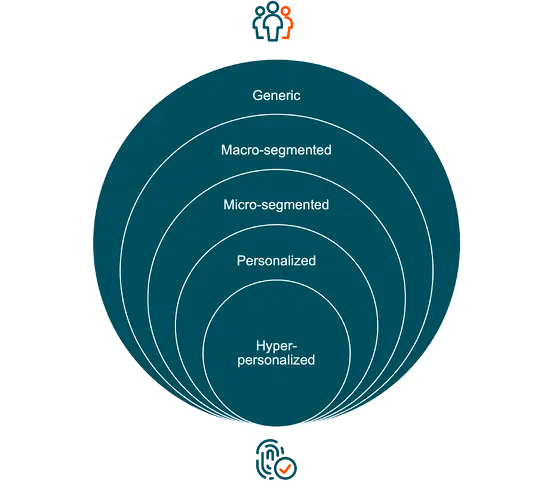
Personalization typically sits beyond more traditional mass-market segmentation strategies and is often characterized as targeting the individual or a collection of individuals with very similar characteristics, interests, and problems, for example, medical professionals or vehicle owners. Segmentation generally addresses a much wider set of demographic similarities, such as geographical region, or gender.
While macro and micro-segmentation strategies remain important, they tend to rely on a view of the world more from the vendor’s perspective and not necessarily that of the consumer. Invariably this leads to a reactive posture; looking at what a consumer has done rather than looking at what they are doing or anticipating their motives.
Personalization is intrinsically linked to customer experience
To differentiate in customer experience, personalization is key. Personalization automatically changes the way the service is being delivered, depending on how it is being used and perceived. For example, when visiting the website of the BBC for the latest news, there may also be displayed some local news, in France for example, based on your current location. In another example, eCommerce sites will often display product recommendations based on previous purchase history.
Recommendation engines are tools that adjust the experience on a website according to behavior. These engines will often have learning algorithms that will change search results, predict product interest, and change the order of pages to automate recommendation strategies.
Personalization is a highly data-intensive process. The accuracy, relevance, coherence, timeliness, pertinence, and intimacy of the data being used to support personalization is going to have a direct impact on your customer’s experience. Do you want to see dog food being recommended when you own a cat?
65% of companies consider the management, quality and availability of data as a major inhibitor of personalization. - Boston Consulting Group, 2019
Achieving successful personalization is challenging. Despite some good tools being available, such as dedicated recommendation engine solutions, for many, they are only as good as the data that drives them.
That’s why you need multidomain master data management.
WHITE PAPER
Building a Hyper-Personalized Customer Experience

Multidomain MDM moves you from personalization to hyper-personalization
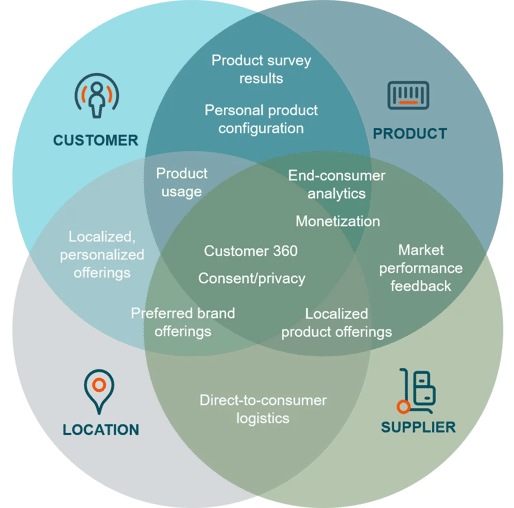
Beyond single domain governance, multidomain master data governance adds new capabilities that play important roles in the management of the data that specifically supports hyper-personalization. Note that multiple-domain refers to a collection of single domain governance capabilities and is not to be confused with multidomain which refers to a unique, cross-domain governance capability. Multidomain master data management carries zones of insight.
Zones of insight refer to the data management capabilities that are unique to cross-domain governance and that make hyper-personalization effective.
Zones of insight provide supporting data management capabilities for hyper-personalization and drive new business models.
The zones of insight occur in the intersections of data domains, here Customer, Product, Location, and Supplier:
How does Multidomain MDM help hyper-personalization?
There is no getting around it. Successful hyper-personalization relies on hard-to-get and hard-to-manage data. Multidomain master data management can help by providing data collection and management capabilities.
The types of data that might be considered to be managed within a multidomain master data management solution to support hyper-personalization include:
- Event-based – the acquisition of real-time information directly impacting the individual, such as local weather, location information, behavior, and device usage.
- Configuration-based – the settings that an individual configures to adapt their user experience to their needs and aspiration, such as their consent information, product preferences, information alerts, and content appearance.
- Deduction-based – the results of analytics based on current or prior behavior that may result in the development of new information concerning the individual, such as their householding, likely next best offer, sentiment, eligibility, and propensity.
As the list indicates, a truly 360° view of the customer is comprehensive and encompasses not just customer data, but also the context of the customer.
Multidomain master data management, via its ability to manage zones of insight, can not only help to see how a product is sold but also potentially, help to provide insight into how it is used.
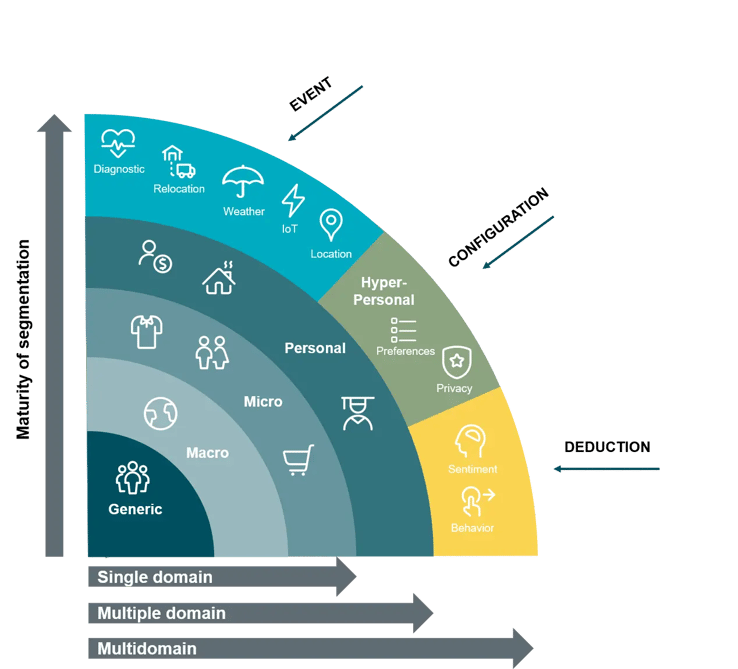
Only multidomain master data management will support hyper-personalization.
Multidomain MDM helps you capture relationships and insights
Multidomain MDM provides governance capabilities that are often used to build a 360° customer view. For hyper-personalization, two types of data sets are particularly useful from this 360° customer view: relationships and insights.
Relationships may be inter- or cross-domain. For example, when defining what constitutes a household, multiple parties and location data must be governed together. A household is not necessarily defined in the same way for all organizations. It might be address-based, or more family member-oriented, for example. Multidomain MDM helps to determine and align the data so that it correctly reflects the policy of household definition.
Insights are arguably the golden data elements of hyper-personalization. They help to make the user experience unique. Many of the data elements can be considered as being small data, such as determining location-based preferences, sentimental analysis, or a life event.
Main points of how to achieve hyper-personalization with Multidomain MDM
- For effective hyper-personalization, a governance strategy is required that provides data transparency (quality, coherence, relevance, auditability, etc.) across many data sources, from analytical to transactional to real-time event-based data. Multidomain master data management provides the governance strategy for transparency.
- Actively managing the complex relationships between data domains adds the ability to reveal new types of information that can directly impact customer experience. Multidomain master data management governs this new information in “zones of insight” making it reliable, and as a result, actionable for hyper-personalization.
EXPLORE
Multidomain Master Data Management
Govern different data domains on a single platform to drive new insights, business agility and digital transformation.