

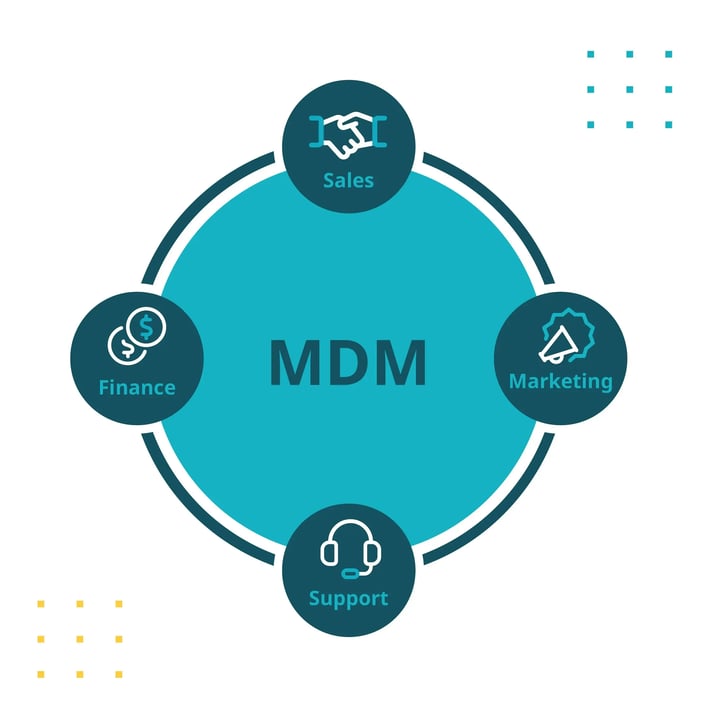
In short, master data management (MDM) gives your organization a consistent, accurate, and unified view of critical data and business information across all systems and departments.
So far, so good. But it pays to dive just a layer or two deeper.
When you truly understand what MDM is and what it does, you’ll be able to navigate a broad landscape of data management systems and processes that are becoming more and more important to how businesses operate and compete.
Read on and learn:
- What makes data "master data"
- The most common types of master data
- How MDM works
- Why companies use MDM
- Frequently asked questions about MDM
We’ll give you answers that are clear, concise and to the point. Let’s get to it.
What is master data management?
Master data management, also known as MDM, is a set of:
- Processes
- Governance standards
- Tools
- Technologies
These coordinate your critical business data across multiple systems and departments. It standardizes how you handle your organization’s most important data assets using agreed-upon definitions, formats and quality data rules consistently throughout the organization.
Think of it as a central control system for your business information that serves as the connective tissue between your various sources of data, including ERP systems, CRM platforms and operational databases.
For example:
If you’re a retailer, MDM makes sure your product specifications appear identically in your e-commerce platform, inventory system and marketing materials.
If you're a manufacturing company, MDM keeps product specifications consistent whether accessed through design systems, production planning or supply chain management.
MDM creates a "single source of truth" by establishing authoritative master records for each data entity. These golden records contain the most complete, accurate version of each piece of information.
When data changes occur, MDM makes sure updates propagate properly to all connected systems, keeping everything nice and consistent across your whole data ecosystem.
The core problem MDM addresses
As your organizations grows, there will always be a natural fragmentation – it's just part of the game.
Without MDM, data silos will form where departments maintain separate, often conflicting versions of the same information. A customer might appear with different addresses in sales and shipping systems, or product specifications might vary between manufacturing and marketing databases.
These inconsistencies lead to operational inefficiencies, poor customer satisfaction and unreliable analytics.
A strong master data management strategy also lays the groundwork for AI success by creating clean, structured information.
AI needs high-quality data to work properly. When you remove duplicates, standardize formats and maintain data quality, your AI tools deliver trustworthy insights instead of amplifying mistakes from messy data.
Now that you know what MDM is, let’s look at what sort of data is being managed.
What exactly is master data?
Master data represents the core business entities your organization uses across multiple processes, systems and departments. It is not to be confused with transactional data, which captures daily activities. Master data defines the fundamental elements that participate in your business operations.
It also differs from reference data, which provides standardized values used to classify or categorize other data, things like country codes, currency types or product status values. Reference data tends to be even more stable than master data and is often shared across systems as a common lookup standard.
While metadata describes the attributes and context of your data assets, master data represents the actual business entities themselves. All three play a role in a well-governed data environment, but master data sits at the center of your day-to-day operations.
Let’s take a closer look:
Master data vs. transactional data
Master data consists of the relatively stable information that identifies and describes your key business objects. It doesn’t change often and serves as reference data for your operations.
Transactional data, on the other hand, records the events and activities happening in your business, including sales, orders, shipments, payments, and similar operational events that happen all the time.
Here’s a helpful way to distinguish them:
Master data answers:
- "Who?"
- "What?"
- "Where?"
In other words, who your customers are, what products you sell and where your facilities operate.
Transactional data answers:
- "When?"
- "How many?"
- "How much?"
Things like when a sale occurred, how many items were purchased or how much revenue was generated.

Why master data matters
Your master data is the foundation for virtually every business activity. So, if it lacks quality or consistency, the impact affects your whole organization.
When your master data is accurate, your operations can run smoothly since everyone works from the same information:
- Marketing
- Sales
- Manufacturing
- Customer service
They all depend on consistent product specifications and customer records to perform effectively. And when your workflows rely on data pulled from various sources, even small inconsistencies can create downstream errors that are costly and time-consuming to fix.
Your business decisions also improve with reliable master data. Executives can trust reports and analytics because the underlying data has integrity across all data sources. That consistency is what makes forecasting more accurate, marketing campaigns more targeted and procurement more strategic.
Regulatory compliance also often depends on master data quality. Especially if you are in an industry like healthcare, finance and pharmaceuticals, where data accuracy carries legal implications.
And don’t forget your AI initiatives.
Your AI projects need clean, consistent, high-quality data to work properly. MDM gives you that foundation. Without it, AI learns from messy data and produces unreliable results. Machine learning models are only as good as the data they're trained on, and master data management is what ensures those models start with a trustworthy, well-governed foundation.
And the relationship goes both ways. Not only does MDM make AI work — AI now plays an ever-bigger part in making MDM run better, too. More on that shortly.
What are the most common types of master data?
Organizations typically manage several key domains of master data, each serving as a cornerstone for different business functions and use cases.
When it comes to technical systems to manage master data, some platforms, called multidomain MDM systems, can handle all data domains in one place. This is particularly valuable for organizations that want a unified view of data across their entire operation, rather than managing separate systems for each domain.
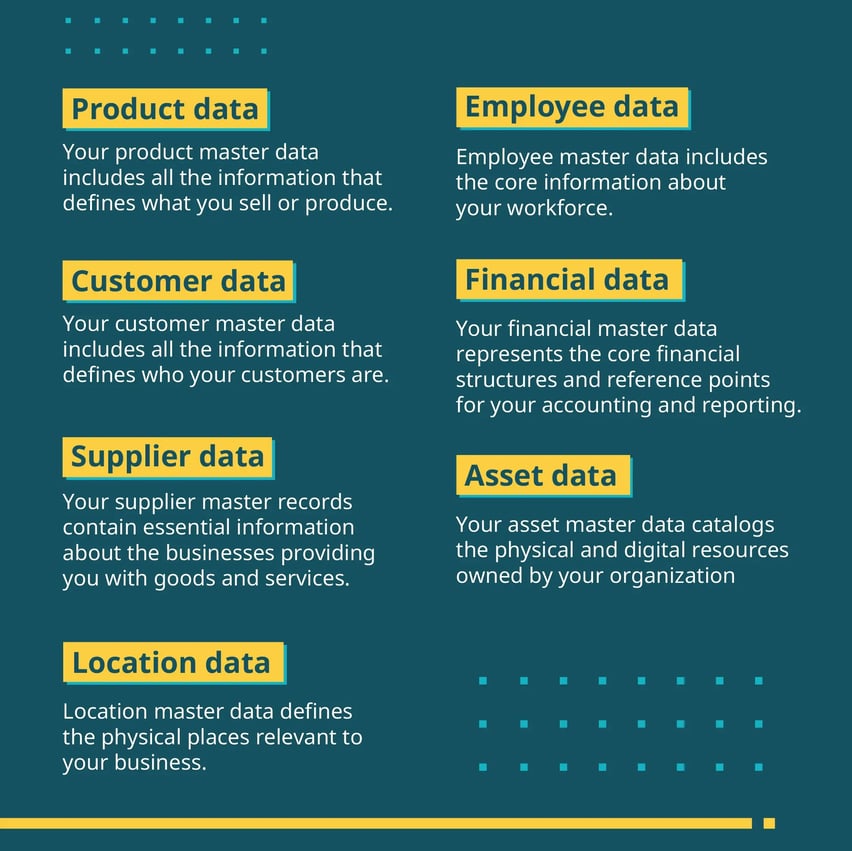
These are the general master data domains:
Product data
Your product master data includes all the information that defines what you sell or produce. This encompasses:
- Basic attributes: SKUs, names, descriptions, dimensions, weights, colors
- Classification data: categories, hierarchies, product families
- Technical specifications: materials, components, compatibility information
- Marketing content: features, benefits, target markets
- Compliance information: certifications, safety data, regulatory approvals
For a furniture retailer, product master data might include details like "Oak Dining Table Model DT-450, 72×42×30 inches, sustainably sourced wood, seats 6–8 people, assembly required, 5-year warranty."
The IEWC success story shows how managing complex product data with confidence is possible through robust MDM implementation.
Customer data
Customer master data forms the foundation of your customer relationships and includes:
- Identity information: names, IDs, contact details, communication preferences
- Segmentation data: demographics, firmographics, behavior categories
- Relationship details: account history, service agreements, pricing tiers
- Structure information: hierarchies, affiliations, related accounts
Maintaining accurate, deduplicated customer records across all your systems is one of the most direct ways MDM improves customer satisfaction. When every team works from the same customer profile, interactions feel more informed and personalized, regardless of which channel or department the customer is dealing with.
A B2B company might maintain customer master data such as "Acme Corporation, enterprise account, manufacturing industry, headquarters in Chicago with 4 satellite offices, 3-year service agreement, 250 licensed users, renewal date April 15."
Supplier/vendor data
Your supplier master records contain essential information about the businesses providing you with goods and services:
- Company details: legal names, identification numbers, contact information
- Financial data: payment terms, bank details, tax information
- Performance metrics: reliability ratings, quality scores, fulfillment speed
- Contract information: agreements, negotiated terms, service levels
Accurate, centralized supplier data is critical for procurement teams that need a reliable view of vendor relationships, contract terms and compliance status across the organization. Without it, procurement decisions get made on incomplete information, leading to missed savings opportunities and supply chain risk.
A hospital might maintain supplier master data like "MedSupply Inc., approved medical equipment vendor, net-60 payment terms, ISO 9001 certified, provides 24-hour emergency delivery, contract renewal June 30."
Location data
Location master data defines the physical places relevant to your business:
- Facilities: offices, stores, warehouses, factories
- Geographic coordinates: addresses, regions, service territories
- Operational details: hours, capacities, capabilities
- Administrative information: managers, departments, cost centers
A retail chain might maintain location data such as "Store #483, 1250 Main Street, Dallas TX, 15,000 sq ft, open 8am–9pm Mon–Sat, 10am–7pm Sun, supports in-store pickup, regional manager Sarah Chen."
Employee data
Employee master data includes the core information about your workforce:
- Personal details: names, IDs, contact information
- Organizational data: titles, departments, reporting structures
- Professional information: skills, certifications, education
- Administrative details: employment status, start dates, benefits eligibility
A manufacturing company might maintain employee master data like "Carlos Mendez, Employee ID 28945, Senior Production Engineer, Automotive Division, certified Six Sigma Black Belt, joined March 2019, reports to Manufacturing Director."
Financial data
Your financial master data represents the core financial structures and reference points for your accounting and reporting:
- Chart of accounts: account codes, account types, descriptions, hierarchies
- Cost and profit centers: identifiers, names, hierarchies, responsibilities
- Currency information: exchange rates, conversion rules, date validities
- Payment terms: standard agreements, discount structures, due dates
- Financial periods: fiscal years, reporting periods, quarter definitions
Consistent financial master data is essential for accurate forecasting and reporting across business units. When financial reference data varies between systems, consolidated reporting becomes unreliable and reconciliation takes up time that should be spent on analysis.
A manufacturing firm might maintain financial master data such as "Account 4010-Revenue from Product Sales, categorized as operational income, mapped to US GAAP and IFRS standards, available for reporting in all business units, managed by Financial Controller James Wilson."
Asset data
Your asset master data catalogs the physical and digital resources owned by your organization:
- Physical assets: equipment, machinery, vehicles, buildings, infrastructure
- Digital assets: software licenses, intellectual property, digital content
- Classification data: categories, types, ownership status, depreciation classes
- Technical details: serial numbers, specifications, warranty information
- Maintenance requirements: service schedules, responsibility assignments, maintenance protocols
Managing asset data within your MDM system, rather than in a separate database, means it stays connected to the rest of your master data throughout its full lifecycle, from acquisition through maintenance to retirement.
A logistics company might maintain asset master data like "Fleet Vehicle #TR-789, 2023 delivery van, VIN 1HGCM82633A004352, assigned to Northeast Region, 150,000 mile warranty valid until May 2028, requires maintenance every 10,000 miles, currently assigned to driver Thomas Reed."
How does master data management work?
MDM turns your scattered, inconsistent data into reliable information your entire organization can trust. For that to happen, you need technology, people and standardized practices working together.
To explore how to evaluate and select the right technology, check out our complete guide to MDM tools.
A well-designed MDM solution handles four core functions:
- Consolidation and cleansing data
- Creating golden records
- Governance and stewardship
- Sharing the single version of truth
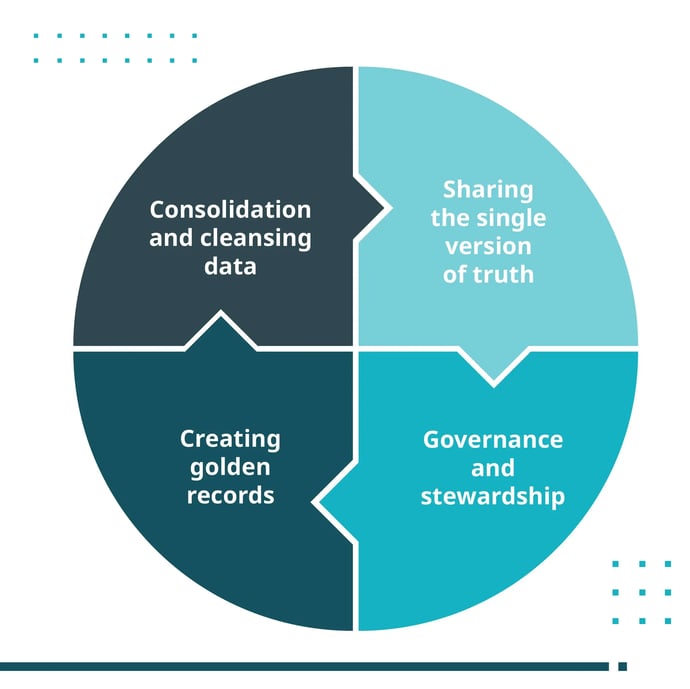
But the real value comes from how these stages interact and build on each other. Let's look at each one.
1. Consolidation and cleansing data
The journey begins with consolidation. Your MDM system connects to databases, applications and files across your company to gather raw data.
This could be product information spread across manufacturing systems, ecommerce platforms and marketing databases — or customer details divided between sales, service and finance applications. It might also include data pulled from ERP systems, supplier portals or other external data sources that feed into your operations.
Next comes the crucial cleansing phase. Your MDM system detects duplicates, standardizes formats and corrects errors through automated validation rules.
Maybe your CRM shows "J. Smith" at "123 Main St," but your billing system has "John Smith" at "123 Main Street, Apt 4B". The system recognizes these as a likely match and prepares them for reconciliation.
Many current MDM systems use AI to improve matching and merging. Unlike rigid rule-based approaches, AI can spot connections between records by analyzing patterns across multiple data points.
When comparing "J. Smith" with "John Smith," AI examines additional context like past purchases, contact information, and location data to determine whether they're the same person. Machine learning models get better at this over time, reducing both missed duplicates and false matches as they're exposed to more of your data.
That means you catch more genuine duplicates and reduce false matches, especially in large datasets where humans can't possibly review everything.
2. Creating golden records
The heart of any MDM solution is establishing authoritative versions of each data entity. This includes "golden records" that represent your official version of the truth.
But it’s not just about picking one version over another. The system applies sophisticated rules to resolve conflicts between different sources, sometimes combining the best elements from each.
What makes this powerful is how it maintains connections to the original sources. When data changes in connected systems, your MDM platform can detect those changes, evaluate them against existing information and decide whether to update the golden record. This keeps your unified view of data current without requiring manual intervention every time something changes upstream.
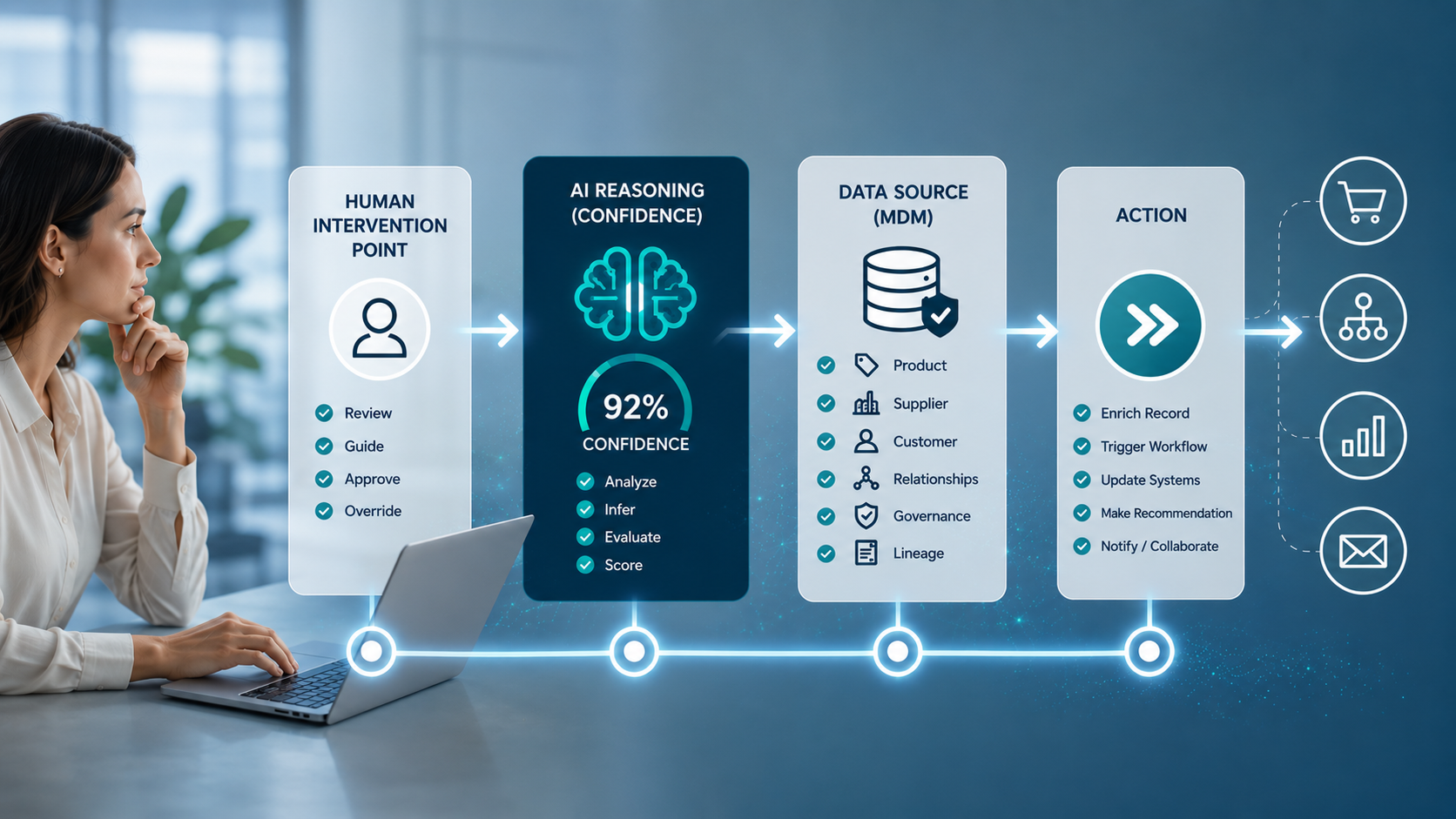
3. Governance and stewardship (where the humans come in)
Technology alone can't manage master data effectively. MDM thrives when paired with clear governance policies that define data standards, quality thresholds and management practices.
Data stewards serve as the human intelligence in this process.
These subject-matter experts make decisions when automated systems run into ambiguities and continuously refine the rules that govern your data. A product data steward might determine which product attributes are mandatory. A customer data steward might set standards for address verification.
Good governance also means defining clear workflows for how data moves through your organization, who can approve changes and how conflicts between data sources get resolved. Without these workflows, even the best MDM technology will struggle to maintain consistency at scale.
AI can also help with data stewardship by spotting patterns humans might miss.
It analyzes datasets to detect anomalies, suggests quality improvements and automates routine decisions.
Humans and AI working together is a more scalable approach to governance, allowing your stewards can focus on complex judgment calls instead of repetitive tasks.
This is particularly important as your data volumes grow. A well-governed MDM strategy, supported by AI, means your data quality doesn't degrade as your organization scales.
4. Sharing the single version of truth
Once golden records are in place, your MDM solution distributes this trusted data back to operational systems. That can be done in different ways:
- Real-time synchronization
- Scheduled batch updates
- On-demand access through services
This is where data integration becomes critical. Your MDM platform needs to connect reliably with the systems your teams actually use, whether that's your ERP, your CRM, your ecommerce platform or your analytics tools, so that every stakeholder across your organization is always working from the same trusted data.
Some organizations use a centralized model where all systems read from the MDM repository. Others prefer a hybrid approach where some data stays in source systems but is indexed and linked through MDM.
The right approach depends on your existing data infrastructure, the complexity of your workflows and how your various stakeholders consume data. What matters most is that the model you choose delivers consistent, high-quality data to the right systems at the right time, without creating bottlenecks or redundancies.
If you’re aiming for a quick start, see our guide to deploying MDM in under six months to understand how to build momentum fast.
Why do companies use master data management?
Organizations use MDM because they want the practical, tangible benefits of master data management that impact both their day-to-day operations and long-term strategic capabilities. These benefits compound over time, and they really matter — especially as you operate at scale.
The value goes far beyond just having "better data."
Improve data quality and consistency
Executives and managers make countless business decisions based on data. When information comes from different systems with conflicting details, those decisions rest on shaky foundations.
MDM gives you accurate, consistent information you can trust.
Without MDM, you might discover product specifications vary between your manufacturing database and sales catalog, confusing both staff and customers. MDM eliminates these discrepancies by giving you a single, authoritative and unified view of your most critical.
Organizations like Danfoss have achieved enterprise-wide digital transformation with MDM, ensuring consistent product data across global operations.
Run more efficient operations
Data inconsistencies create daily friction across your business processes. Your staff wastes valuable time reconciling information from different sources, manually fixing errors and searching for correct data.
Consider how MDM transforms order processing:
When product information matches exactly across your e-commerce site, inventory management and shipping systems, orders flow smoothly from purchase to delivery without manual intervention or verification steps.
The same principle applies across procurement, finance and supply chain workflows. When your teams work from consistent, validated data, the redundancies that slow down operations, duplicate entries, conflicting records and manual reconciliation tasks start to disappear.
If you use an MDM tool equipped with AI, it spots data problems across systems before they disrupt your operations.
It applies fixes based on rules you set and gets better over time by learning from patterns. This ensures your staff doesn’t have to manually hunt for and fix data errors.
Make better decisions with reliable data
When every department works from the same accurate data set, your analysis and reporting become more credible.
A strong MDM strategy ensures that when you compare sales figures against product categories or customer segments, the underlying data definitions remain consistent.
Your marketing team uses the same customer segmentation as your sales team, and your supply chain uses the same product classifications as your merchandising group. There is total alignment, and everybody makes better strategic decisions.
It also means your business intelligence tools and analytics platforms are working with high-quality data rather than reconciling conflicting inputs from various sources. The cleaner your master data, the more you can trust the insights those tools produce.
Make compliance and risk management easier
To stay compliant, you will always need accurate reporting and data governance. MDM gives you the structures you need to stay compliant and avoid the risks that come with unreliable data.
- Financial institutions use MDM to consistently identify customers across systems, a critical requirement for anti-money laundering regulations.
- Manufacturing companies rely on MDM to maintain accurate product specifications for both safety compliance and regulatory reporting.
For any organization handling sensitive customer records or operating in regulated industries, MDM also provides the audit trail that demonstrates how data has been collected, managed and used, an increasingly important requirement as data privacy regulations tighten globally.
Avoid expensive data errors
Data errors cost money in ways that are often invisible until the damage is done:
- Shipping to incorrect addresses
- Manufacturing products with wrong specifications
- Making financial decisions based on flawed information
Address errors lead to returned shipments and wasted customer service time. Inconsistent supplier data causes payment delays and missed discount opportunities in procurement. Fragmented product data results in incorrect orders and inventory discrepancies.
A good master data management strategy addresses these issues at their source through validation rules, deduplication processes and governed workflows that prevent bad data from entering your systems in the first place.
Give customers better experiences
Your customers expect you to know who they are across every touchpoint. Trust and loyalty take time to build, but you can ruin that trust in as little as five seconds — especially if your customer data is spread out across a plethora of systems that don’t talk to each other.
Retailers like Floor and Decor are streamlining product data for better customer experiences by using MDM to unify their systems.
MDM addresses this by maintaining consistent customer records across all channels and departments, enabling truly personalized interactions. You can tailor product recommendations, market campaigns, communications and service approaches based on accurate, complete customer profiles.
When a customer contacts your support team after browsing your website, MDM makes sure the agent has access to their complete profile, including purchase history and preferences.
Your staff can immediately give personalized service that acknowledges past interactions and anticipates needs. That's how you build loyalty and trust.
In summary
- Master data management gives you a solid foundation for your data strategy by creating a reliable, consistent view of your critical business information.
- When you implement MDM, you take control of the data that matters most: your products, customers, suppliers, locations and employees.
- MDM provided the clean, structured data foundation that AI needs, preventing your AI models from learning bad patterns or producing unreliable or untrustworthy outputs.
- As your organization generates more data across more systems, MDM becomes a necessity, not just a nice-to-have.
- Companies that get their master data right enjoy real benefits: they work more efficiently, make smarter decisions and serve customers better.
- If you're struggling with inconsistent or unreliable data across your organization, MDM offers a practical way to turn scattered information into a unified asset that actually helps your business succeed.
If you're ready to put a master data management strategy into action, Stibo Systems offers a proven MDM solution trusted by some of the world's leading organizations.
Our platform gives you the tools to unify critical data across domains, connect data sources across your entire ecosystem and deliver a consistent, high-quality view of data to every team and system that depends on it.
Whether you're just getting started with MDM or looking to expand an existing program, we'd love to show you what's possible. Get in touch with our team or explore our complete guide to MDM tools to take the next step.
REPORT
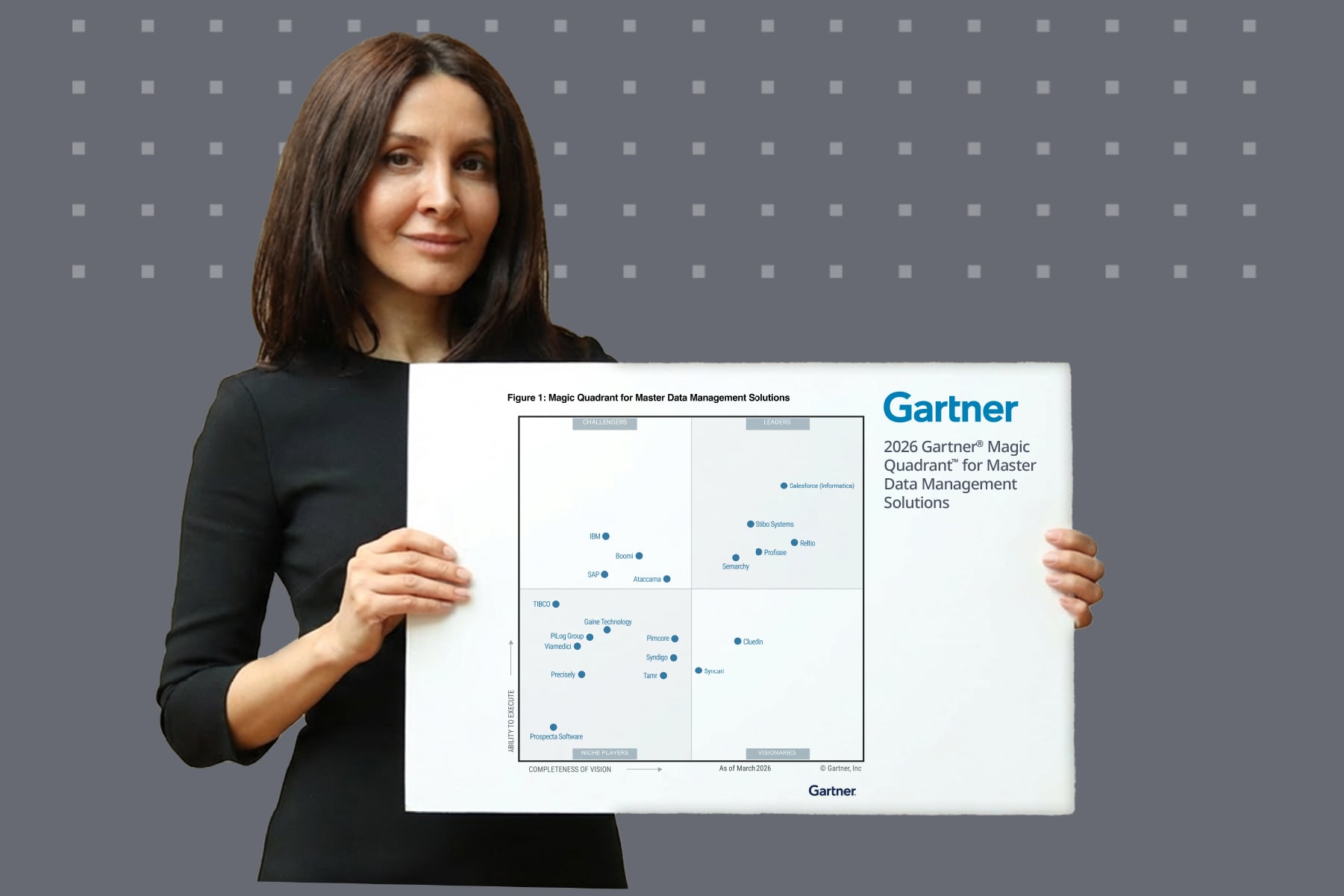
Stibo Systems named a Leader in the Gartner Magic Quadrant for Master Data Management Solutions, 2026
Gartner recognized Stibo Systems as a Leader for our "Completeness of Vision" and "Ability to Execute." This recognition validates years of MDM innovation, strategy and enterprise-scale execution.