Solution Sheet · Reference Data Management

A Seamless Approach to Reference Data Management

Reference data underpins every transaction, decision and report. Yet, many organizations only notice its importance when inconsistencies slow down operations, create reporting errors or block regulatory compliance.

Managing reference data proactively ensures seamless collaboration across systems and partners. It also enables your employees to trust reference data as the validated reference. Having consistent reference data can help: 

  • Reduce costs and mitigate the risks of inconsistent and erroneous data integrations 

  • Meet regulatory compliance requirements 
  • Support process management and operational efficiency 
  • Reduce inconsistencies in data structures and data values between systems 
  • Improve reliability of analytics and reporting
  • Increase data quality by embedded data validations  

Govern reference data with confidence 

To properly maintain reference data sets, you need a strict data governance process. Data sets are versioned and therefore any change will have an impact on downstream business systems. Reference data governance ensures that the organization has a single source and that everyone refers to the same entity using the same terminology. 

However, even large organizations manage reference data sets manually. The manual approach causes efficiency bottlenecks when changes must be pushed to all applications. Governance of reference data includes managing changes and maintaining a crossorganizational process to ensure data will be consistently shared. To strengthen control, versioning and lineage tracking are also essential capabilities, allowing data stewards to view change history and downstream impact before approval. 

Reference data and master data: Understanding the difference 

Reference data is often referred to as a subset of master data. It’s probably more correct to say that reference data overlaps with master data, and both are, generally speaking, low-volatility data. The following definitions provide further distinction: 

  • Reference data is defined as any data used to characterize or classify other data, or to relate data to information external to an organization.  ( Chisholm, 2001 )

  • Master data, on the other hand, is data about the business entities (employees, customers, products, financial structures, assets and location) that provide context for business transactions and analysis.  ( DAMA-DMBOK, 2019 )

Eliminate silos with embedded reference data management

Unlike standalone reference data management (RDM) tools that create additional silos, Stibo Systems embeds RDM directly within its multidomain master data management (MDM) platform. This ensures governance and business rules are consistent across all domains, eliminating duplication, integration headaches and costly rework.

STEP supports management of reference data as part of its multidomain MDM capabilities. That means reference data is included in the data modeling and data governance functions alongside other master data. These shared workflows are policy-driven, configurable and designed to enforce approval logic, ensuring every change is traceable and compliant. Using the same workflows, business rules, automation and controls for master data and reference data, STEP enables the organization to: 

  • Ensure the validity of reference data
  • Connect reference data to the appropriate master data
  • Propagate approved reference data in real time through API and event-driven integrations, ensuring systems remain synchronized.

What is reference data?

Reference data categorizes and classifies other data. Examples include:  

Measure units

Currency codes

Country codes

Language codes

International and proprietary classifications

Taxonomies (GPC, UNSPSC, NAICS,ETIM, etc.)

Regulatory data

Benefits of managing reference data in STEP:

  • Cut costs: Eliminating the need for separate RDM systems reduces the total cost of ownership.
  • Accelerate migrations: Combining RDM and MDM allows you to seamlessly integrate reference data into the master data. For example, you can enrich the product classification with new codes, or remove and add new attributes, such as units of measure or color codes, and link this to specific suppliers or locations. 
  • Share data seamlessly: STEP features integral standard components to support data sharing, maintenance and transformation in compliance with industry standards, such as GS1, ETIM, ECLASS, UNSPSC, ACES, PIES and TecAlliance. 
  • Unify governance: Manage reference data alongside product, customer and location master data, using the same governance workflows, business rules and automations 
  • Integrate with tech stacks: As an open, technology-agnostic platform with out-of-the-box connectivity, the system pushes validated reference data directly into your operational applications. This unified, open architecture makes it easier to harmonize classifications, hierarchies and taxonomies across the enterprise, reducing technical debt and integration friction. 

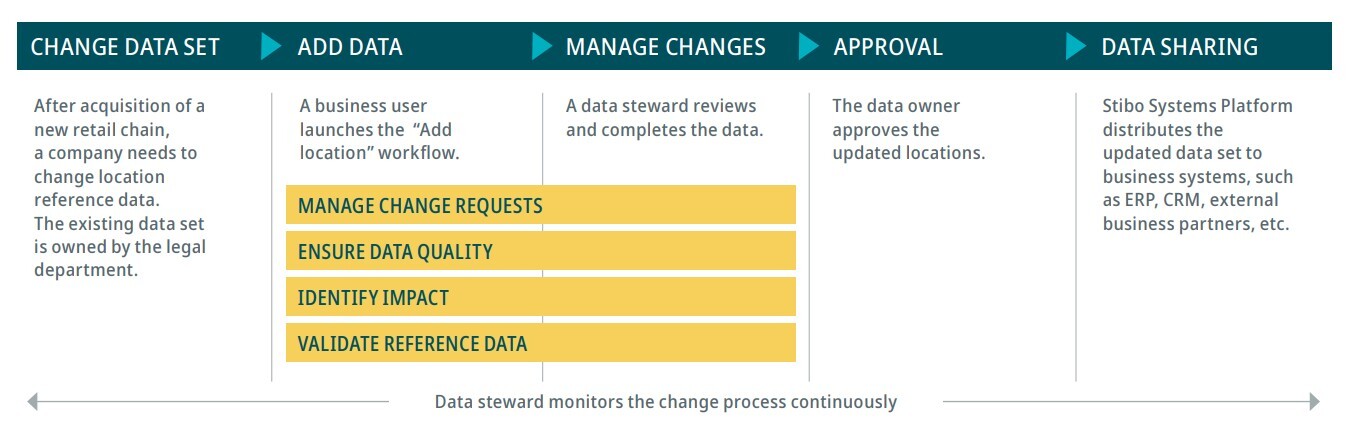
Managing the RDM journey in STEP

With STEP, you can seamlessly integrate reference data into your master data. The following graphic shows how embedded workflow logic and automation capabilities make it simple to manage changes to reference data, reinforcing IT trust. 

solution-sheet-table

Delivering measurable results across industries 

Managing reference data and master data in a single, governed platform empowers you to solve industry-specific data challenges with precision and consistency: 

  • Retailers: Harmonize product category codes across suppliers to ensure faster assortment onboarding. 

  • Manufacturers: Standardize units of measure across plants to avoid costly production mismatches. 
  • Banking and finance organizations: Align ISO currency codes across trading systems for accurate reconciliation. 
  • Healthcare and life science companies: Ensure consistent regulatory codes (e.g., ICD, ATC, MedDRA) to reduce compliance risk. 

Learn more about how to deliver trustworthy data for your business.

2